


 Pусский
 中文
中文


When we design a 70+80 Photovoltaic Double-Layer String Extrusion Production Line, we look at the complete Cable Production process rather than only the extruder. A photovoltaic cable may look simple from the outside, but stable insulation, accurate forming, smooth cooling, reliable traction, and controlled take-up all matter during continuous production.
Our approach is quite practical. We first ask what the customer wants to produce, which material will be used, what the cable structure looks like, how much production capacity is required, and how the equipment needs to fit into the factory. Then we work backward to determine a suitable line configuration.
The 70+80 Photovoltaic Double-Layer String Extrusion Production Line is developed for photovoltaic wire and cable extrusion applications where two extrusion units are used in a coordinated Production Process. The line can be configured for double-layer extrusion according to the product structure, material requirements, production capacity, and manufacturing conditions.
For us, the important word here is coordinated. A good photovoltaic cable extrusion line is not simply a collection of machines. Feeding, extrusion, forming, cooling, traction, and take-up have to work together. When one part is unstable, the whole production process can be affected.
That is the reason we spend time on configuration before manufacturing. We would rather discuss the product details carefully at the beginning than make assumptions and create problems later.
1. What Is a 70+80 Photovoltaic Double-Layer String Extrusion Production Line?
The name tells us several things about the equipment. “70+80” refers to the nominal sizes of two extrusion units in the production line. “Photovoltaic” indicates the intended application area. “Double-layer” describes the extrusion structure, while “string extrusion production line” identifies the continuous production arrangement.
In simple words, the line uses two extrusion units to process and form two material layers in a coordinated process. The exact role of each extruder depends on the cable design and materials selected for the project.
This is important because photovoltaic cables are not all identical. Different manufacturers may use different insulation and sheath materials, conductor structures, product sizes, and production targets. Even when two customers request a similar solar cable extrusion line, their equipment requirements may not be exactly the same.
We therefore do not treat “70+80” as a complete technical specification by itself. The nominal extruder sizes are only one part of the equipment selection process.
Before we prepare a production configuration, we normally need to understand:
the photovoltaic wire or cable structure;
the conductor material and construction;
the insulation and sheath materials;
the required product dimensions;
the required production capacity;
the expected production speed;
the required level of automation;
the factory layout and available space;
the customer's testing and quality requirements;
the applicable product standards.
This information helps us decide how the extrusion units, dies, cooling equipment, traction system, take-up equipment, and control system should be arranged.
For photovoltaic cable manufacturers, this approach is particularly useful because the finished cable may need to meet specific electrical, mechanical, thermal, and environmental requirements. The extrusion equipment is part of that manufacturing process, but it does not by itself guarantee compliance with a finished-cable standard.
For example, IEC 62930:2017 applies to certain single-core cross-linked insulated power cables with cross-linked sheath used on the DC side of photovoltaic systems, with a rated DC voltage up to and including 1.5 kV. The standard also specifies a normal continuous maximum conductor temperature of 90 °C for the applicable cable type.
That distinction matters when selecting equipment. We design the production process around the customer's actual product rather than simply putting an IEC number into a machine specification.
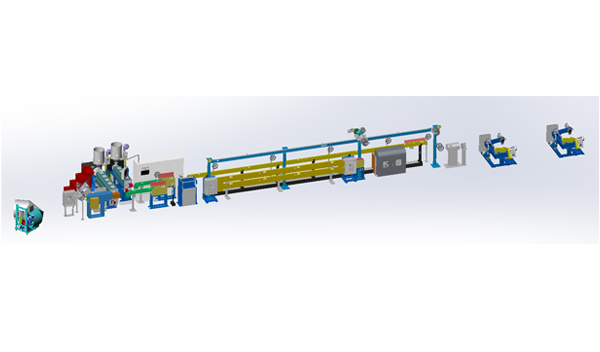
2. How Does the Photovoltaic Double-Layer Extrusion Process Work?
The easiest way to understand the 70+80 Photovoltaic Double-Layer String Extrusion Production Line is to follow the material through the line.
The process begins with material preparation and feeding. Suitable extrusion material is supplied to the corresponding extrusion unit. Stable feeding is important because changes in material supply can affect extrusion output and product forming.
The material then enters the first extrusion unit. Inside the barrel, the screw transports the material forward while heat and mechanical energy help plasticize it. The exact temperature profile and screw conditions depend on the material being processed.
After the first layer is formed, the product continues through the coordinated extrusion process for the second layer. The two-layer structure is created according to the cable design and die arrangement.
This is where the line's configuration becomes important. The two extrusion units cannot simply work independently. Their output, forming conditions, and line speed need to be coordinated so that the resulting cable structure remains stable.
After extrusion, the newly formed cable passes through the cooling section. Cooling helps the material become stable enough for the following traction and winding stages. Cooling conditions need to be selected according to the material, product size, and production process.
The traction system then pulls the cable through the line at a controlled speed. The relationship between extrusion output and traction speed has a direct effect on the final product dimensions.
Finally, the take-up system collects the finished photovoltaic cable. Proper winding helps prevent unnecessary deformation, tangling, or poor coil formation.
| Process Stage | Main Function | Key Point to Control |
|---|---|---|
| Material Feeding | Supply extrusion material | Stable and continuous feeding |
| First Extrusion | Process and form the first layer | Temperature, material flow and output |
| Second Extrusion | Form the second layer | Layer coordination and material flow |
| Die Forming | Shape the cable structure | Die design and dimensional stability |
| Cooling | Stabilize the extruded layers | Cooling conditions and uniformity |
| Traction | Move the cable through the line | Speed and tension coordination |
| Take-Up | Collect the finished cable | Winding tension and alignment |
Source: The table summarizes the general process logic of an industrial photovoltaic cable extrusion line. Exact equipment configuration and process conditions depend on the cable structure, materials, and customer requirements.
In actual production, these stages form one continuous process. The operator does not simply start one machine after another. The whole line needs to be adjusted as a system.
3. Why Double-Layer Extrusion Matters for Photovoltaic Cables
Photovoltaic cables work in a demanding environment. They may be installed outdoors and exposed to sunlight, temperature changes, moisture, mechanical stress, and other environmental conditions. The cable construction therefore needs to match its intended application.
When a product requires two extruded layers, the production process needs to keep both layers under control. The first layer must be formed correctly before the second layer is applied. If the first layer is unstable, the second layer cannot fully correct the problem.
That is one reason we pay attention to the relationship between the two extrusion units.
The first consideration is material compatibility. The two layers may use the same material family or different materials depending on the product design. Their processing temperatures and flow behavior may not be identical.
The second consideration is layer thickness. The required thickness depends on the cable design. We do not use one fixed thickness for every photovoltaic cable because product specifications vary.
The third consideration is concentricity. In simple terms, the extruded layer should remain properly centered around the conductor or underlying cable structure. Uneven forming can lead to dimensional variation and material distribution problems.
The fourth consideration is cooling. The material needs to maintain its intended shape while moving through the cooling section. Cooling conditions should be matched to the material and line speed.
The fifth consideration is traction. The cable needs to move smoothly through the line. Too much tension can create problems, while unstable traction can affect dimensional consistency.
For us, these points are more useful than making broad claims about machine performance. The real quality of a photovoltaic cable extrusion line is seen when it runs continuously under actual production conditions.
4. Technical Features of Our 70+80 Photovoltaic Extrusion Line
Two Coordinated Extrusion Units
The 70+80 configuration provides two extrusion units for a double-layer production process. Their roles can be arranged according to the cable structure and material requirements.
Instead of treating the two extruders as separate machines, we consider them part of one production system. This helps us coordinate extrusion output, product forming, cooling, traction, and take-up.
Stable Material Processing
Material behavior is one of the most important parts of extrusion. Different polymers can behave differently when heated and processed. We therefore consider material properties when discussing screw design, temperature settings, feeding arrangements, and die configuration.
Our goal is not to create unnecessary complexity. We want operators to have a clear and practical process that can be monitored and adjusted during normal production.
Controlled Double-Layer Forming
For double-layer photovoltaic cable production, the forming section needs to match the product design. Die selection and adjustment are important because the die determines how the molten material is distributed around the cable.
When the product specification changes, the forming arrangement may also need to change. That is why we confirm product dimensions and material requirements before finalizing the equipment configuration.
Continuous Cooling
Cooling is a basic but important part of the line. Once the material leaves the die, it needs to become stable enough for traction and take-up.
The correct cooling method depends on the product and material. We do not assume that one cooling arrangement is suitable for every photovoltaic cable application.
Coordinated Traction and Take-Up
The traction system and take-up system are responsible for moving and collecting the finished product. They need to operate at suitable speeds and tension levels.
A stable winding process also makes the finished cable easier to handle, store, transport, and use in later production stages.
Practical Automation
Automation should make production easier, not harder. We aim to provide controls that allow operators to monitor important production conditions and make normal adjustments without unnecessary steps.
The final automation level can be discussed according to the customer's production needs, workforce arrangement, and factory management system.
5. Photovoltaic Cable Standards and What They Mean for Equipment Selection
When we discuss photovoltaic cable production equipment, standards should be considered carefully. A production line is a manufacturing tool; the cable standard applies to the finished product and its testing requirements.
IEC 62930:2017 is one useful reference for photovoltaic cable applications. It covers certain electric cables for photovoltaic systems with a voltage rating of 1.5 kV DC. Its scope includes single-core cross-linked insulated power cables with cross-linked sheath for the DC side of PV systems.
This means that if a customer plans to produce a cable covered by this standard, the material selection, cable construction, extrusion process, and testing plan should all be considered together.
Another relevant document is IEC 60228:2023. It specifies nominal conductor cross-sectional areas and requirements related to conductor wire numbers, sizes, and resistance values for applicable electric power cables and cords. It covers solid, stranded, and Milliken conductors made from copper, aluminium, and aluminium alloy, among others.
For an extrusion equipment manufacturer, this information is useful because the conductor structure and dimensions affect the downstream extrusion process. The die and forming system need to be selected around the actual cable structure rather than treated as independent components.
| Reference | What It Covers | Why It Matters to Cable Production |
|---|---|---|
| IEC 62930:2017 | Electric cables for photovoltaic systems with a voltage rating of 1.5 kV DC | Provides requirements for applicable PV cable construction and performance |
| IEC 60228:2023 | Conductors of insulated cables | Provides conductor size, composition and resistance-related requirements |
| IEC 60811 series | Test methods for non-metallic cable materials | Provides material test methods relevant to cable insulation and sheathing |
Sources: IEC 62930:2017, IEC 60228:2023, and IEC 60811 publications.
There is an important point here: we do not claim that using our extrusion line automatically makes a finished cable compliant with IEC requirements. Compliance depends on the complete cable design, materials, production process, testing, and applicable certification or verification.
This is also why we encourage customers to tell us the target standard before the equipment is finalized. It gives our engineering team a much clearer picture of the production requirements.
6. Applications of the 70+80 Photovoltaic Double-Layer String Extrusion Production Line
The main application is photovoltaic wire and cable production. However, the actual range of products depends on the final equipment configuration and the materials being processed.
Solar Photovoltaic Cables
Photovoltaic cables are used to connect components within solar power systems and carry electrical power generated by PV equipment. The cable may be installed in outdoor environments, so its construction and material selection need to match the intended service conditions.
Our photovoltaic cable extrusion line can be configured around the customer's cable design, including the required double-layer extrusion process.
Solar DC Cables
DC-side cables in photovoltaic systems can have specific voltage and environmental requirements. When customers produce cables for this market, we focus on the cable structure, insulation material, sheath material, product dimensions, and applicable standard before selecting the production configuration.
Photovoltaic Wire Manufacturing
For manufacturers producing photovoltaic wires in continuous lengths, stable extrusion and take-up are important. The line needs to keep the forming process consistent while allowing operators to monitor the main production conditions.
Solar Cable OEM Production
OEM cable manufacturers often need flexibility because they may produce different cable specifications for different customers. In these cases, we can discuss changeover requirements, die arrangements, material combinations, production capacity, and factory layout before the line is manufactured.
Other Double-Layer Extrusion Applications
Although the 70+80 line is intended for photovoltaic double-layer string extrusion applications, the actual process scope can be discussed according to the material and product requirements. We do not recommend using the same configuration for an unrelated extrusion product without first reviewing its process conditions.
7. How We Build and Deliver the Production Line
A complete extrusion line is a project, so our work begins before the machine enters production.
Step 1: Product Requirement Confirmation
We first confirm the customer's product specifications. This includes cable structure, material, dimensions, production capacity, and other important technical information.
For photovoltaic cables, we also ask about the target application and applicable standard. This gives us a clearer understanding of the production process that the equipment needs to support.
Step 2: Equipment Configuration
Once the requirements are clear, we determine the suitable extrusion arrangement and supporting equipment. The two extrusion units, feeding system, die arrangement, cooling section, traction system, take-up equipment, and controls are considered as one complete production system.
Step 3: Manufacturing and Assembly
We manufacture and assemble the equipment according to the confirmed configuration. Mechanical and electrical components need to match properly, especially when several machines operate together.
Step 4: Testing and Inspection
Before shipment, we assemble, test, and inspect the complete production line according to the agreed requirements. This helps us identify issues before the equipment is delivered to the customer.
Step 5: Packaging and Transportation
For overseas orders, equipment may experience loading, unloading, long-distance transportation, humidity, vibration, and storage. We therefore use moisture-resistant materials, protective cushioning, and strong export wooden cases or pallets as appropriate.
Transportation can be arranged by sea, air, or land depending on the destination, equipment size, delivery schedule, and customer requirements.
| Project Stage | What We Confirm | Customer Benefit |
|---|---|---|
| Requirement Review | Product, material and capacity | Reduces configuration mistakes |
| Equipment Design | Extruders and supporting systems | Creates a coordinated production setup |
| Manufacturing | Components and assembly | Builds the agreed equipment configuration |
| Testing | Assembly and operating conditions | Helps identify problems before shipment |
| Packaging | Protection during transportation | Reduces transportation-related risks |
| Delivery | Sea, air or land transportation | Matches the project schedule and destination |
Source: Wuxi Shuochuan Electromechanical Equipment Manufacturing Co., Ltd. project and delivery information supplied for this product page.
8. Why Work With Wuxi Shuochuan?
We know that buying an extrusion production line is different from buying a simple standalone machine. The customer is investing in a production system that may operate for years. Engineering communication before the order is therefore just as important as manufacturing after the order.
Wuxi Shuochuan Electromechanical Equipment Manufacturing Co., Ltd. integrates R&D, manufacturing, and sales. The company has obtained more than ten utility model patent certificates and has developed automated equipment for different wire and cable applications.
Our product range includes high-speed extruders, three-in-one BV extrusion automatic production lines, three-in-one plus one BVVB automated production lines, photovoltaic wire and Cable Production Lines, automotive Wire Production lines, electronic Wire Production Lines, network communication wire production lines, charging pile cable production lines, take-up and unwinding equipment, Auxiliary Equipment, and related raw materials.
This product range gives us a practical view of cable production. We understand that an extrusion line has to fit into the customer's complete manufacturing process.
We also follow a straightforward project workflow. Before manufacturing, we confirm product specifications, material requirements, production capacity, equipment configuration, and delivery schedule. Before shipment, the complete production line is assembled, tested, and inspected according to the agreed requirements.
Our company philosophy is “Quality First, Continuous Improvement, and Honest Service.” We try to apply that idea in the details of each project rather than treating it as just a slogan.
We also understand that international customers need clear information about delivery. Lead time depends on the extruder model, line configuration, customization requirements, and order quantity. Payment terms are arranged according to the contract, commonly with a deposit before production and the balance before shipment.
For the final delivery, the standard package normally includes the complete extrusion production line, necessary components, technical documents, accessories, and other items specified in the order.
9. Frequently Asked Questions
Q1: What is the 70+80 configuration?
The “70+80” identifies two extrusion units with different nominal sizes. In a double-layer photovoltaic extrusion application, the two units can be arranged to process and form the required layers according to the cable design.
Q2: What is a double-layer photovoltaic extrusion line?
It is a production line designed to form two extruded material layers around a cable or wire structure in a coordinated continuous process. The exact layer arrangement depends on the cable design and materials.
Q3: What materials can be processed?
The suitable material depends on the product design and extrusion requirements. Customers should provide the material type and processing information before equipment configuration. We then evaluate the suitable extrusion, die, temperature, cooling, and control arrangement.
Q4: Can the line produce photovoltaic cables for 1.5 kV DC systems?
The equipment can be configured for applicable photovoltaic cable production, but the final suitability must be evaluated against the exact cable design and production requirements. IEC 62930:2017 covers certain photovoltaic cables rated up to 1.5 kV DC, but equipment capability alone does not establish finished-product compliance.
Q5: Can I use the line for different photovoltaic cable sizes?
Potentially, yes, depending on the product range and selected configuration. Die arrangements, process conditions, material combinations, and other components may need to be adjusted for different products. We recommend providing the expected product range before ordering.
Q6: Can the extrusion line be customized for my factory?
Yes. We can discuss the line layout according to the available factory space, production direction, equipment arrangement, automation requirements, and transportation conditions.
Q7: How long is the production lead time?
There is no single lead time for every project. It normally depends on the extruder model, line configuration, customization requirements, and order quantity. We confirm the expected delivery schedule before production.
Q8: Do you test the complete line before shipment?
Yes. Before shipment, we assemble, test, and inspect the complete production line according to the agreed requirements. The exact testing procedure depends on the equipment configuration.
Q9: How should the equipment be packaged?
We normally use moisture-resistant materials, protective cushioning, and strong export wooden cases or pallets according to the equipment and transportation requirements. The purpose is to protect the equipment during loading, handling, storage, and long-distance transportation.
Q10: What information should I send for a quotation?
The most useful information includes cable structure, conductor size and material, insulation material, sheath material if applicable, finished cable dimensions, target production capacity, required automation level, applicable standards, factory space, and destination country.
Q11: Does the machine include all testing equipment for photovoltaic cable certification?
Not necessarily. The standard delivery depends on the agreed order. An extrusion production line is primarily used for the manufacturing process. Finished cable testing and certification may require additional equipment and procedures based on the applicable product standard.
Q12: Why do you need the cable standard before equipment design?
Because the standard can affect the product construction, materials, dimensions, and testing requirements. Understanding these requirements early helps us build the extrusion process around the actual product instead of guessing.
Conclusion: Building the Line Around the Cable
The 70+80 Photovoltaic Double-Layer String Extrusion Production Line is designed around a simple idea: stable photovoltaic cable production requires the entire line to work together.
The two extrusion units provide the foundation for the double-layer process, but they are only part of the system. Feeding, screw processing, die forming, cooling, traction, take-up, and control all have a role to play.
For photovoltaic cable manufacturers, we believe the right equipment selection should start with the cable rather than the machine. Tell us what you want to produce, which materials you plan to use, what dimensions you need, how much output you expect, and which standard applies. From there, we can discuss the extrusion configuration in a much more useful way.
At Wuxi Shuochuan, we combine R&D, manufacturing, sales, equipment assembly, testing, and delivery support in one project process. Our goal is not simply to supply a 70+80 Photovoltaic Double-Layer String Extrusion Production Line, but to provide equipment that fits the customer's actual production needs.
If you are looking for a photovoltaic cable extrusion line, double-layer solar cable extrusion machine, photovoltaic wire production line, or solar cable manufacturing equipment, we can start with your product specifications and work out the suitable configuration from there.
That is usually the better way to buy extrusion equipment: understand the product first, then build the machine around it.



 WhatsApp
 Phone
Phone