


 Pусский
 中文
中文

When a wire or cable manufacturer needs more than a basic extrusion machine, the real challenge is not simply choosing a larger extruder. The complete Production Process has to work together. Material feeding, extrusion, coating, product forming, shaking table handling, take-up, and other supporting steps all need to stay coordinated. That is where the 80+40 Extrusion Shaking Table Coating Integrated Production Line becomes a practical solution.
At Wuxi Shuochuan Electromechanical Equipment Manufacturing Co., Ltd., we develop and manufacture automated extrusion equipment for wire and Cable Production. Our work covers high-speed extruders, photovoltaic wire and Cable Production Lines, automotive Wire Production lines, electronic Wire Production Lines, network communication wire production lines, charging pile cable production lines, take-up and unwinding equipment, Auxiliary Equipment, and related extrusion systems.
We do not look at an extrusion production line as a collection of separate machines. We look at it as one working system. If one section is not matched properly, operators may spend more time adjusting the line, checking material flow, or handling production problems. A well-planned integrated line should make daily production easier, more stable, and easier to manage.
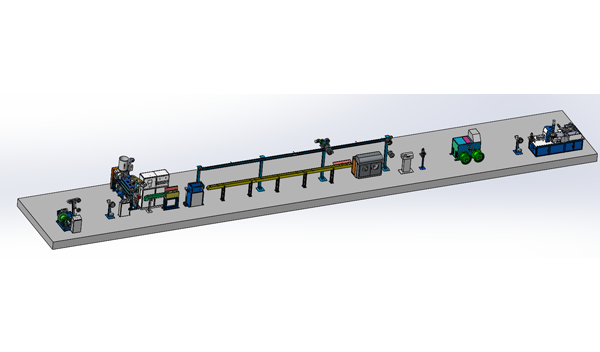
The 80+40 Extrusion Shaking Table Coating Integrated Production Line is developed around this idea. It combines extrusion and coating-related operations with shaking table handling in an integrated production arrangement. Depending on the actual cable structure, material, coating process, product specification, and factory conditions, the equipment configuration can be discussed and adjusted before manufacturing.
1. What Is an 80+40 Extrusion Shaking Table Coating Integrated Production Line?
In simple terms, an extrusion production line uses an extruder to process a selected material and form it around or onto a continuous wire, cable, or other product. The material is heated and plasticized inside the extrusion system, then pushed through a die to create the required shape. Downstream equipment helps cool, guide, coat, handle, and collect the finished product.
The term 80+40 identifies the configuration of the extrusion equipment. The exact meaning of each machine section should be confirmed against the final technical configuration because different production requirements can use different combinations. For this reason, I do not recommend choosing equipment only because the model name looks suitable on paper.
The “shaking table” section is part of the integrated handling arrangement. In a practical production environment, continuous products need controlled movement between different stages. The handling system should work with the extrusion and coating process rather than create another independent operation for the production team.
The coating section is equally important. Coating is not simply about putting another layer onto a product. The material, coating thickness, surface condition, temperature, cooling method, line speed, and product structure can all influence the final result. The actual coating process therefore needs to be discussed before the line is finalized.
For us, the complete 80+40 Extrusion Shaking Table Coating Integrated Production Line is a customized production solution rather than a machine that should be treated as “one size fits all.” We first understand what the customer is producing and then determine which configuration makes practical sense.
| Production Element | Main Purpose | What We Confirm Before Production |
|---|---|---|
| 80+40 Extrusion System | Continuous material extrusion | Extruder configuration, material, product structure |
| Coating Section | Apply the required coating layer | Coating material, process, product specification |
| Shaking Table Handling | Support coordinated product handling | Product shape, handling requirements, line arrangement |
| Supporting Equipment | Connect and support production stages | Factory layout, production process, customer requirements |
| Take-Up / Unwinding | Continuous feeding and product collection | Product type, reel requirements, line configuration |
Source: Wuxi Shuochuan Electromechanical Equipment Manufacturing Co., Ltd. product and configuration information provided for this production line.
2. How Does the 80+40 Extrusion Coating Line Work?
A good way to understand this production line is to follow the material and product from the beginning to the end.
Material Feeding
The process starts with the selected extrusion material. Different products can require different materials and processing conditions. Before production, we confirm the material type and related requirements with the customer. This is important because an extrusion system that works well with one material may need a different process setup for another.
Stable feeding matters more than it may appear. If material feeding changes too much, extrusion conditions can also change. Operators may then see differences in product forming, coating quality, or overall production stability. A properly matched feeding system helps create a more controlled process.
Extrusion and Material Forming
Inside the extruder, the material is processed through a controlled combination of feeding, heating, plasticizing, and conveying. The processed material is then pushed through the extrusion die.
The die is one of the key parts of the process because it determines how the material leaves the extruder. For wire and cable production, the die must be matched to the product structure and material requirements. We therefore treat die selection as part of the overall engineering discussion rather than an afterthought.
Coating Process
After extrusion, the product moves through the coating-related section according to the agreed production process. The goal is to form a consistent coating layer that matches the required product structure.
In actual production, coating quality depends on several factors working together. Material condition, extrusion stability, die design, product movement, cooling, and process control can all have an effect. This is why we focus on the complete line instead of judging coating performance from one component alone.
Shaking Table Handling
The shaking table section supports product handling within the integrated process. Its role is to help coordinate the movement and handling of the product between processing stages.
For continuous wire and cable production, smooth product movement can save operators a lot of trouble. A production line should not force workers to constantly correct product position or manually manage every transition. The more predictable the product movement is, the easier it becomes to maintain stable daily production.
Cooling, Guiding, and Take-Up
Depending on the final configuration, downstream equipment can be used to support cooling, guiding, collection, and other production operations. The finished product is then collected in the required form.
We discuss these details with the customer before manufacturing because the final arrangement depends on the product. A photovoltaic cable, automotive wire, electronic wire, and charging pile cable may have very different production requirements even though all of them involve extrusion.
3. Main Features of the 80+40 Integrated Extrusion Production Line
One of the main reasons customers consider an integrated production line is that they want fewer disconnected production steps. But integration should be useful, not complicated for the sake of looking advanced.
Integrated Production Arrangement
The 80+40 Extrusion Shaking Table Coating Integrated Production Line brings several production functions into a coordinated system. This can help reduce unnecessary manual handling between different processing stages.
For a factory running continuous production, this matters. Every additional manual transfer can create another opportunity for product damage, process interruption, or inconsistent handling. An integrated arrangement gives the production team a clearer workflow.
Stable Continuous Operation
Wire and cable manufacturing is normally a continuous process. Stopping and restarting the line too frequently can affect productivity and create additional material waste.
Our design approach therefore focuses on stable operation. Material feeding, extrusion, coating, product handling, and take-up should be considered together. The exact operating conditions are determined according to the product and agreed technical requirements.
Flexible Configuration
There is no single extrusion configuration suitable for every cable manufacturer. Product diaMeter, conductor structure, insulation or coating material, production speed requirements, factory space, and downstream equipment can all change the equipment arrangement.
For this reason, we can discuss configuration requirements before production. Customers can provide product drawings, material information, target output requirements, cable structures, or existing production process information where available.
Practical Automated Operation
Automation is useful when it makes production easier for people. Our equipment development focuses on efficient, energy-saving, and human-machine-friendly automated equipment.
In daily production, operators need to monitor the process, make reasonable adjustments, and respond to abnormal conditions. A practical control arrangement should give them useful information without making normal operation unnecessarily complicated.
Suitable for Different Cable Applications
The integrated line concept can be considered for a range of extrusion-related applications. These include wire and cable manufacturing, photovoltaic cables, automotive wires, electronic wires, network communication cables, charging pile cables, silicone rubber products, and other extrusion-related products.
| Application | Typical Production Concern | Configuration Focus |
|---|---|---|
| Photovoltaic Wire and Cable | Continuous insulation and stable product forming | Material, cable structure, extrusion stability |
| Automotive Wire | Consistent insulation and controlled dimensions | Product specification, material, process control |
| Electronic Wire | Fine product forming and stable processing | Wire structure, material, coating requirements |
| Network Communication Cable | Controlled production and product consistency | Cable structure and production process |
| Charging Pile Cable | Reliable insulation and coating process | Material, structure, production requirements |
| General Industrial Cable | Stable continuous production | Product specification and line configuration |
Source: Wuxi Shuochuan application information and product scope supplied for this page. Final application suitability should be confirmed against the customer's actual product requirements.
4. Technical Advantages and How We Approach Line Selection
When customers ask us about an extrusion line, one of the first questions is often, “What is the production capacity?” That is understandable, but capacity should not be considered by itself.
A line may have a high theoretical production rate, but if the customer's material, product structure, cooling conditions, coating process, take-up system, or factory layout cannot support it, the number is not very useful.
We therefore look at the whole production process.
Material Compatibility
The first question is what material the customer needs to process. Different polymers and coating materials can have different processing characteristics. The extrusion system, temperature control, die arrangement, and production conditions should be considered around the selected material.
Before manufacturing, we confirm the material requirements with the customer. This simple step helps prevent a common mistake: selecting equipment first and trying to make the product fit the machine later.
Product Structure
We also need to understand what the final product looks like. Is it a single wire? A multi-core cable? A coated conductor? A photovoltaic cable? An automotive wire? A special industrial cable?
Product structure directly affects the extrusion and coating process. It also affects downstream handling and take-up requirements.
Production Capacity
Production capacity is important, but it should be discussed together with product size, material, process conditions, and operating requirements. We do not recommend using a generic production number for every application.
Instead, we confirm the customer's expected production requirements and then discuss the appropriate configuration.
Factory Layout
A production line has to fit into a real factory, not just a technical drawing. Available floor space, material flow, operator access, electrical requirements, transportation routes, and existing equipment can all influence the final arrangement.
For an integrated extrusion and coating line, this is especially important because the equipment is connected into one production flow.
Automation and Operator Experience
We also pay attention to how operators will actually use the equipment. A machine that looks impressive but is difficult to operate is not a good production solution.
Controls should be clear. Maintenance points should be accessible. The production process should be understandable. When equipment is designed around real working conditions, training and daily operation become easier.
| Selection Factor | Why It Matters | Our Recommended Approach |
|---|---|---|
| Material | Influences extrusion and processing conditions | Confirm material before final configuration |
| Product Structure | Affects die, coating, handling, and take-up | Review drawings and product requirements |
| Capacity | Determines production planning | Match capacity expectations with actual product conditions |
| Factory Space | Determines line arrangement and installation | Review layout and available installation area |
| Automation | Affects operation and production management | Choose practical control and handling functions |
| After-Sales Support | Helps maintain long-term operation | Provide technical documents and support according to the order |
Source: Wuxi Shuochuan Electromechanical Equipment Manufacturing Co., Ltd. engineering and customer requirement confirmation process.
5. Where Can the 80+40 Extrusion Shaking Table Coating Line Be Used?
The strongest point of an extrusion production line is its flexibility. Once the extrusion process is properly matched to the material and product structure, the same general production concept can support many industrial applications.
Photovoltaic Cable Production
Solar power systems use specialized cables that need consistent insulation and reliable production quality. A stable extrusion process helps manufacturers maintain repeatable product forming during continuous production.
For photovoltaic cable production, we would normally confirm the insulation material, cable structure, product size, production capacity, and related process requirements before recommending a final configuration.
Automotive Wire Production
Automotive wire production often involves many product specifications. The cable manufacturer may need to handle different wire structures and materials while keeping production consistent.
An appropriately configured 80+40 extrusion production line can be considered where continuous extrusion and coating operations are required. The actual configuration should always follow the specific automotive wire requirements.
Electronic Wire Production
Electronic wires can require controlled dimensions and stable surface quality. Production conditions therefore need to be kept consistent.
For electronic wire manufacturers, the important discussion is usually not simply machine size. Material selection, wire structure, die configuration, cooling, coating, and take-up should be treated as one process.
Network Communication Cables
Network communication cables depend on controlled cable structures and consistent production. Extrusion equipment can be used as part of the insulation or coating process depending on the cable design.
We can review the product structure and production process with the customer before finalizing the equipment arrangement.
Charging Pile Cables
The growth of electric vehicles has increased the need for charging-related cable products. These cables can involve specific insulation and protection requirements, making stable extrusion and coating important.
Our extrusion equipment portfolio includes production solutions for charging pile cable applications. The exact line configuration depends on the cable material, structure, specification, and required production process.
Silicone Rubber and Other Extrusion Products
Our product scope also covers silicone rubber-related extrusion equipment and other extrusion applications. This means our engineering experience is not limited to one type of wire.
However, we always recommend checking actual material behavior and product requirements before using a particular configuration for a new application.
6. Manufacturing, Testing, Packaging, and Delivery
Buying an industrial production line is different from buying a standard machine from a shelf. The production process begins well before the equipment enters the factory.
Requirement Confirmation
Before production, we confirm the customer's product specifications, material requirements, expected production capacity, equipment configuration, and delivery schedule.
This step helps both sides understand what is actually being ordered. It also gives our engineering and manufacturing teams a clear technical basis for production.
Equipment Manufacturing
Wuxi Shuochuan integrates research and development, manufacturing, and sales. We have obtained more than ten utility model patent certificates, reflecting our continuing investment in equipment development.
Our manufacturing work covers extrusion machinery, automated production lines, take-up and unwinding equipment, auxiliary equipment, and related systems.
We follow the company's working principle of “Quality First, Continuous Improvement, and Honest Service.” For industrial equipment, this means paying attention not only to whether a machine can run, but also to whether the complete production arrangement makes sense for the customer's application.
Assembly and Testing
Before shipment, the complete production line is assembled, tested, and inspected according to the agreed requirements.
Testing is important because individual components may work correctly on their own but still need adjustment when connected into a complete production system. The integrated line should be checked as a whole before it leaves the factory.
Technical Documents and Accessories
Standard delivery generally includes the complete Extruder Production Line, necessary components, technical documents, accessories, and other items specified in the order.
The exact delivery list depends on the contract and final configuration. We recommend customers check the agreed packing list before shipment so there is no confusion during installation.
Packaging and Transportation
Industrial extrusion equipment may travel long distances before reaching the customer's factory. Packaging therefore needs to consider moisture, vibration, handling, storage, and loading conditions.
We normally use moisture-resistant materials, protective cushioning, and strong export wooden cases or pallets. Transportation can be arranged by sea, air, or land depending on the destination, equipment size, and delivery schedule.
| Stage | Our Main Work | Customer Benefit |
|---|---|---|
| Requirement Confirmation | Confirm product, material, capacity, configuration | Clear technical scope |
| Production | Manufacture equipment according to agreed requirements | Configuration matches the confirmed order |
| Assembly | Connect and prepare the complete production line | Better preparation before shipment |
| Testing | Test and inspect the equipment | Identify issues before delivery |
| Packaging | Use protective and moisture-resistant packaging | Better protection during transportation |
| Delivery | Arrange transportation based on destination and equipment | Practical international delivery support |
Source: Wuxi Shuochuan Electromechanical Equipment Manufacturing Co., Ltd. manufacturing, inspection, packaging, and delivery information supplied for this product page.
7. Why Choose Wuxi Shuochuan for an Extrusion Production Line?
There are many companies making extrusion equipment. From our point of view, the important question is not simply who can manufacture a machine. The better question is who can understand the production problem behind the machine.
Wuxi Shuochuan Electromechanical Equipment Manufacturing Co., Ltd. is an innovative technology enterprise integrating R&D, manufacturing, and sales. Our product range has grown around the actual needs of wire, cable, and extrusion-related manufacturers.
Our main products include high-speed extruders, three-in-one BV extrusion automatic production lines, three-in-one plus one BVVB automated production lines, photovoltaic wire and cable production lines, automotive wire production lines, electronic wire production lines, network communication wire production lines, cable production lines, charging pile cable production lines, take-up and unwinding series, auxiliary equipment, and raw materials.
We have obtained more than ten utility model patent certificates. These patents are part of our broader equipment development work and show that we continue to improve our machinery rather than simply repeat the same design.
The company has also provided information that it has passed ISO 19001 quality management system certification. Customers requiring certification for procurement or compliance purposes should verify the current certificate, applicable standard, validity, and certification scope with us before placing an order.
For us, quality also includes communication. Before manufacturing, we need to understand the customer's product. During production, we follow the confirmed requirements. Before shipment, we assemble, test, and inspect the equipment. This workflow may sound simple, but it is exactly where many industrial equipment projects succeed or fail.
We also understand that customers do not only need a machine. They need a production solution that can fit their factory, process, operators, materials, and delivery plan.
Frequently Asked Questions About the 80+40 Extrusion Shaking Table Coating Integrated Production Line
1. What is the 80+40 Extrusion Shaking Table Coating Integrated Production Line used for?
It is designed for integrated extrusion and coating-related production with coordinated shaking table handling. It can be considered for wire and cable manufacturing and other extrusion-related applications. The final application depends on the product structure, material, coating process, and technical requirements.
2. Can the production line be customized?
Yes. We normally confirm the product specifications, material requirements, production capacity, equipment configuration, factory conditions, and delivery schedule before production. Based on these details, the final line configuration can be discussed and matched to the application.
3. What materials can the line process?
The suitable material depends on the specific extrusion and coating process. Customers should provide the material type and related processing requirements so that we can evaluate the appropriate configuration.
4. Can it be used for photovoltaic cable production?
Yes, photovoltaic wire and cable production is one of the application areas covered by our extrusion equipment portfolio. However, the final configuration should be selected according to the photovoltaic cable structure, insulation material, product specification, and production requirements.
5. Can it be used for automotive wires?
Yes. We manufacture equipment for automotive wire production applications. For an automotive wire project, we recommend confirming the wire structure, material, product size, coating or insulation requirements, production capacity, and downstream handling requirements before equipment selection.
6. How long does production take?
Production lead time normally depends on the extruder model, line configuration, customization requirements, and order quantity. We confirm the delivery schedule with the customer before production so that the manufacturing plan is based on the actual order.
7. What is included in the delivery?
Standard delivery generally includes the complete extruder production line, necessary components, technical documents, accessories, and other items specified in the order. The exact packing list depends on the final contract and equipment configuration.
8. How is the equipment packaged?
We normally use moisture-resistant materials, protective cushioning, and strong export wooden cases or pallets. The packaging method is selected to help protect the equipment during loading, handling, storage, and long-distance transportation.
9. How can the equipment be transported?
Transportation can be arranged by sea, air, or land depending on the destination, equipment size, and delivery schedule. For international projects, sea transportation is often considered for larger production equipment, but the final method should be discussed according to the actual order.
10. What payment terms do you accept?
Payment terms are normally arranged according to the contract. They commonly include a deposit before production and the balance before shipment. The exact payment schedule should be confirmed in the commercial agreement.
11. Do you provide technical documents?
Yes. Technical documents are generally included as part of the standard delivery according to the order. The specific documents depend on the equipment configuration and customer requirements.
12. How should I choose the right 80+40 extrusion configuration?
Start with the product rather than the machine. Provide us with the product structure, material, size, coating or insulation requirements, expected production capacity, and available factory conditions. We can then discuss the suitable extrusion, coating, handling, and take-up configuration.
Final Thoughts
The 80+40 Extrusion Shaking Table Coating Integrated Production Line is not simply an extruder combined with several pieces of supporting equipment. Its value comes from how the complete production process works together.
For a cable manufacturer, stable material feeding, controlled extrusion, consistent coating, smooth product handling, and reliable take-up are all connected. If these stages are planned separately, operators may have to solve problems manually. If they are planned as one system, the production workflow can become much easier to manage.
That is the approach we take at Wuxi Shuochuan. We start by understanding the product, then consider the material, production process, capacity, equipment configuration, factory conditions, and delivery requirements. We manufacture and assemble the line according to the agreed specifications, test the equipment before shipment, and prepare the necessary delivery items.
Whether the project involves photovoltaic cables, automotive wires, electronic wires, network communication cables, charging pile cables, or another extrusion-related product, the same basic principle applies: the machine should fit the production process, not the other way around.
If you are evaluating an 80+40 extrusion coating production line, an 80+40 wire and cable extrusion line, or an 80+40 integrated extrusion production line, providing your product specifications and material information at the beginning will make equipment selection much more accurate. We can then work from the actual production requirement instead of relying on a generic machine description.



 WhatsApp
 Phone
Phone