

How to Improve Cable Quality with a Modern Stranding Machine?
A Modern Stranding Machine plays an important role in improving cable quality by controlling wire tension, stranding speed, lay length, wire positioning, and take-up performance. In Modern Cable Manufacturing, stable stranding is essential because even small variations in wire movement can affect cable diaMeter, flexibility, mechanical strength, appearance, and downstream processing. By using a modern stranding machine with accurate control and stable mechanical operation, manufacturers can achieve more consistent cable structures while reducing production variation and material waste.
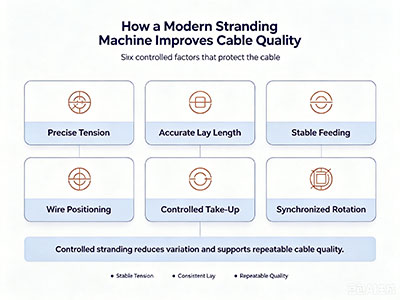
A modern stranding machine is designed to combine multiple individual wires or cable components into a controlled stranded structure. During operation, individual wires are supplied from pay-off units, pass through guiding and tension-control components, and are then twisted or arranged around a common axis. The completed strand moves through forming and haul-off equipment before being collected by a take-up system.
Compared with basic stranding equipment, a modern stranding machine places greater emphasis on synchronization, tension control, production stability, automation, and repeatable process parameters. These capabilities allow manufacturers to maintain more consistent cable quality during long production runs and when producing different cable specifications.
Stranding is not simply the process of twisting wires together. It determines the geometric relationship between individual wires and has a direct influence on the structure of the finished cable. If wires are fed unevenly or tension changes during production, the final cable may show inconsistent lay length, irregular diameter, loose strands, excessive deformation, or surface defects.
A modern stranding machine helps control these factors through coordinated mechanical and electrical systems. Stable wire feeding, controlled cage or rotor movement, accurate haul-off, and synchronized take-up operation work together to create a repeatable stranding process.
For manufacturers focused on consistent cable quality, the stranding stage should therefore be treated as a critical Production Process rather than simply another step in the manufacturing line.
Wire tension is one of the most important factors affecting cable quality. Each wire entering a modern stranding machine must follow a controlled path while maintaining appropriate tension. Excessive tension can stretch or deform the wire, while insufficient tension may create slack, uneven positioning, and unstable strand formation.
A modern stranding machine can use tension-control devices to maintain more stable feeding conditions. When each wire reaches the stranding area under controlled tension, the wires can be arranged more evenly around the cable center.
Consistent tension also helps reduce wire breakage and production interruptions. It provides a more stable foundation for controlling lay length, cable diameter, and finished cable geometry.
Lay length describes the distance required for an individual wire to complete one full turn around the cable axis. It is a fundamental parameter in cable construction because it influences flexibility, mechanical behavior, diameter, and the overall appearance of the stranded cable.
A modern stranding machine can coordinate rotation speed and haul-off speed to maintain the required lay length. Stable synchronization helps prevent unnecessary variations throughout the production run.
When lay length remains consistent, the cable structure becomes more uniform. This makes downstream processes easier to control and helps manufacturers maintain repeatable product specifications from one production batch to another.
Before wires are stranded, they must be supplied smoothly from the pay-off system. Unstable feeding can introduce tension fluctuations, wire vibration, or sudden changes in wire position. These problems can eventually appear as defects in the finished cable.
A modern stranding machine is normally designed with controlled pay-off and guiding systems that help maintain a stable material path. Proper wire alignment allows the stranding section to operate under predictable conditions.
Stable feeding is especially important when processing small-diameter wires, multiple wire components, or materials that are sensitive to bending and tension. Smooth feeding reduces unnecessary mechanical stress and contributes to more consistent cable quality.
The relative position of each wire affects the final cable geometry. If one wire moves away from its intended path, the surrounding wires may also shift. This can create an uneven strand structure and increase diameter variation.
A modern stranding machine uses wire guides, forming components, and controlled rotational movement to keep individual wires on their intended paths. Proper positioning helps the wires form a compact and stable structure.
Accurate wire positioning also makes subsequent processes such as insulation, wrapping, shielding, extrusion, and sheathing more predictable. A stable stranded core provides a better foundation for downstream manufacturing.
The relationship between rotational speed and linear cable movement is critical to stranding quality. If rotation changes without a corresponding adjustment to the haul-off speed, the lay length may change. Likewise, unstable haul-off movement can affect the entire strand structure.
A modern stranding machine can synchronize the main rotating system with the haul-off system. This coordination helps maintain stable production parameters and reduces variations caused by inconsistent mechanical movement.
Stable synchronization is particularly valuable during continuous production because small deviations can accumulate over long cable lengths. Maintaining coordinated movement helps manufacturers produce a more uniform cable structure.
Even advanced equipment cannot compensate for incorrect setup. A modern stranding machine should be configured according to the cable construction, wire diameter, number of wires, conductor material, required lay length, production speed, and finished cable dimensions.
The first step is to confirm the required cable structure. Operators should understand how many wires are required, how they should be arranged, and what final dimensions must be achieved. The pay-off configuration should then be matched to the number and size of individual wires.
Tension settings should be established according to wire characteristics and production requirements. Operators should avoid using excessive tension simply to make wire feeding appear more stable. The correct setting is one that provides reliable feeding without unnecessarily stressing the material.
Rotation speed and haul-off speed should also be synchronized. When changing cable specifications, production parameters should be adjusted systematically rather than changing multiple settings randomly.
A modern stranding machine depends heavily on the stability of its pay-off system. If the pay-off system creates inconsistent resistance, the wire tension entering the stranding section will change continuously.
Operators should check bobbin alignment, brake condition, guide condition, material winding quality, and feeding resistance. Bobbins should rotate smoothly without excessive vibration or sudden resistance changes.
Proper pay-off maintenance helps the modern stranding machine maintain stable wire tension. This simple point is often overlooked, but pay-off performance can have a direct effect on final cable quality.
Although stranding is mainly a mechanical process, material conditions can also influence performance. Different conductor materials and wire constructions may respond differently to tension, bending, and rotational movement.
Environmental conditions can also affect production stability. Excessive humidity, temperature changes, dust, and poor storage conditions may influence material handling. Manufacturers should keep wire materials clean and properly stored before they enter the modern stranding machine.
Where the stranded product includes components with polymeric materials, appropriate temperature and storage conditions become even more important. Stable material conditions allow the stranding process to remain predictable.
Cable diameter is one of the most visible indicators of stranding quality. Excessive variation may indicate inconsistent wire tension, unstable lay length, incorrect forming, or uneven wire distribution.
A modern stranding machine can reduce diameter variation by coordinating wire feeding, cage or rotor rotation, haul-off, and forming. When the individual wires maintain their intended positions, the finished cable can achieve a more stable circular structure.
Operators should regularly measure cable diameter during production instead of relying only on the initial machine setup. Continuous monitoring makes it easier to identify changes before a large quantity of material becomes affected.
Stranding structure has a strong influence on cable flexibility. The relationship between wire arrangement, lay length, conductor diameter, and strand construction determines how the finished cable responds to bending.
A modern stranding machine provides controlled lay formation, allowing manufacturers to establish a consistent cable structure according to product requirements. Stable lay formation can help prevent areas of the cable from becoming excessively tight or loose.
For cables used in applications involving repeated bending or movement, stable stranding is particularly important. A consistent structure helps distribute mechanical movement more evenly across the cable.
Surface appearance is another important aspect of cable quality. Uneven wires, loose strands, excessive deformation, or poor forming can create visible irregularities on the finished cable.
A modern stranding machine can improve surface quality by maintaining controlled wire positioning and stable forming conditions. Smooth wire guides and correctly adjusted closing components help prevent unnecessary marks and deformation.
Operators should inspect the cable surface regularly during production. If an abnormal pattern appears, the cause may be related to tension, guiding, lay length, forming pressure, or mechanical alignment.
Automation is an important feature of many modern stranding machine systems. Automated controls can coordinate rotation, haul-off, take-up, tension, and other production parameters.
The main benefit of automation is repeatability. Once the correct parameters have been established, the machine can reproduce similar operating conditions during future production runs. This reduces dependence on manual adjustment and helps minimize differences between batches.
Automation can also make production monitoring easier. Operators can observe important operating parameters and identify abnormal conditions before they become major quality problems.
Poor stranding control can lead to material waste through wire breakage, rejected cable, repeated setup adjustments, and unstable production. A modern stranding machine can help reduce these losses by providing more predictable operating conditions.
Stable tension and accurate lay length reduce the likelihood of producing long sections of cable outside the required specification. Consistent take-up also helps prevent unnecessary damage to finished cable during collection.
Reducing waste is not only a cost consideration. Lower material waste also improves Production Efficiency and makes manufacturing processes easier to manage.
Regular maintenance is essential for keeping a modern stranding machine operating consistently. Bearings, wire guides, tension devices, pay-off components, rotating systems, haul-off equipment, and take-up units should be inspected according to actual operating conditions.
Wire guides deserve particular attention because worn or damaged guides can change the wire path and create surface defects. Bearings and rotating components should also be checked for abnormal noise, vibration, or temperature.
Electrical and control systems should be inspected as well. Sensors, motors, drives, and control components must work reliably to maintain synchronization throughout production.
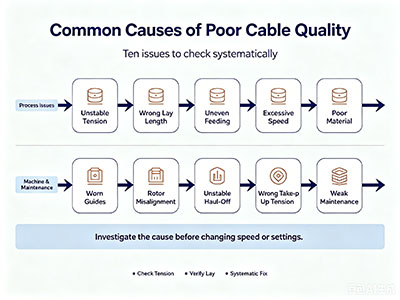
Poor cable quality does not always mean that the modern stranding machine itself is unsuitable. In many cases, quality problems result from incorrect setup or maintenance.
Unstable wire tension
Incorrect lay length settings
Uneven wire feeding
Worn wire guides
Improper cage or rotor alignment
Unstable haul-off speed
Incorrect take-up tension
Excessive production speed
Poor material preparation
Insufficient preventive maintenance
Each problem should be investigated systematically. Changing machine speed without identifying the actual cause may temporarily hide a problem while creating new production variation elsewhere.
Manufacturers should choose a modern stranding machine according to actual Cable Production requirements. Important factors include wire diameter, conductor material, number of wires, cable diameter, lay length, required production speed, pay-off capacity, take-up capacity, tension control, automation, and factory space.
The machine should also be compatible with upstream and downstream equipment. A stranding machine that operates efficiently by itself may still create production bottlenecks if its output does not match the capacity of subsequent processes.
Manufacturers should therefore evaluate the complete Production Line rather than selecting equipment based only on maximum speed. Stable quality, reliable operation, maintenance accessibility, product changeover, and long-term production requirements should all be considered.
Continuous production requires more than setting the machine correctly at startup. Operators should monitor cable diameter, lay condition, tension, machine vibration, take-up performance, and finished surface quality throughout the production run.
Production records can be useful for identifying recurring problems. Recording machine settings for different cable specifications allows operators to establish practical reference parameters and reduce setup time during future production.
When quality inspection identifies a deviation, operators should compare the current conditions with previous stable production records. This approach can make troubleshooting faster and more systematic.
A modern stranding machine can support many types of wire and cable manufacturing. Applications may include power cables, control cables, industrial cables, communication cables, electronic wires, automotive wires, flexible cables, and other multi-wire products.
Different cable applications require different stranding structures. The correct machine configuration should therefore be selected according to conductor size, strand count, material characteristics, cable construction, and finished product requirements.
For high-quality production, the objective is not simply to achieve higher speed. The more important goal is to maintain stable production conditions while achieving the required output and cable specifications.
Manufacturers can improve cable quality by following a structured production approach. Start with correct material preparation and suitable pay-off conditions. Set appropriate wire tension and verify wire alignment before production. Establish the required lay length and synchronize cage or rotor speed with haul-off speed.
During production, monitor cable diameter and surface condition regularly. Check for unusual vibration, wire movement, tension changes, or take-up problems. When a defect appears, identify its source before adjusting production speed or other parameters.
Finally, establish preventive maintenance procedures for the modern stranding machine. Regular inspection and timely replacement of worn components can prevent small mechanical problems from becoming major quality issues.
A modern stranding machine provides manufacturers with better control over one of the most important stages of cable production. Its ability to manage wire tension, lay length, rotational movement, material feeding, forming, and take-up creates a more stable manufacturing environment.
Better process control can lead to more consistent cable dimensions, improved surface quality, stable flexibility, reduced material waste, and fewer production interruptions. These benefits become increasingly important as cable specifications become more demanding and production requirements become more diversified.
Improving cable quality requires consistent control of every major stranding parameter. A modern stranding machine can provide the mechanical stability, tension control, synchronization, and automation needed to produce reliable cable structures.
Manufacturers should focus on stable wire feeding, accurate tension control, consistent lay length, proper wire positioning, synchronized rotation and haul-off, reliable take-up, and regular maintenance. The machine should also be correctly matched to the cable construction and integrated with the complete production line.
When equipment selection, machine setup, material handling, process monitoring, and preventive maintenance are managed together, a modern stranding machine can significantly improve cable quality and production consistency. The result is a more stable manufacturing process, lower material waste, better dimensional control, and more reliable finished cable performance.
SEO Description: Learn how a modern stranding machine can improve cable quality through precise tension control, accurate lay length, stable wire feeding, synchronized rotation, consistent wire positioning, and reliable take-up. Discover practical methods for reducing cable defects, material waste, dimensional variation, and production instability while improving overall wire and cable manufacturing efficiency.
This website uses cookies to ensure you get the best experience on our website.


 Pусский
 中文
中文



 WhatsApp
 Phone
Phone
Comment
(0)