

Wire Drawing Production Line: Key Equipment and Production Process
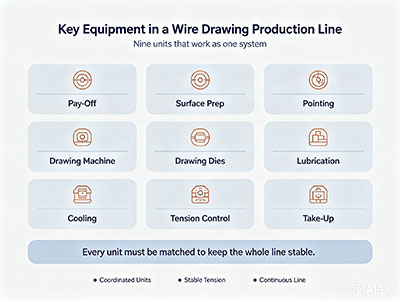
A Wire Drawing Production Line is an integrated manufacturing system designed to reduce wire diaMeter, improve dimensional accuracy, control surface quality, and produce finished wire with stable mechanical properties. A complete wire Drawing Production Line normally combines pay-off equipment, surface preparation, pointing, drawing equipment, lubrication and cooling systems, tension control, and take-up equipment. When these key equipment units operate together, the Wire Drawing Production line can provide continuous, efficient, and consistent production for different wire and cable applications.
A wire drawing production line uses controlled mechanical force to pull wire through one or more drawing dies. Each drawing die reduces the cross-sectional area of the wire while increasing its length. Industrial wire drawing commonly uses multiple drawing stages because gradual reduction provides better control over dimensional accuracy, material deformation, heat generation, and surface quality.
The complete wire drawing production line connects these drawing stages with supporting equipment. Depending on the material and finished wire requirements, the line may also include surface cleaning, descaling, lubrication, annealing, cooling, online inspection, and automatic winding systems.
The main objective of a wire drawing production line is not simply to reduce wire diameter. The production line must also maintain stable tension, control drawing speed, manage heat, protect the wire surface, and ensure that the finished wire meets the required dimensional and quality specifications.
Wire drawing is widely used in the production of metal wire, electrical conductors, cable components, industrial wire, and other precision wire products. During the process, the original wire rod is progressively reduced to the required diameter.
A properly designed wire drawing production line can improve production consistency because each process stage is coordinated. Instead of operating individual machines independently, the complete line manages material movement from raw material pay-off through drawing and finally to finished wire take-up.
This integrated approach can reduce unnecessary handling, improve production continuity, simplify process management, and support more consistent finished wire quality.
The pay-off system is the starting point of a wire drawing production line. It supplies wire rod or incoming wire continuously to the drawing section. Stable pay-off is important because sudden changes in feeding resistance can influence wire tension and drawing performance.
A suitable pay-off should match the incoming material size, coil weight, production speed, and line configuration. For continuous production, reliable pay-off operation helps prevent tangling, sudden wire movement, and unnecessary production interruptions.
Incoming wire may contain oxide scale, surface contamination, oil residue, or other materials that can affect the drawing process. Surface preparation equipment is therefore an important part of many wire drawing production line configurations.
Depending on the material and application, surface preparation may include mechanical descaling, brushing, cleaning, pickling, or other treatment processes. The purpose is to create a suitable wire surface before the material enters the drawing dies.
Effective surface preparation can reduce die wear, improve lubrication performance, and help maintain a cleaner finished wire surface.
Wire pointing equipment prepares the leading end of the wire so that it can pass through the first drawing die. This is particularly important when processing larger incoming wire sizes.
A properly pointed wire end makes threading easier and can reduce setup time. It also supports smoother transition from the incoming material to the first drawing stage.
The drawing machine is the core equipment of a wire drawing production line. It pulls the wire through drawing dies and progressively reduces the wire diameter.
Depending on the required reduction and finished diameter, a wire drawing production line may use several drawing passes. Each pass removes a controlled amount of cross-sectional area while maintaining continuous material movement.
The drawing machine must provide stable mechanical movement, accurate speed control, reliable tension, and effective cooling or lubrication. These factors directly influence drawing quality and Production Efficiency.
Drawing dies are essential components of the wire drawing process. The wire passes through the die opening under controlled tensile force, causing its cross-sectional dimensions to decrease.
Different wire materials and finished dimensions require different die configurations. The number of drawing passes depends on the incoming diameter, target diameter, material characteristics, and allowable reduction per pass.
Proper die selection is important because excessive reduction can increase drawing force and heat, while insufficient reduction may require additional passes and increase production complexity.
Lubrication is an important part of a wire drawing production line because drawing generates friction between the wire and drawing die. Appropriate lubrication helps reduce friction, heat generation, die wear, and surface damage.
Depending on the drawing method and wire material, the lubrication system may use dry lubricants, wet lubricants, or specialized drawing fluids. The system should maintain suitable lubrication conditions throughout continuous production.
Stable lubrication can also improve drawing consistency and extend the useful life of drawing dies.
Heat is generated during wire drawing because of friction and plastic deformation. If heat is not controlled, excessive temperature can affect the wire, lubricant, drawing dies, and other machine components.
A wire drawing production line may use internal or external cooling systems to control drawing temperature. Effective cooling helps maintain stable operating conditions and supports continuous production at the required speed.
Cooling performance should be monitored together with drawing speed, material characteristics, lubrication, and reduction per pass.
Tension control is one of the most important functions of a modern wire drawing production line. Each drawing stage must maintain an appropriate relationship between incoming and outgoing wire speed and tension.
Unstable tension can cause wire deformation, breakage, diameter variation, and inconsistent drawing conditions. Proper tension control allows the production line to coordinate multiple drawing stages and maintain smoother material movement.
Stable tension is particularly important for fine wire and high-speed drawing because small fluctuations can become more noticeable as the wire diameter decreases.
The take-up system collects finished wire after the final drawing stage. It must maintain suitable winding tension and produce an orderly finished coil or spool.
A stable take-up system prevents excessive winding tension, loose winding, overlapping, and other problems that can affect subsequent handling. Automatic take-up equipment can also reduce manual handling and improve production continuity.
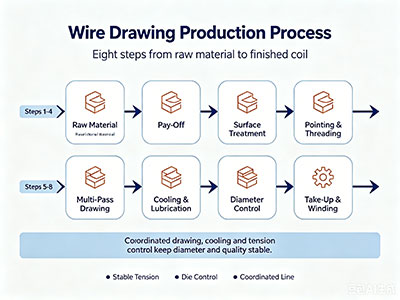
The wire drawing production process begins with selecting suitable raw material. The incoming wire diameter, material grade, surface condition, mechanical properties, and coil condition should match the production requirements.
Proper material preparation reduces the risk of unexpected breakage and helps the wire drawing production line operate under stable conditions.
The incoming wire is loaded onto the pay-off system and supplied continuously toward the drawing section. The pay-off should provide smooth and controlled material movement without sudden tension changes.
Correct pay-off adjustment is important because unstable feeding can affect every downstream drawing stage.
If required, the incoming wire passes through surface preparation equipment. Oxide scale and other contaminants are removed before drawing.
Surface treatment improves contact conditions between the wire, lubricant, and drawing die. It also helps protect drawing equipment and maintain finished surface quality.
The wire end is prepared and guided into the first drawing die. Proper threading helps reduce setup time and allows the drawing process to begin smoothly.
Operators should ensure that the wire enters the drawing path correctly and that the die and guide components are properly aligned.
The main drawing process consists of passing the wire through a sequence of dies. Each die provides a controlled reduction in diameter. Multiple drawing passes allow the total reduction to be distributed across several stages.
During this process, the wire drawing production line must coordinate drawing speed, tension, lubrication, cooling, and die conditions. The relationship between these parameters determines the stability of the complete drawing process.
During drawing, friction and deformation generate heat. Cooling and lubrication systems work together to control temperature and reduce friction.
Stable cooling and lubrication can help protect the wire surface and drawing dies while supporting continuous production. Operators should monitor lubricant condition, cooling performance, and machine temperature during operation.
After the final drawing stage, the finished wire should meet the required diameter and dimensional tolerance. Depending on the production system, online or offline inspection can be used to verify finished wire dimensions.
Consistent diameter is one of the primary quality targets of a wire drawing production line. Regular measurement helps identify drawing problems before large quantities of material are affected.
The finished wire is transferred to the take-up system, where it is wound onto a spool or formed into a coil. Winding tension should be controlled to avoid excessive compression or loose winding.
Proper take-up improves finished product handling and prepares the wire for subsequent processes such as stranding, extrusion, cabling, coating, or other manufacturing operations.
Wire diameter is primarily controlled through drawing die dimensions, reduction per pass, drawing speed, material tension, and machine synchronization. Each drawing die is selected according to the required reduction and the properties of the material.
A multi-stage wire drawing production line gradually reduces the wire diameter rather than attempting to achieve the entire reduction in one operation. This approach allows the drawing load and deformation to be distributed across several stages.
Stable machine speed and tension are also important. If the relationship between drawing stages changes unexpectedly, the finished diameter may fluctuate. Consistent process control therefore plays an important role in maintaining dimensional accuracy.
Tension influences the stability of the entire wire drawing production line. Each drawing stage must operate at a suitable speed relative to the previous and following stages.
Excessive tension can increase the risk of wire breakage, while insufficient tension can cause unstable wire movement. The correct balance depends on wire material, diameter, drawing reduction, lubrication, and production speed.
Modern control systems can coordinate drawing motors and other components to maintain more stable tension. Better synchronization can improve dimensional consistency and reduce production interruptions.
Wire drawing production line configurations can generally be divided into dry drawing and wet drawing approaches. Dry drawing uses solid or dry lubricating materials around the drawing area, while wet drawing uses liquid drawing lubricant to provide lubrication and cooling.
The appropriate method depends on wire material, diameter, production speed, surface requirements, and finished product specifications. Wet drawing can provide effective cooling and lubrication for certain applications, while dry drawing can be suitable for other wire products and production conditions.
Manufacturers should select the drawing method based on the complete process rather than using one configuration for every material.
Automation can improve the consistency and efficiency of a wire drawing production line. Modern control systems can coordinate motor speed, drawing stages, tension, lubrication, cooling, and take-up operation.
Production parameters can be monitored through a centralized control interface. Operators can use stored settings for different wire specifications, reducing setup time and improving repeatability between production runs.
Automation can also help identify abnormal conditions. Monitoring motor load, temperature, tension, speed, and other parameters allows operators to respond before minor deviations become major production problems.
Quality control should cover the complete wire drawing production process rather than focusing only on final inspection. Incoming material should be checked before production, while machine conditions should be monitored during drawing.
Finished wire can be inspected for diameter, surface condition, winding quality, mechanical properties, and other product-specific requirements. Where necessary, online monitoring can provide faster detection of dimensional variation or surface problems.
Maintaining production records is also useful. Operators can compare machine parameters and inspection results to identify trends and improve process stability over time.
Several common problems can affect wire drawing performance. Wire breakage may result from excessive reduction, unstable tension, poor lubrication, damaged dies, material defects, or excessive drawing speed.
Surface defects may be related to poor surface preparation, contaminated lubricant, damaged drawing dies, or improper cooling. Diameter variation can occur when drawing stages are not properly synchronized or when die wear changes the effective drawing geometry.
Unstable winding can be caused by incorrect take-up tension, poor spool alignment, or inconsistent wire speed. Systematic inspection is essential when troubleshooting these problems.
Improving wire drawing production line efficiency begins with proper equipment selection and process coordination. Drawing passes should be matched to the incoming and finished wire diameters. Lubrication and cooling should be sufficient for the required production speed.
Preventive maintenance is equally important. Drawing dies, bearings, guides, motors, cooling systems, lubrication systems, and take-up components should be inspected regularly.
Operators should also minimize unnecessary machine stops and setup adjustments. Standardized production parameters for different wire specifications can reduce changeover time and improve overall line utilization.
Regular maintenance helps keep a wire drawing production line stable and efficient. Drawing dies should be inspected for wear and surface damage. Wire guides should be checked to ensure that they do not create unnecessary friction or damage the wire.
Lubrication systems should be kept clean, and lubricant condition should be monitored. Cooling systems should provide sufficient heat removal during continuous operation.
Motors, transmission components, bearings, sensors, and electrical systems should also be inspected according to actual operating conditions. Preventive maintenance can reduce unexpected downtime and extend equipment service life.
Choosing the right wire drawing production line requires a clear understanding of the finished product. Manufacturers should consider incoming wire diameter, finished diameter, material type, total reduction, required production speed, number of drawing passes, lubrication method, cooling requirements, and take-up configuration.
The production environment should also be considered. Available factory space, material handling, operator access, maintenance requirements, electrical capacity, and future production expansion can all affect the final equipment configuration.
It is important to evaluate the complete line rather than focusing only on the drawing machine. Pay-off, surface preparation, drawing, lubrication, cooling, inspection, and take-up equipment must work together to achieve stable production.
A wire drawing production line can be used for many wire manufacturing applications. Typical products include steel wire, Copper Wire, aluminum wire, alloy wire, electrical conductors, cable components, industrial wire, and other drawn wire products.
The required configuration varies according to the material and final application. Fine Wire Production may require more drawing stages and precise tension control, while larger wire may require heavier-duty drawing equipment and stronger pay-off systems.
For cable manufacturing, the finished drawn wire can become the raw material for subsequent stranding, insulation extrusion, cabling, shielding, or other processes.
The quality of drawn wire has a direct effect on subsequent manufacturing processes. Consistent diameter and surface quality provide a more stable input for stranding and Cable Production.
If the wire diameter varies excessively, downstream equipment may experience changes in tension or material positioning. Surface defects can also influence subsequent processing and finished cable appearance.
For this reason, the wire drawing production line should be considered the foundation of a broader wire and cable manufacturing process. Stable drawing creates better conditions for the processes that follow.
Incoming wire diameter and material condition
Finished wire diameter requirements
Number and configuration of drawing passes
Drawing die quality and condition
Wire tension stability
Lubrication performance
Cooling capacity
Drawing speed
Machine synchronization
Take-up performance
Preventive maintenance
Operator process control
These factors are interconnected. Improving only one parameter may not solve a production problem if another part of the wire drawing production line remains unstable.
Wire drawing production line technology continues to move toward higher automation, better process monitoring, improved energy management, and more precise production control. Automated parameter management can reduce manual intervention, while online inspection can help detect quality variation earlier.
More integrated production systems can also connect material handling, drawing, inspection, winding, and production data management. These developments can help manufacturers improve traceability, reduce downtime, and optimize production based on actual operating conditions.
The long-term direction is not simply higher drawing speed. Stable quality, efficient energy use, reduced material waste, reliable equipment operation, and flexible production are equally important.
A wire drawing production line combines multiple key equipment units and production stages to transform incoming wire into accurately sized finished wire. Pay-off equipment, surface preparation, pointing, drawing machines, dies, lubrication systems, cooling systems, tension control, and take-up equipment all contribute to the performance of the complete line.
The wire drawing production process requires careful coordination of drawing reduction, speed, tension, lubrication, cooling, and winding. When these parameters are properly controlled, manufacturers can achieve stable wire diameter, consistent surface quality, improved production efficiency, and reliable finished wire performance.
Choosing the right wire drawing production line should therefore be based on the complete manufacturing requirement rather than one machine specification. By matching equipment configuration with material characteristics, finished dimensions, production capacity, quality requirements, and downstream processes, manufacturers can build a more stable and Efficient Wire Production system.
SEO Description: Explore the key equipment and production process of a wire drawing production line, including pay-off, surface preparation, drawing machines, dies, lubrication, cooling, tension control, and take-up systems. Learn how each stage works together to reduce wire diameter, improve dimensional consistency, control surface quality, increase production efficiency, and support reliable wire manufacturing.
This website uses cookies to ensure you get the best experience on our website.


 Pусский
 中文
中文



 WhatsApp
 Phone
Phone
Comment
(0)