

How to Choose a Wire Drawing Production Line for Copper Wire
Choosing the right Wire Drawing Production Line for copper wire is an important decision for manufacturers that need stable dimensions, reliable surface quality, efficient production, and consistent downstream processing. A suitable wire Drawing Production Line must match the copper material, incoming wire size, finished diaMeter, production speed, drawing stages, lubrication, cooling, tension control, and take-up requirements. The right configuration helps manufacturers achieve stable copper wire quality while reducing wire breakage, material waste, equipment downtime, and unnecessary production adjustments.
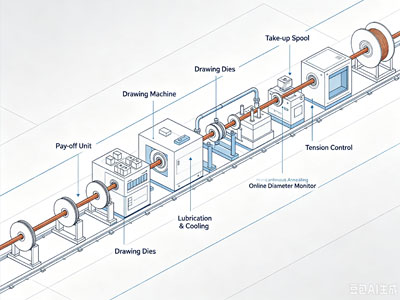
A wire drawing production line for copper wire is not simply a collection of drawing machines. It is an integrated production system in which pay-off, drawing dies, capstans, lubrication, cooling, tension control, annealing when required, inspection, and take-up equipment work together. If one part of the system is poorly matched to the copper wire specification, the entire Production Process may become less stable.
Copper is widely used for electrical conductors because of its conductivity and processing characteristics. However, copper wire drawing requires careful control of deformation, friction, temperature, tension, and surface condition. A properly configured wire drawing production line can gradually reduce copper wire diameter while maintaining consistent dimensions and surface quality.
For this reason, manufacturers should evaluate the complete wire drawing production line instead of selecting equipment only according to maximum drawing speed or individual machine capacity.
A wire drawing production line for copper wire uses controlled pulling force to pass copper wire through a series of drawing dies. Each die reduces the cross-sectional area of the wire and increases its length. Multiple drawing stages distribute the total reduction and allow the production line to control drawing force, material temperature, surface condition, and finished diameter.
A typical wire drawing production line may include a pay-off unit, wire preparation section, drawing machine, drawing dies, lubrication system, cooling system, tension control system, annealing equipment, online inspection, and Take-up Machine. The exact configuration depends on the incoming copper wire diameter, target finished diameter, production speed, and final application.
The first step in choosing a wire drawing production line is to define the copper wire specification. Before comparing equipment, manufacturers should identify the incoming wire diameter, finished wire diameter, copper material condition, required production output, dimensional tolerance, surface requirements, and downstream application.
These parameters determine the basic structure of the wire drawing production line. A line designed for coarse copper wire reduction will have different requirements from a line designed for fine copper Wire Production. Fine drawing generally requires more precise tension management, die control, cooling, and take-up performance.
Manufacturers should also consider whether the finished copper wire will be used for cable conductors, electronic wires, winding applications, communication products, or other applications. The final use determines how much emphasis should be placed on diameter accuracy, surface quality, mechanical properties, and production speed.
The incoming copper wire diameter has a direct influence on the configuration of the wire drawing production line. A larger starting diameter normally requires greater total reduction before reaching the finished wire size.
The production line should provide enough drawing stages to distribute the reduction properly. Attempting to achieve excessive reduction in too few stages can increase drawing force, heat generation, die wear, and the risk of wire breakage.
Manufacturers should provide accurate incoming and finished diameter information when evaluating a wire drawing production line. This allows the drawing process to be designed around an appropriate reduction schedule.
The finished diameter is one of the most important factors when selecting a wire drawing production line. Copper wire may need to be reduced to different sizes depending on the final application. Smaller finished diameters require greater process control because even a small dimensional change can represent a significant percentage of the final diameter.
The drawing dies must be arranged according to the required reduction sequence. The final drawing stage should provide stable dimensional control without creating excessive deformation or unnecessary stress.
A suitable wire drawing production line should therefore be selected according to the complete reduction path rather than only the final die size.
The number of drawing stages affects production stability, line length, equipment cost, maintenance requirements, and output. A multi-stage wire drawing production line distributes copper deformation across several dies.
Each stage should provide an appropriate reduction according to the copper material and finished product requirements. If the reduction is too aggressive, drawing force and temperature can increase. If the reduction is too small, the production line may require additional stages and become unnecessarily complex.
The correct number of drawing stages should therefore be determined through the complete production calculation rather than by using a fixed number for every copper wire product.
Production speed is an important consideration when choosing a wire drawing production line for copper wire. Higher speed can increase output, but speed must remain compatible with lubrication, cooling, tension control, die condition, and take-up performance.
A production line operating at excessive speed may experience higher heat generation, greater die wear, unstable tension, or increased wire breakage. In contrast, a line with stable speed control can provide more predictable production conditions.
Manufacturers should therefore focus on usable production speed rather than only the maximum theoretical speed. Stable continuous operation is often more valuable than short periods of extremely high output.
Drawing dies are central components of a wire drawing production line. The copper wire passes through the die opening under controlled pulling force, reducing its diameter as it moves through each drawing stage.
Die geometry, material, surface condition, and wear resistance can all influence copper wire quality. Worn or damaged dies can create diameter variation, surface marks, increased drawing force, and unstable production.
When choosing a wire drawing production line, manufacturers should evaluate how easily drawing dies can be installed, inspected, adjusted, and replaced. Convenient die maintenance can reduce downtime and help maintain consistent copper wire quality.
Tension control is one of the most important factors in a copper wire drawing process. The copper wire becomes longer as its diameter decreases, so each drawing stage must operate at an appropriate speed relative to the previous stage.
A wire drawing production line with stable tension control can reduce wire vibration, breakage, diameter variation, and unstable winding. This is especially important when producing fine copper wire because the wire has less mechanical tolerance for sudden tension changes.
Manufacturers should examine how the production line controls tension between drawing stages and how the control system responds to changes in production conditions.
Lubrication and cooling have a major influence on copper wire drawing performance. Drawing creates friction between the copper wire and the die, while plastic deformation also generates heat. Without suitable lubrication and cooling, the drawing process can become unstable.
A suitable wire drawing production line should provide an effective lubrication system matched to the selected drawing process. The system should maintain consistent lubricant conditions and remove heat generated during production.
Cooling also helps protect drawing dies and maintain stable process conditions. Manufacturers should consider cooling capacity together with production speed, copper wire diameter, total reduction, and drawing method.
Cold drawing changes the mechanical condition of copper wire. Depending on the required finished properties and production sequence, annealing may be required to restore ductility and reduce the effects of work hardening.
Some copper wire drawing production line configurations include continuous online annealing, while other applications may use separate heat treatment processes. The choice depends on the finished wire specification and downstream requirements.
If annealing is required, the wire drawing production line should be designed so that drawing speed, annealing performance, cooling, and take-up remain properly synchronized.
The take-up system collects the finished copper wire after drawing. Although it is located at the end of the line, take-up performance can directly affect production stability and finished wire handling.
Take-up tension should remain stable to prevent loose winding, excessive compression, overlapping, or deformation. The winding system should also match the required spool size, wire diameter, production speed, and finished product weight.
A well-designed wire drawing production line should maintain a smooth transition from final drawing to take-up without creating sudden tension changes.
Dimensional consistency is a major quality requirement for copper wire. Online measurement can provide continuous information about wire diameter during production and allow operators to identify deviations earlier.
When selecting a wire drawing production line, manufacturers should consider whether online diameter monitoring is required for their products. Continuous measurement can be particularly valuable for fine copper wire and applications with tight dimensional requirements.
Monitoring also provides useful production data. If diameter variation appears repeatedly at a certain drawing stage, operators can investigate die wear, tension, speed synchronization, or other process conditions.
Modern automation can improve the consistency of a wire drawing production line by coordinating drawing speed, tension, lubrication, cooling, annealing, and take-up operation.
A centralized control system allows operators to monitor important parameters and adjust production settings more efficiently. Stored production recipes can also help reduce setup time when switching between different copper wire specifications.
Automation should not be evaluated only by the number of functions available. The most useful control system is one that provides stable synchronization, clear parameter monitoring, reliable alarms, and practical operator access.
Surface quality is particularly important for copper wire used in electrical and downstream processing applications. Scratches, marks, contamination, or irregularities can affect subsequent processes and finished product performance.
The wire drawing production line should therefore provide stable surface preparation, lubrication, die contact, cooling, and take-up conditions. Wire guides should be smooth and properly aligned to prevent unnecessary contact damage.
Manufacturers should also inspect copper wire during production instead of relying only on final inspection. Early detection can prevent large quantities of defective material from continuing through the production process.
Energy consumption should be considered when selecting a wire drawing production line, particularly for continuous high-volume copper wire manufacturing. Drawing motors, cooling systems, lubrication systems, take-up equipment, and optional annealing systems all contribute to total energy use.
Efficient motor control and appropriate equipment sizing can help reduce unnecessary energy consumption. A production line should provide the required output without significantly oversizing motors or auxiliary systems.
Energy efficiency should be evaluated together with production stability. A system that uses less energy but creates frequent downtime or quality problems may not provide better overall operating performance.
Maintenance requirements should be evaluated before purchasing a wire drawing production line. Regular inspection of dies, bearings, guides, motors, tension components, lubrication systems, cooling equipment, sensors, and take-up systems is essential.
Easy access to maintenance points can reduce downtime. Manufacturers should also consider the availability of replacement components, routine maintenance procedures, and the time required for die changes and cleaning.
A well-maintained wire drawing production line can operate more consistently and reduce the risk of unexpected production interruptions.
One common mistake is selecting equipment based only on maximum production speed. Maximum speed does not necessarily represent stable production speed for a specific copper wire size.
Another mistake is ignoring the complete production process. A drawing machine may have sufficient capacity, but inadequate pay-off, cooling, tension control, or take-up equipment can limit actual production performance.
Manufacturers may also overlook future product requirements. If the factory expects to produce several copper wire sizes or expand production later, the wire drawing production line should provide suitable flexibility.
Choosing only by maximum speed
Ignoring finished wire diameter requirements
Underestimating tension control
Using unsuitable lubrication or cooling
Ignoring take-up performance
Failing to consider future product changes
Neglecting maintenance accessibility
Evaluating equipment without considering downstream processes
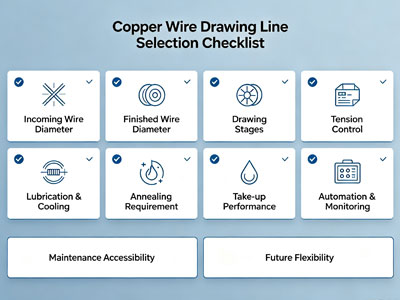
When comparing different wire drawing production line configurations, manufacturers should use the same technical requirements for each option. Compare incoming wire size, finished diameter, number of drawing stages, production speed, tension control, lubrication, cooling, annealing, inspection, take-up, automation, maintenance, and factory space.
It is also useful to evaluate expected production conditions rather than theoretical specifications. The selected line should be capable of maintaining stable copper wire quality during normal continuous operation.
Manufacturers should consider the complete operating cost as well. Die consumption, energy use, lubricant consumption, maintenance, labor, downtime, and material waste can all influence the long-term value of a wire drawing production line.
The quality produced by a wire drawing production line affects many downstream processes. Drawn copper wire may continue to stranding, insulation extrusion, enameling, cabling, winding, or other conductor processing operations.
Consistent diameter helps downstream equipment maintain stable tension and material positioning. A clean and smooth surface can also reduce problems during insulation or coating processes.
For this reason, manufacturers should view the wire drawing production line as the foundation of copper wire manufacturing rather than an isolated piece of equipment.
Before selecting a wire drawing production line for copper wire, manufacturers can review the following points:
What is the incoming copper wire diameter?
What is the required finished wire diameter?
What copper material specification will be processed?
What production output is required?
How many drawing stages are needed?
What drawing speed is suitable for continuous operation?
What type of lubrication and cooling is required?
Is continuous annealing necessary?
What level of tension control is required?
Is online diameter monitoring needed?
What take-up spool or coil configuration is required?
What level of automation is appropriate?
How much factory space is available?
What maintenance access is required?
What future copper wire products may be produced?
Choosing the correct wire drawing production line is only the first step. After installation, manufacturers should establish standardized operating parameters for different copper wire specifications.
Operators should monitor wire tension, drawing speed, die condition, lubricant condition, cooling performance, diameter, surface quality, and take-up tension. Production data should be recorded so that stable settings can be repeated.
Preventive maintenance should be performed according to actual operating conditions. Replacing worn dies and guides before they create quality problems can help maintain stable copper wire production.
Training operators is also important. Even a highly automated wire drawing production line requires people who understand how material condition, tension, lubrication, cooling, and drawing speed interact.
A complete wire drawing production line provides coordinated control from material pay-off to finished copper wire take-up. This integrated approach can reduce unnecessary material handling and improve production continuity.
When pay-off, drawing, tension, lubrication, cooling, annealing, inspection, and take-up are properly matched, the production line can maintain more stable operating conditions. This can improve product consistency while reducing waste and unplanned downtime.
The most suitable wire drawing production line is therefore not necessarily the one with the highest nominal speed. It is the line that matches the actual copper wire specification, production volume, quality requirements, factory conditions, and future manufacturing plans.
Choosing a wire drawing production line for copper wire requires careful evaluation of the entire manufacturing process. Incoming wire diameter, finished diameter, drawing stages, production speed, die configuration, tension control, lubrication, cooling, annealing, inspection, automation, and take-up performance all influence the final result.
A properly selected wire drawing production line can provide stable copper wire dimensions, consistent surface quality, efficient material processing, and reliable continuous production. It can also create better conditions for downstream operations such as stranding, extrusion, enameling, cabling, and conductor assembly.
Manufacturers should avoid selecting equipment based on one specification alone. A complete technical evaluation should consider both current production requirements and future product development. By matching the wire drawing production line to copper wire characteristics and actual manufacturing conditions, manufacturers can build a more stable, efficient, and flexible copper wire production process.
SEO Description: Learn how to choose a wire drawing production line for copper wire based on incoming diameter, finished size, drawing stages, production speed, tension control, lubrication, cooling, annealing, automation, inspection, and take-up requirements. Discover practical selection factors that support stable copper wire quality, efficient production, reduced waste, and reliable downstream processing.
This website uses cookies to ensure you get the best experience on our website.


 Pусский
 中文
中文



 WhatsApp
 Phone
Phone
Comment
(0)