

Rewinding Machine for Wire and Cable: Applications and Benefits
A rewinding machine for wire and cable is an important piece of equipment used to transfer, organize, measure, and wind wire or cable onto reels, spools, or other suitable winding containers. In Modern Cable Manufacturing, a rewinding machine helps maintain stable tension, consistent winding layers, accurate cable length, and efficient material handling. A properly configured rewinding machine can also reduce manual handling, prevent tangling, protect cable surfaces, and improve Production Efficiency. Because different wire and cable products have different diaMeters, materials, weights, lengths, and winding requirements, selecting the right rewinding machine is important for stable production and reliable finished-product handling.
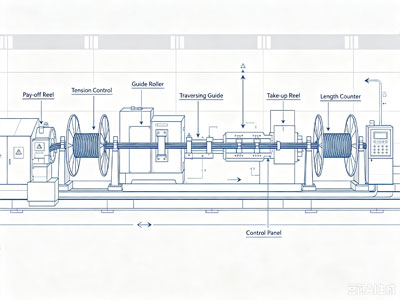
A rewinding machine is designed to take wire or cable from an existing reel, coil, or Production Line and wind it onto another reel or spool in a controlled manner. The rewinding machine normally combines a pay-off system, tension control system, guiding mechanism, winding shaft, traverse system, drive system, and control unit.
During operation, the wire or cable is continuously supplied from the source reel. The rewinding machine controls the feeding speed and material tension while guiding the product evenly across the receiving spool. The winding speed is coordinated with the traverse movement so that the finished spool has stable and orderly layers.
This process is especially important when finished wire or cable needs to be transferred into a different reel size, divided into specified lengths, prepared for storage, or delivered to another production stage. A rewinding machine can therefore function as both a production support system and a finished-product handling system.
The basic working principle of a rewinding machine is straightforward, but stable operation depends on accurate control of several parameters. First, the original wire or cable is installed on the pay-off side. The material then passes through guide rollers and a tension control system before reaching the winding spool.
The winding motor rotates the receiving spool at a controlled speed. At the same time, the traverse mechanism moves the wire or cable from side to side so that the material is distributed evenly across the spool width. As the winding diameter increases, the control system adjusts the winding speed to maintain suitable line speed and winding tension.
A modern rewinding machine may also include Length Measurement, automatic stopping, tension monitoring, speed adjustment, fault detection, and programmable operating parameters. These functions make the rewinding machine suitable for continuous industrial production and different wire and cable specifications.
The pay-off system supplies wire or cable to the rewinding machine. It must provide smooth and stable material release without sudden tension changes. A properly designed pay-off system helps prevent twisting, tangling, excessive pulling force, and material deformation.
Tension control is one of the most important functions of a rewinding machine. Excessive tension can stretch, deform, or damage wire and cable, while insufficient tension can create loose or uneven winding layers. A stable tension control system helps maintain consistent winding quality as the spool diameter changes.
The guide system directs the wire or cable toward the winding spool. The traverse system moves the material across the spool width to create orderly layers. Accurate traverse control is essential for preventing overlapping, gaps, loose edges, and irregular winding patterns.
The winding drive provides rotational power to the receiving spool. The drive system must provide smooth acceleration, stable operating speed, and appropriate torque for the cable size and spool load. Variable-speed control allows the rewinding machine to accommodate different production requirements.
The control system coordinates winding speed, tension, traverse movement, length measurement, and safety functions. Depending on the configuration, operators may adjust winding parameters through a control panel and store settings for different wire and cable products.
A rewinding machine has a wide range of applications in wire and cable manufacturing. Its main purpose is to reorganize wire or cable into a suitable winding format while maintaining controlled tension and stable product handling.
In wire manufacturing, a rewinding machine can transfer wire from production reels to smaller or larger reels according to downstream requirements. It can also help prepare wire for inspection, packaging, storage, or subsequent processing.
Cable manufacturing is one of the most common applications of a rewinding machine. Finished cable can be rewound into specified reel lengths, transferred between spool types, or prepared for shipment. Stable winding helps protect the outer surface of cable and makes later cable handling easier.
Electronic wires often require careful tension and winding control because smaller wire diameters can be more sensitive to mechanical stress. A suitable rewinding machine can provide controlled feeding and orderly winding for different electronic wire products.
Communication cable production also benefits from controlled rewinding. Proper tension and smooth guiding help reduce unnecessary bending and mechanical stress while producing compact, organized cable reels for storage or further processing.
Automotive wire and cable products may require accurate length control and consistent winding. A rewinding machine can help prepare wires for subsequent assembly, cutting, bundling, or storage while reducing manual handling.
Large and heavy power cables require a robust rewinding machine with sufficient winding torque, stable tension control, and suitable reel capacity. Proper equipment selection is particularly important when handling long cable lengths and heavy winding loads.
A rewinding machine creates more consistent and orderly cable layers than manual winding. Controlled traverse movement and stable tension help produce compact reels with fewer gaps, overlaps, and irregular sections.
Consistent tension is essential for maintaining wire and Cable Quality during rewinding. A rewinding machine can regulate tension throughout the winding process, helping prevent loose winding, excessive compression, stretching, and surface damage.
Manual rewinding requires considerable operator effort and can become inefficient when handling long lengths of wire or cable. A rewinding machine automates the winding process, allowing continuous operation and reducing repetitive manual work.
A rewinding machine can transfer cable directly from one reel to another, reducing unnecessary handling between production stages. Less manual movement can help lower the risk of cable damage and improve overall workflow efficiency.
Many rewinding systems can incorporate length measurement functions. This allows operators to prepare reels according to specified cable lengths, helping standardize finished products and simplify downstream packaging or installation.
Uneven manual winding can result in crossed layers, loose loops, and tangling. A rewinding machine guides the material systematically onto the spool, helping maintain an organized winding structure and reducing unnecessary mechanical stress.
Different cable products may require different reel sizes and winding capacities. A flexible rewinding machine can be configured for different spool dimensions, winding widths, cable diameters, and production lengths.
Tension is one of the most important factors affecting rewinding quality. If tension is too high, the wire or cable may experience excessive mechanical stress. Fine wires can be stretched, while cable insulation may be compressed or damaged. If tension is too low, the winding layers may become loose and unstable.
A good rewinding machine continuously manages material tension according to production conditions. As the receiving spool becomes larger, the winding diameter changes. The rewinding machine must therefore coordinate rotational speed and tension to maintain stable material handling throughout the complete winding cycle.
Stable tension also improves spool appearance. Even tension helps create compact layers and consistent edges, making the finished reel easier to transport, store, and use.
Winding speed directly affects production capacity, but higher speed does not always mean better performance. If the rewinding machine operates too quickly without sufficient tension and guiding control, wire or cable may move unpredictably, resulting in uneven layers or material damage.
The ideal winding speed depends on wire diameter, cable structure, material characteristics, reel dimensions, required tension, and production requirements. A suitable rewinding machine should provide adjustable speed control so operators can establish stable operating conditions for different products.
Speed control is especially important during acceleration and deceleration. Smooth changes help prevent sudden tension fluctuations and reduce the risk of cable movement or winding defects.
The receiving spool must match the wire and cable being processed. Important considerations include spool diameter, winding width, core diameter, flange size, maximum load, and material compatibility. If the spool is not suitable, even a well-designed rewinding machine may produce poor winding results.
The spool should rotate smoothly and remain properly aligned during operation. Excessive runout or mechanical looseness can cause uneven winding and increase tension variation. For this reason, spool condition should be included in routine production checks.
Rewinding machines can be configured with different levels of automation. Semi-automatic systems require operators to perform certain setup and spool-changing tasks, while automatic systems can integrate more functions such as programmed winding, length measurement, tension control, automatic stopping, and production monitoring.
The appropriate automation level depends on production volume, product variety, labor requirements, available floor space, and desired workflow. High-volume wire and cable production generally benefits from greater automation, while smaller operations may prefer a simpler rewinding machine that provides flexibility and straightforward operation.
Selecting the right rewinding machine should begin with the actual wire and cable specifications rather than machine speed alone. The first consideration is the product diameter. Different wire and cable diameters require different guiding, tension, and winding configurations.
The second consideration is the required reel size. The machine should be capable of supporting the intended spool diameter, spool width, core dimensions, and maximum winding weight.
Production speed is another important factor. Manufacturers should determine the required line speed and daily production volume before selecting a rewinding machine. The machine should provide sufficient capacity without sacrificing winding stability.
Tension control should also receive close attention. Fine electronic wires may require delicate tension management, while large cables may require higher winding torque and stronger mechanical structures.
Other factors include length measurement accuracy, traverse control, automation level, changeover time, operator interface, maintenance requirements, safety functions, and compatibility with upstream and downstream equipment.
Small-diameter wire requires careful handling because excessive tension or aggressive guiding can damage the product. A rewinding machine used for fine wire should therefore provide sensitive tension adjustment and smooth material guidance.
Medium-sized cables usually require balanced winding speed, stable traverse movement, and reliable spool handling. These products often benefit from flexible winding parameters that can be adjusted for different cable constructions.
Large cables require stronger mechanical structures, higher torque, and suitable reel capacity. The rewinding machine must be able to handle the weight of the cable while maintaining stable rotation and controlled tension.
Uneven winding can result from incorrect traverse settings, unstable tension, spool misalignment, or inconsistent feeding. Checking the guide path, tension settings, and spool condition can help identify the cause.
Loose layers usually indicate insufficient winding tension or unstable feeding. Adjusting the tension control system and checking the pay-off operation can improve winding stability.
Excessive tension may result from incorrect control settings, mechanical resistance, or poor coordination between the pay-off and winding systems. Excessive tension should be corrected before it affects product quality.
Tangling may occur when the guide path is incorrect, winding layers become disordered, or the pay-off system releases material unevenly. A stable guiding and traverse system helps reduce these problems.
Regular maintenance is necessary to keep a rewinding machine operating reliably. Operators should inspect guide rollers, bearings, winding shafts, tension components, drive mechanisms, sensors, and electrical connections at appropriate intervals.
Moving components should be maintained according to equipment requirements. Guide surfaces should remain clean and free from contamination that could scratch wire or cable. Spool holders and mechanical fastening components should also be checked for looseness.
Control parameters should be reviewed when product specifications change. Preventive maintenance helps identify mechanical wear before it causes production interruptions or winding defects.
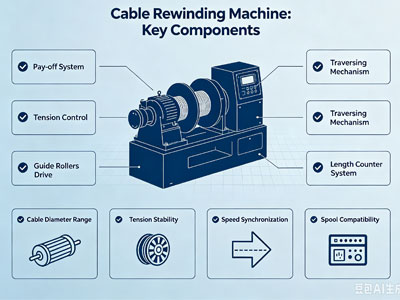
A rewinding machine can operate as an independent unit or as part of a complete wire and Cable Production Line. When integrated with extrusion, stranding, drawing, testing, measuring, or packaging equipment, the rewinding machine becomes an important link between production and finished-product handling.
Synchronization between upstream equipment and the rewinding machine is important for maintaining stable line speed and tension. Proper integration can reduce manual transfers, improve material flow, and simplify production management.
Efficiency can be improved by selecting appropriate winding parameters, maintaining stable tension, reducing unnecessary spool changes, and keeping the material path clean and properly aligned. Operators should also use consistent setup procedures for recurring products.
Reducing changeover time is another practical way to improve efficiency. Clearly defined spool specifications, stored operating parameters, and organized production planning can make product changes faster and more consistent.
Regular equipment maintenance also supports efficiency. A rewinding machine with worn bearings, unstable guides, or inaccurate sensors may continue operating but produce inconsistent results and require more frequent adjustments.
The rewinding stage may appear simple compared with drawing, extrusion, or stranding, but it directly affects finished-product handling and presentation. Poor rewinding can create unnecessary tension, tangling, surface damage, unstable reels, and additional manual work.
A properly selected rewinding machine helps connect manufacturing efficiency with finished-product quality. By controlling tension, winding speed, traverse movement, reel rotation, and material length, the rewinding machine provides a more stable and repeatable final handling process.
A rewinding machine for wire and cable is an important solution for controlled cable handling, spool transfer, length management, and organized winding. Its applications cover wire manufacturing, cable manufacturing, electronic wire production, communication cable production, automotive wire production, and power cable processing.
The main benefits of a rewinding machine include stable tension control, improved winding quality, higher production efficiency, reduced manual handling, better cable protection, accurate length management, and flexible spool handling. When choosing a rewinding machine, manufacturers should evaluate wire and cable size, spool specifications, production speed, winding tension, automation requirements, maintenance, and compatibility with the complete production line.
With suitable equipment configuration and proper operating practices, a rewinding machine can provide stable winding performance and support efficient wire and cable production from the manufacturing stage through finished-product storage and delivery.
SEO Description: A rewinding machine for wire and cable provides controlled winding, stable tension, accurate length management, and organized spool handling. Explore rewinding machine applications and benefits for wire manufacturing, cable production, electronic wire, communication cable, automotive wire, and power cable processing while improving winding quality, production efficiency, material handling, and cable protection.
This website uses cookies to ensure you get the best experience on our website.


 Pусский
 中文
中文



 WhatsApp
 Phone
Phone
Comment
(0)