

What Is a Rewinding Machine and How Does It Improve Cable Production?
A rewinding machine is an important piece of equipment used in modern wire and cable manufacturing to transfer cable from one reel or spool to another while maintaining controlled tension, stable speed, accurate guiding, and orderly winding. A rewinding machine can improve cable production by reducing manual handling, improving winding consistency, controlling cable tension, supporting accurate length management, and preparing finished cable for storage, transportation, or further processing.
In cable production, the final handling stage is just as important as earlier processes such as Wire Drawing, stranding, insulation extrusion, and sheathing. If cable is poorly wound, even a well-manufactured product can become difficult to store, transport, or use. A properly selected rewinding machine creates a controlled winding process that helps maintain product quality while improving overall Production Efficiency.
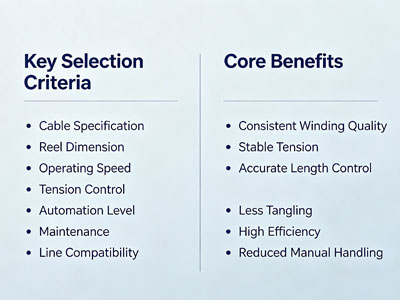
A rewinding machine is equipment designed to unwind wire or cable from a source reel and wind it onto a receiving reel, spool, drum, or coil. The rewinding machine controls the movement of the cable during this transfer process. Depending on the application, it can also measure cable length, control winding tension, adjust winding speed, guide cable position, and stop automatically after a preset length or winding condition is reached.
The basic structure of a rewinding machine normally includes a pay-off unit, guide rollers, tension control system, measuring system, winding shaft, traverse mechanism, drive motor, control system, and safety protection. These components work together to create a stable winding process.
The main purpose of a rewinding machine is not simply to transfer cable from one reel to another. The rewinding machine must keep the cable organized, prevent excessive tension, maintain consistent winding layers, and protect the cable from unnecessary mechanical stress.
The working process of a rewinding machine begins when a source reel containing wire or cable is installed on the pay-off side. The cable is then guided through rollers and tension-control components before reaching the receiving reel.
The winding motor rotates the receiving reel while the traverse system moves the cable across the reel width. This coordinated movement allows the cable to form orderly layers. As the winding diaMeter increases, the control system adjusts the winding conditions to maintain suitable line speed and tension.
A modern rewinding machine may use sensors to monitor cable position, winding speed, reel rotation, cable length, and tension. When the preset length is reached, the machine can stop automatically. This reduces operator workload and helps standardize finished cable reels.
The exact configuration depends on cable diameter, cable construction, reel size, winding speed, production capacity, and required automation level. Fine wire, communication cable, automotive wire, industrial cable, and large power cable may all require different rewinding machine configurations.
The pay-off unit supplies cable to the rewinding machine. Smooth material release is important because sudden changes in cable tension can affect winding quality. The pay-off unit should match the reel dimensions and weight of the cable being processed.
Tension control is one of the most important functions of a rewinding machine. Stable tension helps prevent loose winding, excessive compression, cable stretching, and surface damage. Tension requirements vary according to cable diameter, construction, insulation material, and winding speed.
Guide rollers control the cable path between the pay-off and receiving reel. Their position and surface condition can influence cable movement and winding stability. Smooth and properly aligned guide rollers help reduce friction and prevent unnecessary surface marks.
The traverse system distributes the cable across the width of the receiving reel. Controlled traverse movement is essential for creating even layers and preventing excessive accumulation at one position.
The winding drive provides rotational power to the receiving reel. A suitable drive system should provide stable speed, sufficient torque, smooth acceleration, and controlled deceleration. Variable-speed operation is particularly useful when handling different cable sizes.
The control system coordinates winding speed, cable tension, traverse movement, Length Measurement, and stopping functions. A well-designed control system allows operators to adjust production parameters and repeat stable settings for different cable products.
A rewinding machine improves cable production by making the final winding process more controlled, repeatable, and efficient. Instead of relying on manual winding, the machine coordinates cable feeding, tension, reel rotation, and cable distribution.
A rewinding machine can create uniform cable layers across the receiving reel. Controlled traverse movement helps prevent random overlaps, large gaps, loose loops, and irregular edges. Consistent winding makes the finished reel easier to store and handle.
Uniform winding is particularly important when cable will later be installed using automated or semi-automated equipment. An orderly reel allows cable to unwind more smoothly and reduces the possibility of tangling.
Cable tension directly affects the quality of rewinding. Excessive tension can stretch fine wire, compress insulation, deform cable structures, or create unnecessary mechanical stress. Insufficient tension can produce loose and unstable layers.
A rewinding machine provides controlled tension throughout the winding cycle. This helps maintain stable cable handling as the receiving reel gradually increases in diameter.
Manual cable winding requires continuous operator involvement and can become slow when processing long cable lengths. A rewinding machine automates the main winding operation, allowing operators to focus on setup, inspection, reel changes, and other production tasks.
Higher automation can reduce repetitive labor and help maintain a more consistent production rhythm. In high-volume cable production, these improvements can have a significant effect on overall output.
Many rewinding machines can integrate length measurement systems. The machine can monitor the amount of cable transferred and stop when the required length is reached.
Accurate length control is useful when finished cable must be supplied in standard reel lengths. It reduces the need for additional manual measurement and makes production planning easier.
Improper winding can create crossing layers, loose loops, and tangled cable. These problems increase handling time and may damage the cable during later use.
A rewinding machine guides the cable through a controlled path and distributes it evenly across the reel. This creates a more organized winding structure and reduces the possibility of tangling.
Manual transfer between cable reels requires physical handling and additional production time. A rewinding machine can complete the transfer continuously while maintaining controlled winding conditions.
Reducing manual handling also lowers the risk of accidental cable damage caused by dragging, dropping, bending, or uncontrolled pulling.
The finished reel is often the form in which cable is stored, transported, or delivered. A clean and stable winding structure improves reel appearance and makes subsequent cable handling easier.
A rewinding machine therefore contributes to finished-product consistency even though the machine operates after the primary cable manufacturing processes have been completed.
Cable tension is one of the key factors determining rewinding quality. The ideal tension depends on the cable construction and mechanical characteristics. Fine electronic wires require careful tension control, while heavy industrial and power cables require stronger winding torque and mechanical support.
During the winding process, the receiving reel becomes progressively larger. If rotational speed is not adjusted appropriately, cable tension can change. A suitable rewinding machine coordinates reel speed and cable movement to maintain stable winding conditions.
Stable tension also helps protect cable insulation. Excessive mechanical force can cause surface deformation, while unstable tension may result in uneven layers. Proper tension control therefore supports both winding quality and cable protection.
Production speed is an important consideration when selecting a rewinding machine, but maximum speed should not be the only selection criterion. A machine operating at very high speed may produce unstable winding if tension control, guiding, or traverse movement cannot keep up.
The appropriate winding speed depends on cable diameter, cable construction, reel size, cable weight, required winding tension, and production objectives. A good rewinding machine should provide adjustable speed so that manufacturers can balance output and winding quality.
Smooth acceleration and deceleration are also important. Sudden changes in speed can create tension fluctuations and cable movement. Controlled speed changes help maintain stable production.
Electronic wire is often relatively small in diameter and can be sensitive to mechanical stress. A rewinding machine with precise tension control can transfer electronic wire onto suitable reels while reducing unnecessary pulling force.
Communication cable requires careful handling to maintain its physical structure. A rewinding machine provides controlled winding and helps organize cable for storage, transportation, and later installation.
Automotive Wire Production often involves large quantities of wire and frequent handling requirements. A rewinding machine can prepare wire into standardized reels or lengths for subsequent processing and assembly.
Industrial cables can vary significantly in diameter, weight, and construction. A suitable rewinding machine can provide the required winding torque and tension control for different cable specifications.
Large power cables require heavy-duty winding equipment. A rewinding machine used for power cable should have sufficient reel capacity, mechanical strength, winding torque, and stable cable guidance.
Flexible cables often require orderly winding to prevent unnecessary bending and tangling. Controlled winding helps maintain a suitable reel structure and simplifies later cable handling.
Reel selection directly affects rewinding performance. The receiving reel must be compatible with cable diameter, cable length, winding width, core diameter, flange dimensions, and total cable weight.
A rewinding machine should provide sufficient adjustment range to accommodate the intended reel sizes. If the reel is too small, excessive bending may occur. If the reel is too large for the production requirement, unnecessary storage space may be consumed.
Proper reel alignment is also important. A reel with excessive runout can create uneven winding and tension fluctuations. Regular inspection of reel condition should therefore be included in production management.
Manual winding provides flexibility but depends heavily on operator experience. It can be difficult to maintain consistent tension and winding layers over long cable lengths. Manual winding also requires more labor and can create greater variation between finished reels.
An automatic or semi-automatic rewinding machine provides more consistent control of winding speed, cable tension, traverse movement, and cable length. Automation is especially valuable for repetitive production tasks and high-volume cable manufacturing.
The appropriate automation level depends on production volume, cable variety, labor availability, reel specifications, and factory layout. Not every application requires complete automation, but controlled winding is beneficial for most industrial cable Production Processes.
Uneven winding can result from incorrect traverse settings, unstable tension, poor reel alignment, or inconsistent cable feeding. Checking the material path and winding parameters is an important first step when troubleshooting.
Loose layers may indicate insufficient winding tension or unstable pay-off operation. Adjusting the tension system and checking the cable feeding path can help improve winding stability.
Excessive tension may cause cable deformation or surface damage. It can be related to incorrect settings, mechanical resistance, or poor coordination between the pay-off and winding drive.
Overlapping occurs when traverse movement does not match cable speed or when the guiding system is incorrectly adjusted. Correct synchronization helps distribute cable evenly across the reel.
Tangling may occur when the winding pattern is unstable or the pay-off releases cable irregularly. A stable material path and consistent tension are essential for preventing tangling.
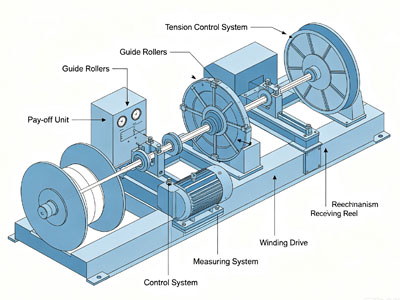
The first step in selecting a rewinding machine is to define the cable specifications. Cable diameter, construction, material, weight, flexibility, and required winding length all influence machine configuration.
The second step is to determine the required reel dimensions. The machine should support the required core diameter, reel width, flange diameter, and maximum winding weight.
The third step is to determine the required production speed. Manufacturers should consider normal operating speed rather than selecting equipment only according to maximum rated speed.
The fourth step is to evaluate tension control. Fine wires require sensitive control, while heavy cables require higher torque and robust mechanical components.
Additional factors include length measurement, traverse accuracy, automation level, product changeover, maintenance requirements, safety functions, factory space, and compatibility with upstream and downstream production equipment.
Regular maintenance helps a rewinding machine maintain stable performance. Guide rollers, bearings, winding shafts, tension components, sensors, drive systems, and electrical connections should be inspected according to operating conditions.
Guide surfaces should remain clean and smooth. Dirt or damaged surfaces can increase friction and potentially affect Cable Quality. Mechanical fasteners should also be checked regularly to prevent looseness and vibration.
Operators should monitor changes in winding quality. Uneven layers, unusual vibration, abnormal noise, or unstable tension can indicate developing mechanical or control problems. Early inspection can prevent small problems from becoming production interruptions.
Several practical measures can improve rewinding machine efficiency. First, use standardized operating parameters for frequently produced cable types. Consistent settings reduce setup time and make production more repeatable.
Second, maintain proper tension throughout the winding process. Stable tension reduces defects and minimizes the need for manual corrections.
Third, optimize reel changes. Preparing empty reels and production information in advance can reduce downtime between winding cycles.
Fourth, maintain the machine regularly. Worn guide rollers, bearings, sensors, and drive components can reduce efficiency even when the machine remains operational.
Finally, integrate the rewinding machine with upstream cable production equipment whenever practical. Coordinated line operation can improve material flow and reduce unnecessary manual transfers.
A rewinding machine can be used as an independent unit or integrated into a complete cable Production Line. In an integrated system, the rewinding machine can receive cable directly from extrusion, stranding, testing, measuring, or other production processes.
Integration can reduce intermediate handling and create a more continuous material flow. The production system can coordinate line speed, cable tension, length measurement, and reel winding conditions.
This approach is particularly useful when production volumes are high or when consistent finished-reel specifications are required. The rewinding machine becomes an important connection between manufacturing and finished-product handling.
A rewinding machine may operate at the final stage of cable production, but its influence on production efficiency is significant. Poor winding can create tangles, loose layers, damaged surfaces, inaccurate lengths, and additional manual work.
A properly configured rewinding machine solves these problems by providing controlled winding conditions. It helps manufacturers standardize finished reels, reduce handling requirements, improve workflow, and maintain consistent cable presentation.
For cable manufacturers producing different cable types, a flexible rewinding machine can also simplify product changes. Adjustable tension, speed, traverse movement, and reel configurations allow the same equipment to support multiple production requirements.
A rewinding machine is an important part of modern cable production because it provides controlled cable transfer, stable tension, orderly winding, accurate length management, and efficient reel handling. A rewinding machine improves cable production by reducing manual work, minimizing tangling, protecting cable surfaces, improving finished-reel consistency, and supporting smoother material flow.
When selecting a rewinding machine, manufacturers should consider cable diameter, cable construction, reel size, winding length, production speed, tension requirements, automation level, maintenance, and integration with the complete cable production line. Proper machine selection and operation can help improve production efficiency while maintaining stable finished-cable quality.
SEO Description: A rewinding machine improves cable production through controlled winding, stable tension, accurate cable length management, orderly reel handling, and reduced manual work. Learn how a rewinding machine supports electronic wire, communication cable, automotive wire, industrial cable, flexible cable, and power cable production while improving winding quality, efficiency, cable protection, and finished-product handling.
This website uses cookies to ensure you get the best experience on our website.


 Pусский
 中文
中文



 WhatsApp
 Phone
Phone
Comment
(0)