


 Pусский
 中文
中文


A stranding machine is an important piece of equipment in Modern Cable Manufacturing. It combines multiple individual wires into a uniform stranded conductor by controlling wire tension, rotation, lay length, and take-up speed. This process improves conductor flexibility, mechanical stability, and consistency, making the stranding machine widely used in power cable, communication cable, automotive wire, electronic wire, and other Cable Production applications.
Understanding how a Stranding Machine Works helps cable manufacturers select suitable equipment, optimize production paraMeters, reduce material waste, and maintain consistent product quality. Although different machine structures are available, the basic working principle remains similar: individual wires are paid off, guided under controlled tension, twisted around a common axis, formed into the required conductor structure, and then collected by a take-up system.
What Is a Stranding Machine?
A stranding machine is a Cable Manufacturing Machine designed to combine several individual wires into one stranded conductor. Instead of using a single solid wire, multiple smaller wires are arranged and twisted together according to a specified pattern and lay length. The resulting conductor can provide improved flexibility and mechanical performance compared with an equivalent solid conductor.
During operation, individual wire reels are installed on the pay-off system of the stranding machine. The wires travel through guide components and enter the stranding area, where controlled rotation creates the required helical arrangement. The finished stranded conductor is then pulled forward and wound onto a take-up reel.
The performance of a stranding machine depends on the coordination of several systems. Pay-off tension, rotational speed, line speed, guide positioning, closing conditions, and take-up speed all influence the final conductor. Precise synchronization is therefore essential for stable cable manufacturing.
How Does a Stranding Machine Work?
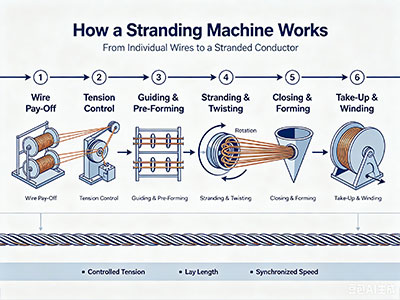
The working principle of a stranding machine is based on controlled rotational movement and synchronized wire feeding. Multiple wires are supplied from individual pay-off positions and guided toward a common closing point. As the machine rotates, the wires are arranged helically around a central axis. At the same time, the take-up system continuously pulls the finished conductor forward.
The basic process can be divided into several stages.
1. Wire Pay-Off
The first stage of the stranding process is wire pay-off. Individual copper, aluminum, alloy, or other suitable wires are loaded onto separate reels or bobbins. Each wire must be released smoothly and continuously to prevent sudden changes in tension.
The pay-off system provides the raw wire needed by the stranding machine. Depending on the machine structure and production requirements, the pay-off arrangement may use different reel sizes, braking systems, or tension control methods.
2. Wire Tension Control
Tension control is one of the most important factors in stable stranding machine operation. All individual wires should enter the stranding area with consistent and properly adjusted tension. Excessive tension can stretch or deform the wire, while insufficient tension may cause loose strands, uneven lay, or conductor instability.
Modern Stranding Machines can use mechanical brakes, Dancer systems, tension sensors, or automated control systems to maintain stable wire feeding. Consistent tension allows each strand to occupy its intended position and helps produce a more uniform conductor.
3. Wire Guiding and Pre-Forming
After leaving the pay-off system, the wires pass through guides and pre-forming components. These components control the position and movement of each wire before the strands reach the closing point.
Proper wire guiding is essential because even small positioning differences can affect conductor geometry. A well-designed stranding machine keeps the individual wires properly aligned during continuous operation and reduces the possibility of crossover, loose strands, or irregular conductor surfaces.
4. Stranding and Twisting
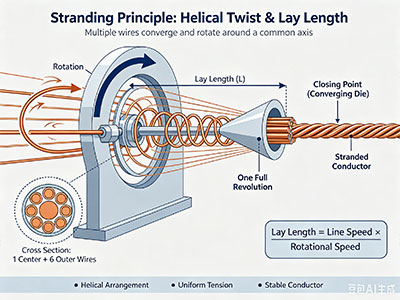
The central operation of a stranding machine is the controlled twisting of individual wires. The machine creates rotational movement around the conductor axis, causing each wire to follow a helical path. Several wires are therefore combined into a single stranded structure.
The number of wires, wire diameter, rotation direction, and lay length determine the final structure. Different cable products require different stranding configurations, so the machine must be adjusted according to the conductor design and production requirements.
5. Lay Length Control
Lay length describes the axial distance required for an individual strand to complete one full revolution around the conductor. It is a key parameter in stranding machine operation because it affects conductor geometry, flexibility, and production characteristics.
Lay length is determined by the relationship between rotational speed and linear production speed. If the relationship changes, the stranding pitch also changes. Therefore, the rotation system and take-up system need to operate in a coordinated manner.
Accurate lay length control helps maintain consistent conductor structure throughout a production run. For cable manufacturers, stable lay length is particularly important when producing conductors that must meet defined dimensional and electrical requirements.
6. Closing and Forming
After the wires are twisted together, they pass through a closing or forming area. This stage brings the individual strands together and helps establish the required conductor shape.
Depending on the product design, the finished conductor may have a round, compact, or other specified cross-section. The closing system should be properly matched to the wire size, number of strands, and required conductor dimensions.
7. Take-Up and Winding
Once the conductor has been formed, the take-up system continuously pulls the stranded product through the Production Line and winds it onto a reel. The take-up speed must remain synchronized with the stranding speed to maintain consistent production.
A stable winding system prevents excessive overlap, loose winding, and irregular reel formation. Good take-up control also makes subsequent cable manufacturing processes easier because the stranded conductor can be transferred and processed efficiently.
Why Is a Stranding Machine Important in Cable Manufacturing?
A stranding machine plays an important role because the conductor structure directly influences the performance of the finished cable. By combining multiple wires into a controlled stranded structure, manufacturers can produce conductors with useful flexibility and stable mechanical characteristics.
Stranded conductors are commonly used where flexibility, repeated bending, installation convenience, or specific conductor construction is required. They can be found in power cables, control cables, electronic wires, automotive wiring, communication cables, charging cables, and other cable products.
For high-volume cable manufacturing, production consistency is equally important. A properly configured stranding machine can continuously process large quantities of wire while maintaining controlled tension, stable lay length, and consistent conductor dimensions.
Main Types of Stranding Machines
Different cable manufacturing applications require different stranding machine structures. The most suitable machine depends on conductor size, wire material, production speed, required lay accuracy, and finished cable specifications.
Rigid Frame Stranding Machine
A rigid frame stranding machine uses rotating cages or frames carrying multiple wire bobbins. It is commonly used for medium and larger conductor applications where robust construction and stable stranding performance are important.
Planetary Stranding Machine
A planetary stranding machine uses a planetary arrangement of wire carriers. Its structure can provide controlled wire movement and is suitable for applications requiring stable conductor formation and precise stranding characteristics.
Tubular Stranding Machine
A tubular stranding machine uses rotating tubes or similar structures to guide the wire during production. This type of stranding machine is commonly considered for larger conductor applications and cable manufacturing processes requiring stable continuous operation.
Bow Stranding Machine
A bow stranding machine uses rotating bows to create the required twisting motion. Its configuration can support high-speed production and is often used in applications involving smaller wires and flexible cable products.
Key Factors Affecting Stranding Machine Performance
Several factors determine how effectively a stranding machine performs during cable manufacturing. Understanding these factors can help manufacturers establish suitable operating conditions and reduce common production problems.
Wire Diameter
Wire diameter affects the required machine configuration, tension settings, closing conditions, and final conductor dimensions. A stranding machine should be selected according to the range of wire sizes used in production.
Number of Strands
The number of individual wires determines the conductor structure and influences the required pay-off configuration. More strands generally require more carefully coordinated wire guiding and tension control.
Wire Material
Copper and aluminum have different mechanical characteristics, so operating parameters should be adjusted according to the material being processed. Material properties influence tension, deformation, handling, and conductor formation.
Stranding Speed
Production speed directly affects output capacity. However, increasing speed without maintaining stable tension and synchronization can create quality problems. A high-performance stranding machine should balance production speed with conductor consistency.
Tension Stability
Uneven wire tension can lead to irregular strand positioning, loose wires, conductor deformation, or surface defects. Stable tension is therefore essential for maintaining uniform production quality.
Lay Direction and Lay Length
The lay direction and lay length must match the conductor specification. Incorrect settings can change the finished conductor structure and affect downstream cable processing.
How to Improve Stranding Machine Production Efficiency
Improving production efficiency is not simply a matter of increasing machine speed. A more practical approach is to optimize the complete stranding process, including wire preparation, tension control, machine settings, maintenance, and take-up operation.
First, manufacturers should select wire reels and raw materials that are consistent in size and quality. Stable input materials make it easier for the stranding machine to maintain uniform operation.
Second, tension parameters should be checked regularly. Operators should pay attention to abnormal tension changes, wire vibration, and irregular strand formation. Early adjustment can prevent larger quality problems during continuous production.
Third, the relationship between rotational speed and line speed should be maintained accurately. Stable synchronization helps keep the lay length consistent throughout the Production Process.
Finally, regular inspection and maintenance are important. Bearings, guides, tension components, drive systems, electrical controls, and take-up mechanisms should be checked according to the machine's operating conditions and maintenance requirements.
Common Stranding Machine Problems
Even a well-designed stranding machine can experience production problems if operating parameters are not properly adjusted. Common issues include uneven lay, loose strands, wire breakage, conductor diameter variation, irregular winding, and excessive vibration.
Uneven lay is often associated with unstable tension or incorrect speed synchronization. Loose strands may result from insufficient tension or improper forming conditions. Wire breakage can be related to excessive tension, damaged wire surfaces, unsuitable guides, or incorrect machine settings.
When a problem occurs, operators should examine the complete production process rather than adjusting only one parameter. Checking wire quality, pay-off tension, guide alignment, rotational speed, take-up speed, and closing conditions can help identify the actual cause.
How to Choose a Stranding Machine
Choosing the right stranding machine begins with understanding the cable products that will be manufactured. Important considerations include wire material, conductor diameter, number of strands, target production speed, lay length, reel dimensions, and required conductor structure.
Manufacturers should also consider future production requirements. A machine designed only around current products may limit production flexibility later. Selecting equipment with an appropriate operating range can provide greater adaptability when product specifications change.
Automation and control functions are also worth considering. Stable speed control, tension management, monitoring functions, and coordinated take-up operation can simplify production and improve process consistency.
Machine construction and maintenance requirements should also be evaluated. Easy access to key components can reduce maintenance time, while a stable mechanical structure can support long-term continuous operation.
Stranding Machine Applications
Stranding machines are used across a wide range of cable manufacturing applications. In power cable production, they are used to form stranded conductors from copper or aluminum wires. In automotive Wire Production, they can process fine conductors that require flexibility and consistent construction.
Electronic wire and communication cable production can also require precise stranding processes. Other applications include control cables, charging cables, photovoltaic cables, industrial cables, and various flexible wire products.
The specific machine configuration should always be matched to the product structure. Different applications may require different wire sizes, strand counts, production speeds, tension conditions, and take-up arrangements.
Conclusion
A stranding machine works by combining multiple individual wires through controlled feeding, tension regulation, rotational movement, forming, and take-up. Although the basic principle is straightforward, achieving stable cable manufacturing requires accurate control of several interconnected production parameters.
Wire tension, lay length, rotational speed, line speed, conductor geometry, and take-up performance all influence the final result. When these factors are properly coordinated, a stranding machine can provide consistent conductor formation and reliable production efficiency.
For cable manufacturers, understanding the working principle of a stranding machine is an important step toward improving production processes and selecting suitable equipment. By matching machine configuration with conductor requirements and maintaining stable operating conditions, manufacturers can build a more efficient and consistent cable manufacturing process.



 WhatsApp
 Phone
Phone
Comment
(0)