

What Are the Advantages of a Vertical Cage Strander?
A vertical Cage Strander is an important piece of equipment for modern wire and cable manufacturing. By using a Vertical Cage structure to organize, guide, and strand multiple wires or cable components, a vertical cage strander can provide stable production performance, controlled tension, consistent lay formation, and efficient use of factory space. For manufacturers handling larger cable constructions or continuous production requirements, understanding the advantages of a vertical cage strander is essential when selecting suitable stranding equipment.
A vertical cage strander is designed around a vertically arranged rotating cage. During operation, individual wires or cable components are supplied from pay-off positions, guided through the stranding system, and combined into a controlled cable structure. The vertical arrangement changes the equipment layout compared with conventional horizontal configurations and can provide practical benefits in production organization, material handling, and equipment installation.
A vertical cage strander is a Stranding Machine that uses a vertically oriented cage to rotate and guide multiple wires or cable elements around a common axis. The cage provides controlled movement while the individual wires are fed through dedicated guiding and tensioning components. The combined wires then pass through forming, closing, hauling, and take-up sections to create the required stranded product.
The basic purpose of a vertical cage strander is to maintain controlled relative movement between individual wires while producing a stable lay structure. Depending on the machine configuration, the equipment can be adapted to different cable sizes, wire arrangements, strand constructions, and production requirements.
The main advantages of a vertical cage strander come from its structural design and its ability to coordinate multiple production functions. Space utilization, tension control, stable operation, production flexibility, and consistent stranding quality are among the most important factors to consider.
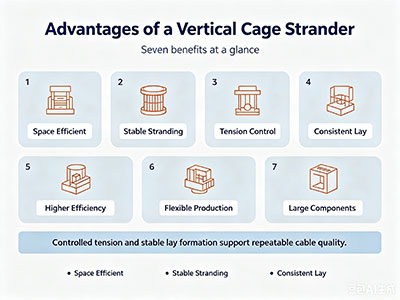
One of the most noticeable advantages of a vertical cage strander is efficient use of factory floor space. A vertical configuration uses the height of the production area rather than relying entirely on a long horizontal arrangement. This can help manufacturers organize equipment more efficiently when available floor space is limited.
A vertical cage strander can also simplify production planning because the main stranding structure occupies a defined area while material movement is organized around the vertical cage. For factories expanding production capacity without significantly increasing floor area, this structural advantage can be particularly useful.
Stable stranding performance is another important advantage of a vertical cage strander. During Cable Production, wires must follow controlled paths while maintaining appropriate tension and rotational movement. The cage structure provides a stable mechanical framework for guiding these components through the stranding process.
When the cage rotates smoothly and the wire tension remains consistent, the resulting strand can achieve more uniform lay formation. A vertical cage strander therefore helps manufacturers maintain repeatable production conditions and reduce variations caused by unstable feeding or inconsistent mechanical movement.
Wire tension directly affects the quality of stranded cable. Excessive tension may cause wire deformation, surface damage, or unnecessary material stress, while insufficient tension can lead to loose strands, uneven lay formation, and unstable cable geometry.
A vertical cage strander can integrate controlled pay-off and tensioning systems to manage individual wires before they enter the central stranding area. Proper tension control allows each wire to follow its intended path and helps maintain a more uniform strand structure.
For manufacturers producing cables with strict dimensional requirements, the tension control capability of a vertical cage strander can contribute significantly to stable production quality.
Lay length is a critical paraMeter in cable stranding. It determines how far a wire travels along the cable axis during one complete rotation around the cable center. Variations in lay length can affect cable flexibility, diameter, mechanical behavior, and downstream processing performance.
A vertical cage strander can maintain controlled rotational speed and synchronized material movement to achieve consistent lay formation. When the cage speed, haul-off speed, and wire tension are properly coordinated, the vertical cage strander can produce a more stable lay length throughout continuous production.
This consistency is particularly useful when the finished cable must meet defined construction specifications and dimensional tolerances.
Production efficiency is another major reason manufacturers consider a vertical cage strander. Efficient wire feeding, synchronized cage rotation, controlled haul-off, and automated take-up can reduce unnecessary interruptions during cable production.
A properly configured vertical cage strander allows several production functions to operate as one coordinated system. Operators can monitor key parameters, adjust production settings, and maintain stable operation without constantly making manual corrections.
When combined with appropriate upstream and downstream equipment, a vertical cage strander can support continuous production and improve overall manufacturing efficiency.
A vertical cage strander can be configured for different cable constructions depending on the number of wires, conductor size, cable diameter, required lay length, and production speed. This flexibility allows one production system to support multiple product specifications when the equipment is properly designed.
For manufacturers producing several cable types, production flexibility can reduce the need for completely separate equipment systems. A vertical cage strander with suitable pay-off, guiding, forming, and take-up arrangements can be adjusted according to the production requirements of different products.
Another advantage of a vertical cage strander is its suitability for applications involving larger cable components. The vertical structure can provide a practical arrangement for handling heavier or larger-diameter wires and cable elements while keeping the main production system organized.
Large cable manufacturing requires careful control of material movement because heavier components can increase mechanical loads and affect equipment stability. A properly designed vertical cage strander provides structural support for the rotating cage, pay-off system, guiding components, and downstream forming equipment.
The working process of a vertical cage strander begins with wire or cable components being loaded onto pay-off positions. Each component is supplied toward the central production path through guiding and tension-control devices. The vertical cage rotates around the production axis while the individual components follow controlled paths.
As the cage rotates, the wires gradually form the required stranded structure. The cable then passes through a closing or forming section, where its geometry can be stabilized before entering the haul-off and take-up systems.
The vertical cage strander must coordinate cage rotation, wire feeding, tension, haul-off speed, and take-up speed. If these parameters remain synchronized, the machine can maintain stable production conditions over long production runs.
Tension control should not be overlooked when evaluating a vertical cage strander. Each wire may have different feeding resistance, material characteristics, or pay-off conditions. Without suitable tension control, these differences can influence the final stranded structure.
A well-designed vertical cage strander uses tensioning and guiding components to keep individual wires under controlled conditions. Stable tension helps prevent wire slack, excessive stretching, surface damage, and uneven strand distribution.
Operators should regularly inspect tension-control components, pay-off conditions, guides, and bearings. Stable mechanical conditions are essential for maintaining the expected performance of the vertical cage strander.
Production quality depends on more than the rotation of the cage. The complete process includes material preparation, pay-off, tension control, guiding, stranding, closing, haul-off, and take-up. A vertical cage strander must coordinate these functions accurately to produce consistent cable.
Stable operation helps reduce common problems such as uneven strand distribution, inconsistent lay length, excessive cable diameter variation, and irregular surface appearance. Manufacturers should therefore evaluate the complete production system rather than considering the vertical cage strander as an isolated machine.
A vertical cage strander can be used in different wire and cable manufacturing applications. Typical applications include power cable production, industrial cable production, control cable manufacturing, communication cable production, automotive Wire Production, and other multi-component cable structures.
For power cable applications, a vertical cage strander can help organize multiple conductor or cable components into a controlled arrangement. For industrial cables, stable tension and lay formation can support consistent cable construction. For communication and electronic cables, accurate material handling can help maintain dimensional consistency.
The specific application of a vertical cage strander depends on cable construction, material properties, component diameter, production speed, and required finished dimensions.
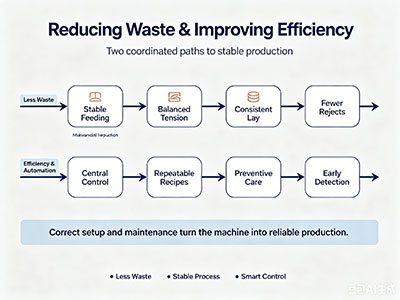
Material waste can increase when wire breakage, incorrect tension, unstable feeding, or inconsistent stranding occurs. A vertical cage strander with stable feeding and tension control can reduce these risks by maintaining more predictable production conditions.
Consistent lay formation also helps reduce rejected products caused by construction variation. When production parameters are properly controlled, manufacturers can reduce the amount of material consumed during repeated adjustments and process corrections.
However, reducing waste also requires correct machine setup, suitable raw materials, regular maintenance, and proper operator training. The vertical cage strander provides the production platform, while process management determines how effectively that platform is used.
Automation can further improve the performance of a vertical cage strander. Modern control systems can coordinate cage rotation, haul-off speed, take-up operation, and other production parameters. Operators can monitor production conditions through a centralized control interface and make adjustments according to cable specifications.
Automation also helps improve repeatability. Once suitable production parameters are established, the vertical cage strander can reproduce similar operating conditions during subsequent production runs. This is especially useful for manufacturers handling repeated orders with the same cable construction.
Automated monitoring can also help operators identify abnormal operating conditions earlier. This can reduce unexpected downtime and support more systematic maintenance.
Regular maintenance is essential for keeping a vertical cage strander operating reliably. Bearings, rotating components, wire guides, tensioning devices, pay-off systems, haul-off components, and take-up systems should be inspected according to operating conditions and maintenance schedules.
Lubrication should be performed correctly, and rotating components should be checked for abnormal noise, vibration, or temperature. Wire guides should remain clean and free from damage because worn guides can affect wire movement and surface quality.
Electrical and control systems should also be inspected regularly. Stable sensors, motors, drives, switches, and control components are important for maintaining synchronized operation of the vertical cage strander.
Although a vertical cage strander can provide stable performance, incorrect operation or maintenance can still cause production problems. Uneven strand distribution may result from inconsistent wire tension or incorrect guiding. Lay length variation may occur when cage speed and haul-off speed are not properly synchronized.
Wire breakage may be related to excessive tension, damaged guides, unsuitable material conditions, or mechanical problems. Excessive vibration may indicate imbalance, bearing wear, loose components, or improper installation.
When a problem occurs, operators should check the complete production system instead of changing only one parameter. A systematic inspection of tension, rotation, guiding, haul-off, and take-up conditions usually provides a clearer path toward troubleshooting.
Choosing the right vertical cage strander begins with understanding the finished cable requirements. Manufacturers should consider conductor material, individual wire diameter, number of components, maximum cable diameter, required lay length, production speed, and take-up requirements.
The cage capacity is also important. The machine should provide sufficient positions for the required number of wires while maintaining appropriate mechanical stability. Pay-off capacity should match the expected production length and material weight.
Manufacturers should also evaluate tension-control capability, cage rotation control, haul-off configuration, take-up capacity, automation level, maintenance accessibility, and factory installation conditions.
A vertical cage strander should not be selected based only on maximum speed. A machine operating at a moderate speed with stable tension, reliable synchronization, and consistent product quality may provide better overall production results than a machine focused only on nominal speed.
Factory layout has a direct influence on equipment efficiency. The vertical configuration of a vertical cage strander can help manufacturers make better use of available production height and floor space. However, sufficient clearance must still be provided for installation, material loading, maintenance, inspection, and safe operation.
Material flow should also be considered. Pay-off areas, stranding sections, haul-off equipment, take-up systems, and finished cable handling should be arranged to minimize unnecessary movement. A well-planned layout can improve operator access and reduce material handling time.
Several practical measures can improve vertical cage strander performance. First, maintain stable wire tension throughout the Production Process. Second, keep guides and rotating components in good condition. Third, verify cage rotation and haul-off synchronization regularly.
Operators should also establish standard setup procedures for different cable specifications. Recording suitable production parameters can shorten future changeover times and reduce repeated trial production.
Preventive maintenance should be performed before mechanical wear develops into a serious production problem. Monitoring vibration, bearing condition, lubrication, electrical performance, and wire guide wear can help maintain stable vertical cage strander operation.
The advantages of a vertical cage strander are closely connected with its structural design and production control capabilities. It can make efficient use of factory space, provide stable wire guidance, support controlled tension, maintain consistent lay formation, and handle different cable manufacturing requirements.
For manufacturers seeking a practical solution for continuous cable production, a vertical cage strander can provide a balanced combination of production stability, flexibility, material control, and equipment organization. Its value is particularly clear when the machine is integrated with suitable pay-off, haul-off, take-up, control, and inspection systems.
A vertical cage strander provides several practical advantages for modern wire and cable manufacturing. Its vertical structure can improve space utilization, while controlled wire feeding and cage rotation support stable stranding performance. Consistent tension, controlled lay length, flexible production configurations, and improved automation can further contribute to manufacturing efficiency.
When selecting a vertical cage strander, manufacturers should consider the complete production process rather than focusing on one specification. Cable construction, wire diameter, strand count, production speed, tension requirements, take-up capacity, factory layout, automation, and maintenance should all be evaluated together.
With correct equipment selection, proper setup, regular maintenance, and effective process control, a vertical cage strander can become an important part of a reliable cable production system. For manufacturers looking to improve production stability, optimize factory space, reduce material waste, and maintain consistent Cable Quality, the vertical cage strander offers a practical and flexible equipment solution.
SEO Description: Discover the advantages of a vertical cage strander, including efficient space utilization, stable stranding, precise tension control, consistent lay length, flexible cable production, reduced material waste, and improved manufacturing efficiency. Learn how vertical cage strander equipment supports reliable wire and cable production and how to choose the right configuration for different applications.
This website uses cookies to ensure you get the best experience on our website.


 Pусский
 中文
中文



 WhatsApp
 Phone
Phone
Comment
(0)