

Vertical Cage Strander: Working Principle, Applications and Benefits
A vertical Cage Strander is specialized cable manufacturing equipment used to combine multiple wires into a controlled stranded conductor or cable structure. With a Vertical Cage configuration, the machine can provide stable wire feeding, controlled tension, organized strand formation, and efficient production management. Understanding the vertical cage strander working principle, applications, and benefits helps cable manufacturers select suitable equipment and improve Production Efficiency.
A vertical cage strander is a type of Stranding Machine designed with a vertical cage arrangement for carrying wire reels or wire-feeding components. During operation, individual wires are supplied from separate positions and guided toward a common stranding point. The cage rotates while the Production Line pulls the combined conductor forward.
The vertical cage strander is mainly used to produce stranded conductors and cable components that require stable wire arrangement, controlled lay length, and consistent tension. The exact machine configuration depends on the wire diaMeter, number of wires, conductor structure, production speed, and final cable application.
Compared with conventional horizontal equipment, the vertical configuration changes the way wire reels, material paths, and machine components are arranged. This can provide practical advantages in factory layout, material handling, maintenance access, and production organization when the machine is properly matched to the manufacturing process.
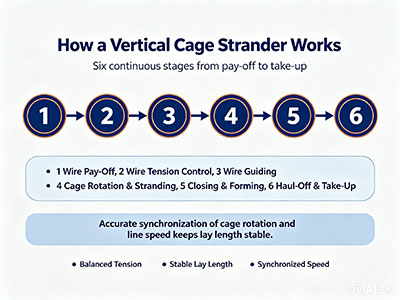
The vertical cage strander working principle is based on synchronized wire feeding, cage rotation, controlled tension, stranding, forming, traction, and take-up. Each individual wire is supplied from a pay-off position and travels through guides toward the central stranding area.
As the cage rotates, the wires move around the central axis and form a helical structure. At the same time, the haul-off system pulls the newly formed conductor forward. The relationship between cage rotation and line speed determines the lay length.
After the wires are combined, the conductor passes through a forming or closing section. This helps stabilize the wire arrangement and establish the required conductor shape. The finished conductor then travels through the traction system and is wound onto a take-up reel.
Although the vertical cage strander working principle is relatively straightforward, stable synchronization is essential. Variations in wire tension, cage speed, line speed, or take-up tension can affect conductor geometry and finished product quality.
The Production Process begins with the wire pay-off system. Individual wire reels are positioned in the cage or associated pay-off structure. Each reel supplies one wire toward the central production path.
The pay-off system must release wire smoothly. Sudden resistance or uncontrolled reel rotation can create tension fluctuations that affect the entire vertical cage strander process.
Proper reel loading is also important. Operators should make sure each wire is correctly routed through the required guides and that the reel rotates freely before production begins.
Wire tension control is one of the most important functions of a vertical cage strander. All wires should reach the stranding point under suitable and relatively balanced tension.
If one wire has significantly higher tension than another, the finished conductor may develop uneven strand distribution. Loose wires, irregular conductor surfaces, and unstable geometry can result from poor tension control.
A suitable tension system helps the vertical cage strander maintain consistent wire movement throughout the production process. Depending on the equipment configuration, tension may be controlled through mechanical braking, tension devices, Dancer mechanisms, or other control systems.
After leaving the pay-off positions, wires pass through guides that establish their movement path. The guides help maintain the correct position of each wire and prevent unnecessary contact with machine components.
Guide condition is important for production quality. Worn or damaged guides can increase friction and create surface marks on the wire. Regular inspection helps maintain smooth wire movement and stable tension.
The cage is the central moving structure of the vertical cage strander. When the cage rotates, the wire positions move around the central axis and create the required twisting movement.
The cage drive system must provide stable rotation throughout the production range. Sudden speed changes can affect lay length and conductor structure.
Stable rotation is particularly important when the vertical cage strander operates at higher production speeds or processes products with tight dimensional requirements.
As the wires rotate around the central axis, they form the stranded structure. The lay length is controlled by the relationship between cage rotation and the linear speed of the conductor.
A shorter lay length creates a different strand arrangement from a longer lay length. The required lay length depends on the cable design, conductor flexibility, mechanical requirements, and downstream processing conditions.
The vertical cage strander must therefore provide accurate speed coordination so that the selected lay length remains stable throughout the production run.
After stranding, the individual wires need to remain in the required arrangement. A closing die or forming section can help stabilize the stranded conductor and control its shape.
For some applications, additional forming or compacting may be required. The forming process should be matched to wire size, wire count, conductor diameter, and material characteristics.
Correct forming helps improve conductor roundness and provides a stable structure for subsequent cable manufacturing processes.
The haul-off system pulls the stranded conductor away from the stranding area. Its speed must remain synchronized with cage rotation to maintain the required lay length.
Stable traction is essential because changes in line speed can directly affect the strand structure. The vertical cage strander should therefore provide coordinated control between the rotating cage and haul-off system.
The final stage is take-up. The completed stranded conductor is wound onto a reel or other suitable collection system.
Take-up tension should remain stable. Excessive tension can deform the conductor, while insufficient tension can create loose or irregular winding. A well-coordinated take-up system supports smooth production and simplifies downstream cable processing.
A vertical cage strander can include several features designed to support stable and efficient cable manufacturing. The exact configuration depends on the intended application.
Vertical cage configuration: Organizes wire pay-off positions around a vertical machine structure.
Stable wire feeding: Provides controlled delivery of individual wires to the stranding point.
Tension control: Helps maintain balanced wire tension during continuous production.
Accurate lay control: Coordinates cage rotation and line speed.
Central forming system: Helps stabilize the finished stranded conductor.
Controlled traction: Maintains continuous material movement.
Take-up system: Collects finished conductor in an organized manner.
Automated control: Allows production parameters to be monitored and adjusted.
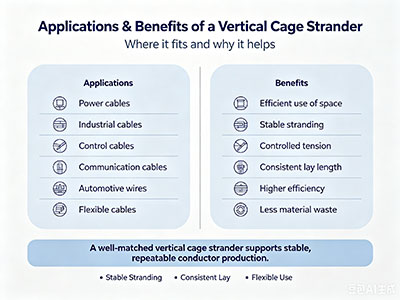
The vertical cage strander can be used in a variety of wire and cable manufacturing applications. Its suitability depends on the conductor structure, wire material, wire size, production capacity, and final cable requirements.
A vertical cage strander can be used for producing stranded conductors used in power cable manufacturing. Stable wire arrangement is important because the conductor may later pass through insulation extrusion, cabling, shielding, or sheathing processes.
Industrial cables may require different conductor constructions depending on their working environment and mechanical requirements. A vertical cage strander can provide controlled strand formation for suitable industrial conductor applications.
Control cables often require consistent conductor dimensions and reliable flexibility. A properly configured vertical cage strander can help produce stable stranded conductors for subsequent insulation and cable assembly processes.
Communication cable production requires careful control of conductor dimensions and material handling. For suitable conductor structures, a vertical cage strander can provide repeatable wire arrangement and controlled production conditions.
Automotive wires can require flexible conductors capable of handling repeated movement and vibration. When configured for suitable wire sizes and conductor constructions, a vertical cage strander can support stable production of stranded conductors used in automotive wire manufacturing.
Flexible cable applications often require specific strand constructions to achieve the desired bending performance. The vertical cage strander can be configured according to wire count, wire diameter, and required lay length.
The vertical configuration can provide a different approach to factory layout compared with horizontally arranged equipment. Depending on the machine size and production environment, vertical organization may help manufacturers manage floor space more efficiently.
However, factory layout should always consider machine height, operator access, reel handling, maintenance clearance, and material flow before installation.
A properly configured vertical cage strander provides controlled cage rotation and wire feeding. Stable movement helps maintain consistent strand formation and supports repeatable conductor quality.
Balanced wire tension is essential for consistent conductor geometry. A suitable tension system can reduce variations between individual wires and help prevent loose or excessively tight strands.
Accurate coordination between cage rotation and line speed allows the vertical cage strander to maintain a stable lay length. Consistent lay length supports repeatable conductor construction across production batches.
When pay-off, stranding, haul-off, and take-up systems operate together, the vertical cage strander can support continuous manufacturing with fewer unnecessary interruptions.
Automation can further improve efficiency by reducing manual adjustment and allowing operators to monitor important production parameters during operation.
Stable machine operation can reduce waste caused by incorrect lay length, wire breakage, unstable tension, and poor winding. Better process control means fewer defective sections need to be removed from finished production.
A properly selected vertical cage strander can support different conductor constructions within its designed operating range. This can be useful for manufacturers that produce multiple wire and cable specifications.
Tension control deserves particular attention when evaluating a vertical cage strander. Individual wires must travel from their pay-off positions to the central stranding point without excessive tension variation.
When tension is stable, the wires can be distributed more evenly around the conductor. This helps maintain conductor roundness, consistent lay, and stable surface appearance.
When tension is unstable, the vertical cage strander may produce loose strands, uneven conductor geometry, or wire breakage. Operators should therefore inspect braking systems, guides, bearings, tension components, and wire paths when quality changes occur.
Lay length is determined by the relationship between rotational movement and linear movement. The vertical cage strander must maintain accurate synchronization between these two movements.
If cage speed increases without a corresponding adjustment to line speed, the lay length changes. Similarly, changes in haul-off speed can affect the strand pitch even when cage rotation remains constant.
For this reason, the control system should coordinate cage rotation and traction accurately. Stable lay length is particularly important when the stranded conductor must meet defined dimensional and mechanical requirements.
Production speed should be selected according to the actual conductor structure rather than simply using the maximum available speed. Larger wires, heavier reels, complex conductor arrangements, and demanding tension requirements may require lower operating speeds.
Increasing speed without maintaining stable tension and cooling can increase wire breakage and production variation. The most efficient vertical cage strander is therefore one that provides a suitable balance between speed, quality, stability, and equipment life.
Several practical measures can improve vertical cage strander efficiency. First, ensure that all wire reels are correctly installed and properly aligned. Second, set appropriate tension before starting continuous production. Third, verify lay length and line speed during initial operation.
Operators should also monitor machine vibration, temperature, noise, wire surface condition, and finished conductor geometry. Abnormal changes should be investigated before continuing long production runs.
Regular cleaning and preventive maintenance are equally important. Wire guides, bearings, tension devices, rotating components, drive systems, and take-up components should be inspected according to a planned schedule.
Uneven strand distribution may be caused by inconsistent tension, incorrect wire guiding, improper forming, or unsuitable machine settings. The complete wire path should be inspected when this problem occurs.
Lay length variation is commonly associated with unstable cage speed, inconsistent haul-off speed, or incorrect parameter settings. Speed synchronization should be checked carefully.
Wire breakage can result from excessive tension, damaged wire, poor lubrication where applicable, sharp guide surfaces, excessive speed, or incorrect conductor configuration.
Irregular winding can result from unstable take-up tension, incorrect traversing, reel alignment problems, or poor coordination between haul-off and take-up systems.
Vibration may be associated with rotating component imbalance, bearing wear, incorrect installation, loose mechanical connections, or unsuitable operating conditions. Regular mechanical inspection can help identify the source.
Choosing a vertical cage strander should begin with the required finished conductor specifications. Manufacturers should define wire material, individual wire diameter, wire count, conductor diameter, lay length, production speed, reel dimensions, and expected production volume.
The machine's tension control system should also be evaluated. A suitable tension system is essential when producing conductors that require consistent geometry and stable quality.
Manufacturers should also consider automation, factory space, maintenance access, take-up capacity, power requirements, safety functions, and compatibility with existing production lines.
Regular maintenance helps maintain reliable vertical cage strander performance. Operators should inspect bearings, rotating structures, wire guides, tension devices, drive systems, electrical connections, safety components, and take-up equipment.
Wire-contact components should be checked for wear because damaged guides can affect wire surface quality and tension. Rotating components should also be monitored for unusual vibration, noise, or temperature increases.
Maintenance should be preventive rather than reactive. Regular inspection can identify wear before it develops into equipment failure or extended production downtime.
The vertical cage strander is normally one part of a larger cable manufacturing process. Upstream processes may include Wire Drawing and annealing, while downstream processes may include insulation extrusion, cabling, shielding, sheathing, testing, and rewinding.
For this reason, the output characteristics of the vertical cage strander should match downstream equipment. Conductor diameter, line speed, take-up reel size, tension, and material handling should be considered together.
Good coordination between production stages can reduce bottlenecks and improve overall manufacturing efficiency. A vertical cage strander should therefore be selected as part of the complete production system rather than as an isolated machine.
Automation can improve the operation of a vertical cage strander by coordinating cage rotation, line speed, tension, take-up, alarms, and other operating parameters.
Automated control can also improve production repeatability. Once suitable parameters are established for a particular conductor specification, operators can reproduce those settings during future production runs.
Monitoring production conditions can also help identify abnormal tension, speed fluctuations, or mechanical problems earlier. This supports preventive maintenance and reduces unnecessary production interruptions.
Individual wire diameter
Wire material
Number of wires
Finished conductor diameter
Required lay length
Cage rotation speed
Production line speed
Wire tension
Pay-off reel capacity
Take-up reel capacity
Forming conditions
Control system performance
Machine maintenance
Factory operating environment
A vertical cage strander can be a practical choice when manufacturers require controlled stranding, stable wire feeding, consistent tension, and efficient handling of suitable conductor structures. Its vertical arrangement can also provide useful possibilities for factory layout and production organization.
The real benefit, however, depends on correct equipment selection and operating conditions. A vertical cage strander should match the conductor specifications, wire range, production capacity, lay requirements, and downstream manufacturing process.
When properly selected, installed, and maintained, a vertical cage strander can support stable production, consistent conductor quality, efficient operation, and reduced production waste.
A vertical cage strander works by feeding multiple individual wires through controlled pay-off and tension systems while a rotating vertical cage creates the required stranding movement. The wires are then combined, formed, pulled through the production line, and wound onto a take-up reel.
The vertical cage strander working principle depends on accurate coordination between wire feeding, tension, cage rotation, lay length, haul-off, and take-up. Stable control of these parameters is essential for consistent conductor quality and reliable production.
The applications of a vertical cage strander can cover suitable power, industrial, control, communication, automotive, and flexible cable manufacturing processes. Its benefits include stable stranding performance, controlled tension, consistent lay length, efficient production, flexible application, and practical factory organization.
For cable manufacturers, choosing the right vertical cage strander requires careful consideration of wire diameter, material, wire count, conductor size, production speed, lay length, automation, maintenance, and downstream compatibility. With the correct configuration and proper operation, a vertical cage strander can become an important part of an efficient and reliable wire and cable production system.
This website uses cookies to ensure you get the best experience on our website.


 Pусский
 中文
中文



 WhatsApp
 Phone
Phone
Comment
(0)