

What Is a Wire Drawing Production Line and How Does It Work?
A Wire Drawing Production Line is an important manufacturing system used to reduce the diaMeter of metal wire while improving dimensional consistency, surface quality, and mechanical performance. A wire Drawing Production Line normally combines pay-off, wire preparation, drawing dies, drawing blocks, lubrication, cooling, tension control, and take-up equipment. Understanding how a Wire Drawing Production line works helps manufacturers select suitable equipment, improve Production Efficiency, reduce wire breakage, and maintain stable finished wire quality.
A wire drawing production line is a continuous or multi-stage manufacturing system that changes the diameter and properties of wire through controlled drawing operations. The basic process involves pulling wire through a drawing die with a smaller opening. As the wire passes through the die, its cross-sectional area decreases while its length increases.
Unlike a simple single-pass drawing machine, a complete wire drawing production line normally includes multiple drawing stages. Each stage removes part of the material cross section until the required final wire diameter is achieved. The number of drawing stages depends on the starting diameter, final diameter, material characteristics, required reduction, and production requirements.
A modern wire drawing production line is not simply a group of machines placed together. The pay-off, drawing blocks, dies, lubrication system, cooling system, control system, and take-up unit must operate as one coordinated production system. Stable synchronization is essential for consistent wire quality and reliable continuous operation.
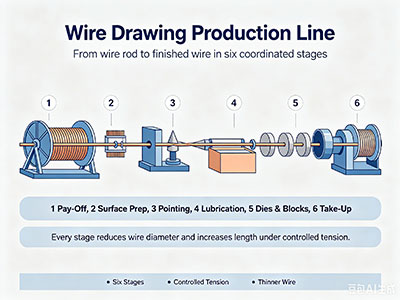
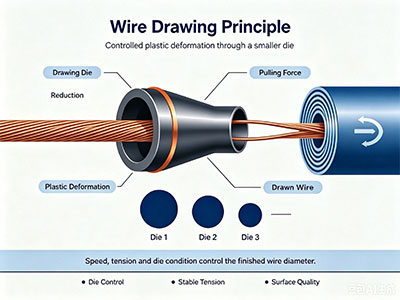
The working principle of a wire drawing production line is based on controlled plastic deformation. The incoming wire is pulled through a series of progressively smaller dies. Each drawing stage reduces the wire diameter and increases its length. The drawing blocks provide the pulling force required to move the wire through the dies.
Although the basic principle is straightforward, industrial wire drawing requires accurate control of speed, tension, lubrication, temperature, die condition, and material movement. Small changes in these factors can affect surface finish, dimensional accuracy, wire strength, and production stability.
The wire drawing production line begins with the pay-off system. Wire rod or larger-diameter wire is supplied from coils, reels, or other material storage systems. The pay-off equipment releases the material at a controlled rate and guides it toward the first processing stage.
Stable pay-off is important because irregular feeding can create sudden tension changes. Excessive tension can contribute to wire breakage, while insufficient control can cause loops, tangling, or unstable material movement.
The pay-off system should therefore be matched to the incoming material size, coil weight, production speed, and line configuration. A suitable pay-off system provides smooth material delivery throughout the wire drawing production line.
Before drawing begins, the surface of the incoming wire may require preparation. Depending on the material and manufacturing process, surface preparation can include mechanical descaling, cleaning, chemical treatment, or other methods used to remove unwanted surface contaminants.
A clean and suitable wire surface is important because contaminants can affect lubrication, increase die wear, damage the finished wire surface, and create drawing defects.
Surface preparation should therefore be considered an integral part of the wire drawing production line rather than an unrelated preliminary operation.
The leading end of the wire normally needs to be reduced before it can pass through the first drawing die. This preparation process is commonly known as wire pointing.
Pointing creates a smaller leading section that can be inserted through the drawing die. The prepared end can then be connected to the drawing mechanism and pulled through the die.
Accurate pointing helps simplify machine threading and reduces unnecessary setup problems during production. For automated wire drawing production line operation, efficient threading and preparation can also reduce startup time.
Lubrication is a critical part of the wire drawing production line. During drawing, the wire comes into contact with the drawing die under substantial pressure. Friction between the wire and die generates heat and can increase tool wear.
Suitable lubrication reduces friction, improves wire movement, protects the drawing die, and helps maintain surface quality. Depending on the application, wire drawing production line configurations may use dry drawing lubrication or wet lubrication systems.
Lubrication conditions should be controlled carefully. Insufficient lubricant can increase friction and temperature, while unsuitable lubrication can affect surface appearance or interfere with subsequent processing.
The drawing die is the central component of the wire drawing production line. Each die has a controlled opening that determines the approximate output diameter for that drawing stage.
The wire is pulled through the die rather than pushed through it. As the wire passes through the smaller opening, the material undergoes plastic deformation. The diameter decreases while the wire becomes longer.
A wire drawing production line generally uses several drawing dies because reducing the entire diameter in a single pass would place excessive demands on the material and equipment. Multiple drawing stages distribute the total reduction across the production line.
Drawing blocks, also called capstans, provide the pulling force required to move the wire through each die. In a multi-stage wire drawing production line, multiple blocks operate in coordination.
Because the wire becomes longer after every drawing stage, the line speed changes from one stage to another. The drawing blocks must therefore operate at properly coordinated speeds to accommodate the increasing wire length.
Accurate speed synchronization is essential. If one drawing block runs too quickly or too slowly, wire tension can become unstable. This may result in wire breakage, diameter variation, surface defects, or unstable production.
Tension control is one of the most important factors affecting wire drawing production line performance. The wire must move through every drawing stage with controlled tension. Excessive tension can increase the risk of breakage, while insufficient tension can cause unstable feeding and poor coordination between drawing blocks.
Stable tension also supports consistent wire dimensions. When tension changes unexpectedly, the interaction between the wire, drawing die, and drawing block can change. Maintaining suitable tension helps the production line operate continuously and reduces unnecessary adjustments.
Modern wire drawing production line systems can coordinate motor speeds and material movement to maintain more stable operating conditions. Proper tension control is especially important for fine wire and applications requiring tight dimensional tolerances.
Drawing generates heat because the wire undergoes plastic deformation and friction occurs between the wire and drawing die. If heat is not controlled, excessive temperature can affect lubrication, die life, surface quality, and production stability.
A wire drawing production line may therefore include cooling systems for drawing blocks, dies, lubricant, or other machine components. Cooling helps maintain appropriate operating temperatures during continuous production.
The cooling system should be designed according to production speed, material type, drawing reduction, lubrication method, and machine configuration. Effective cooling supports stable long-term operation and helps prevent temperature-related production problems.
Wire diameter is mainly controlled through the drawing die sequence and the operating parameters of the wire drawing production line. Each drawing die has a defined working opening, and the combination of multiple dies gradually brings the material to the required final size.
Die condition is important because wear can change the effective opening and affect finished wire dimensions. Regular inspection and timely replacement of worn dies help maintain consistent production.
Production speed and tension should also remain stable. Even when the correct dies are installed, unstable machine operation can create variations in the finished wire. For this reason, dimensional control depends on the entire wire drawing production line rather than one component alone.
A complete wire drawing production line can include several interconnected systems. The exact configuration depends on the material, wire diameter, production capacity, and final application.
Pay-off system: Supplies incoming wire or wire rod at a controlled rate.
Surface preparation system: Removes scale, contaminants, or unwanted surface material when required.
Pointing equipment: Reduces the wire end so it can enter the first drawing die.
Drawing dies: Reduce wire diameter during each drawing pass.
Drawing blocks: Pull the wire through the dies and control material movement.
Lubrication system: Reduces friction and supports stable drawing.
Cooling system: Controls heat generated during continuous drawing.
Tension control system: Maintains stable material tension between production stages.
Control system: Coordinates machine speed, operation, monitoring, and safety functions.
Take-up system: Collects the finished wire onto reels, spools, or coils.
A wire drawing production line can be configured for different lubrication methods. Dry drawing commonly uses solid or powdered lubricants around the drawing area. Wet drawing uses liquid lubrication and cooling media to reduce friction and control temperature.
The appropriate method depends on the wire material, diameter, production speed, required surface quality, and equipment configuration. Fine Wire Production may require particularly careful control of lubrication and cooling because small changes in operating conditions can have a noticeable effect on finished wire quality.
The lubrication system should always be considered together with the drawing dies, wire material, line speed, and cooling system. A suitable combination helps the wire drawing production line maintain stable production conditions.
A properly designed wire drawing production line can improve efficiency by integrating multiple drawing stages into a continuous process. Instead of manually transferring wire between separate operations, the material can move through coordinated drawing stages with controlled speed and tension.
Continuous operation reduces unnecessary handling and helps improve production consistency. Automated control can also reduce the amount of manual adjustment required during normal operation.
Another important factor is production stability. When the pay-off, drawing blocks, lubrication, cooling, and take-up systems work together, the wire drawing production line can operate for longer periods with fewer interruptions.
Efficiency is not simply a matter of increasing line speed. Excessive speed can increase heat generation, die wear, tension fluctuations, and wire breakage. The most effective wire drawing production line balances output with stable product quality and reliable equipment operation.
Wire breakage can result from excessive drawing reduction, unstable tension, poor lubrication, damaged material, worn dies, excessive temperature, or incorrect machine settings. Operators should inspect the entire wire drawing production line instead of focusing only on the point where the break occurred.
Surface scratches may be caused by damaged dies, contaminated lubricant, worn guides, poor wire preparation, or excessive friction. Regular cleaning and inspection can help reduce these problems.
Diameter variation may be related to die wear, unstable drawing speed, tension fluctuations, inconsistent material properties, or improper die selection. Measuring finished wire regularly can help identify changes before they become larger production problems.
Excessive heat can result from poor lubrication, high drawing speed, inadequate cooling, or excessive reduction. Temperature should be monitored as part of routine wire drawing production line management.
Uneven winding can occur when take-up tension, traversing movement, or reel alignment is incorrect. A properly synchronized take-up system helps maintain organized finished-wire coils and simplifies downstream handling.
Choosing the right wire drawing production line should begin with the actual product requirements. Important factors include input wire diameter, required output diameter, wire material, production capacity, drawing stages, line speed, surface quality, dimensional tolerance, and final application.
Manufacturers should also consider the type of lubrication system, cooling capacity, die arrangement, drawing block configuration, take-up method, and control system. These components influence both production performance and long-term operating stability.
Factory conditions should also be evaluated. Available floor space, power requirements, material handling, maintenance access, operator requirements, and integration with other equipment can all affect the practical installation of a wire drawing production line.
A wire drawing production line is especially important in wire and cable manufacturing because conductor diameter directly affects downstream processing. Drawn copper, aluminum, steel, and other conductive wires can be further processed through stranding, annealing, insulation extrusion, cabling, shielding, or sheathing.
Stable wire dimensions make downstream processes easier to control. For example, consistent conductor diameter can support more stable stranding and extrusion conditions. When the wire drawing production line produces inconsistent material, problems can continue into later production stages.
For cable manufacturers, the wire drawing production line should therefore be considered as part of the complete wire and Cable Production system rather than an isolated machine.
Regular maintenance is essential for maintaining stable wire drawing production line performance. Operators should inspect drawing dies, capstans, bearings, guides, lubrication systems, cooling circuits, drive components, electrical connections, and safety systems according to an established maintenance schedule.
Drawing dies should be inspected for wear and surface damage. Worn dies can affect wire diameter and surface quality while increasing production variation. Lubrication systems should also be kept clean, and cooling systems should be checked for proper circulation.
Unusual vibration, noise, temperature, tension changes, or repeated wire breakage should be treated as warning signs. Early inspection can prevent equipment problems from developing into extended production downtime.
Automation has become an important part of modern wire drawing production line operation. A coordinated control system can manage drawing speed, block synchronization, tension, cooling, lubrication, alarms, and other operating parameters.
Automatic monitoring can also help operators identify abnormal conditions quickly. When the production line detects changes in operating parameters, adjustments can be made before a large quantity of wire is affected.
Production data can also support process optimization. By comparing production speed, wire breakage, die life, material consumption, and other operating conditions, manufacturers can identify opportunities to improve overall wire drawing production line efficiency.
Several practical measures can improve wire drawing production line performance. First, use suitable drawing dies and maintain them regularly. Second, maintain stable lubrication and cooling conditions. Third, keep drawing block speeds properly synchronized. Fourth, monitor wire tension throughout the Production Process.
Operators should also ensure that wire preparation is consistent. Proper surface cleaning and pointing can reduce startup problems and improve drawing stability. Take-up tension should be adjusted according to the finished wire and reel requirements.
Preventive maintenance should be combined with production monitoring. Instead of waiting for a component to fail, manufacturers can inspect equipment based on operating time, production output, wear condition, and observed performance changes.
Wire drawing production line systems are used to manufacture many types of metal wire. Applications can include electrical conductors, cable conductors, industrial wire, steel wire, stainless steel wire, communication wire, flexible wire, and various downstream wire products.
The configuration of the wire drawing production line depends on the material and final product. Copper and aluminum wire may require different processing conditions from steel or stainless steel wire. Fine wire production also requires different control considerations from larger-diameter wire.
Therefore, equipment selection should always be based on actual production specifications rather than simply choosing a machine according to its maximum rated capacity.
A complete wire drawing production line provides better coordination between material feeding, drawing, lubrication, cooling, tension control, and take-up. When these systems are properly matched, production can become more stable and predictable.
Integrated equipment also makes it easier to establish consistent operating parameters. This is important for manufacturers producing multiple batches of the same wire specification because repeatable settings can reduce production variation.
A complete wire drawing production line can also simplify production management. Operators can monitor major operating conditions from a centralized control system and respond more quickly when abnormal conditions occur.
A wire drawing production line works by continuously pulling wire through a sequence of drawing dies to gradually reduce its diameter and achieve the required finished dimensions. The process depends on coordinated pay-off, wire preparation, drawing dies, drawing blocks, lubrication, cooling, tension control, and take-up systems.
The performance of a wire drawing production line is determined by more than drawing speed. Stable tension, suitable die selection, effective lubrication, reliable cooling, accurate speed synchronization, proper maintenance, and consistent material preparation all contribute to finished wire quality.
For manufacturers, understanding how a wire drawing production line works provides a practical foundation for equipment selection, process optimization, maintenance planning, and production management. A properly configured wire drawing production line can support stable dimensions, consistent surface quality, efficient continuous production, and reliable integration with downstream wire and cable manufacturing processes.
This website uses cookies to ensure you get the best experience on our website.


 Pусский
 中文
中文



 WhatsApp
 Phone
Phone
Comment
(0)