

How to Choose the Right Stranding Machine for Cable Production?
Choosing the right stranding machine is an important decision in cable production because the machine directly affects conductor structure, lay length, production speed, wire tension, product consistency, and overall manufacturing efficiency. Different cable products require different stranding methods, machine configurations, and control systems. A suitable stranding machine should match the conductor material, wire diaMeter, cable construction, production capacity, required quality, and downstream processing requirements.
A stranding machine combines multiple individual wires into a single conductor or cable component through controlled twisting. The final conductor must maintain a stable structure throughout the Production Process. If the stranding machine is not suitable for the product, manufacturers may experience unstable tension, inconsistent lay length, conductor deformation, wire breakage, excessive material waste, and reduced Production Efficiency.
The right stranding machine does more than provide sufficient production speed. It must provide stable wire feeding, accurate tension control, reliable twisting, consistent forming, and suitable take-up performance. Selecting equipment according to actual production requirements is therefore more practical than simply choosing a machine with the highest rated speed.
For cable manufacturers, equipment selection should begin with the finished cable specification. Once the cable structure is clearly defined, the manufacturer can determine which stranding machine type, wire capacity, speed range, tension system, and take-up configuration are appropriate.
A stranding machine is cable manufacturing equipment used to twist individual wires around a common axis. The process creates a stranded conductor with a controlled arrangement of wires. Depending on the cable design, the wires may be copper, aluminum, steel, alloy, insulated conductors, or other suitable materials.
The basic stranding process includes pay-off, wire tension control, wire guiding, twisting, forming, traction, and take-up. Every stage needs to work together. The stranding machine must maintain the correct relationship between rotational speed and linear production speed so that the required lay length remains stable.
Different stranding machine configurations are designed for different applications. Some machines are suitable for fine flexible conductors, while others are designed for larger conductors, multi-layer constructions, or demanding cable structures.
The first step when choosing a stranding machine is to clearly define the cable products that the machine will manufacture. This sounds simple, but it is one of the most important decisions in the entire selection process.
Manufacturers should identify whether the machine will be used for power cables, building wires, control cables, communication cables, automotive wires, industrial cables, flexible cables, or other products.
Each product may require different conductor structures. A machine designed for fine flexible wires may not be appropriate for large conductors. Similarly, equipment designed for simple conductor stranding may not be suitable for complex multi-layer cable structures.
If the factory produces several types of cables, the complete product range should be considered before selecting the stranding machine. This helps avoid purchasing equipment that works well for one product but has limited flexibility for other production requirements.
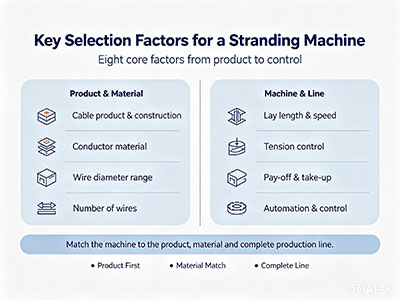
Conductor material is another important factor when choosing a stranding machine. Copper, aluminum, steel, and other conductive materials have different mechanical characteristics and require different handling conditions.
Copper Wire is relatively flexible and is widely used for electrical and communication applications. Aluminum wire has different mechanical characteristics and may require careful tension control during stranding. Steel wire can require stronger mechanical handling systems because of its higher strength and stiffness.
The stranding machine should therefore be selected according to the material characteristics of the actual production range. Pay-off tension, guide design, forming conditions, drawing force, and take-up settings should all be compatible with the conductor material.
Individual wire diameter directly affects stranding machine selection. Fine wires require precise tension control and smooth wire guidance because small changes in tension can have a noticeable effect on the finished conductor.
Larger wires require stronger mechanical components and suitable pay-off capacity. Heavy wire also places greater demands on the rotating structure, bearings, guides, and take-up system.
Before selecting a stranding machine, manufacturers should determine the minimum and maximum individual wire diameters that will be processed. If the machine is expected to handle several wire sizes, the entire range should be evaluated rather than selecting equipment based on one common specification.
The number of wires required in the finished conductor is another key selection parameter. A simple stranded conductor may use a relatively small number of wires, while more complex constructions can require significantly more wire positions.
The number of wires affects the pay-off configuration, rotating structure, wire guide arrangement, machine dimensions, tension control requirements, and overall production capacity.
Manufacturers should consider both current and future conductor constructions. Selecting a machine with insufficient wire capacity can limit future product development, while excessive capacity may increase equipment size and investment unnecessarily.
Different stranding machine types are designed for different production requirements. The most suitable type depends on conductor construction, wire size, required flexibility, production speed, lay precision, and cable application.
A tubular stranding machine uses a rotating tubular structure to carry wire bobbins and create the required twisting movement. It can be suitable for a wide range of conventional stranded conductor applications.
This type of stranding machine can provide a useful balance between production efficiency, conductor quality, and equipment configuration. It is often considered when manufacturers need stable continuous production and consistent lay control.
A planetary stranding machine uses a planetary arrangement of wire carriers. Its configuration can provide controlled stranding for applications that require specific conductor structures or multi-layer cable construction.
When the cable design requires accurate control of different layers or complex stranding arrangements, a planetary stranding machine can provide useful production flexibility.
A rigid stranding machine uses rotating cages or frames to carry wire reels around the production axis. It is commonly considered for larger conductors and applications where substantial wire and reel capacity are required.
The rigid structure provides strong mechanical support for larger production requirements. Manufacturers should evaluate reel weight, conductor size, machine footprint, and required line speed before selecting this type of stranding machine.
Bunching and bow-type equipment can be suitable for fine, flexible conductors where high production speed and smooth wire handling are important. The equipment configuration is generally more compact and is suitable for specific small-wire applications.
When selecting a stranding machine for fine wires, manufacturers should pay particular attention to wire tension, wire guidance, production speed, and finished conductor flexibility.
Lay length is one of the most important parameters of a stranding machine. It describes the distance required for a wire to complete one complete revolution around the conductor axis.
Different cable constructions require different lay lengths. The selected stranding machine must therefore provide a suitable lay length range and sufficient adjustment accuracy.
Lay length affects conductor flexibility, geometry, surface appearance, and mechanical behavior. If lay length changes during production, the finished conductor may not meet the required specifications.
Manufacturers should confirm the required lay length range before purchasing a stranding machine. They should also check how the machine adjusts lay length and whether the adjustment method provides sufficient repeatability.
Production speed is an important factor, but it should not be the only factor used to select a stranding machine. A machine with a very high rated speed may not be the best choice if the cable construction requires careful tension control or precise lay length.
The required output should first be calculated according to daily production volume, working hours, product specifications, changeover frequency, and expected equipment utilization.
Higher speed can improve output when the product and machine configuration are suitable. However, excessive speed can increase vibration, tension fluctuations, wire breakage, heat generation, and maintenance requirements.
The best stranding machine provides the required production capacity while maintaining stable conductor quality.
Tension control is one of the most important features of a stranding machine. Individual wires must reach the stranding point with relatively stable and balanced tension. If one wire is significantly tighter or looser than the others, the conductor may become uneven.
Stable tension helps maintain consistent wire distribution and supports uniform conductor geometry. It also reduces the risk of loose strands, excessive deformation, and wire breakage.
When comparing a stranding machine, manufacturers should evaluate the pay-off system, braking method, tension adjustment, wire guides, and control functions. The tension system should be suitable for the smallest and largest wire sizes in the planned production range.
The pay-off system supplies individual wires to the stranding machine. Its capacity must match the wire reels used in production.
Reel size and weight affect production continuity because frequent reel replacement increases downtime. Larger reel capacity can reduce changeover frequency when the production process and factory conditions allow it.
Manufacturers should also consider how reels are loaded and replaced. Easy access and practical reel handling can improve operator efficiency and reduce unnecessary production interruptions.
The take-up system collects the finished stranded conductor. Its reel size, maximum winding weight, traversing system, and tension control should be compatible with the finished conductor.
Take-up performance is particularly important because unstable winding can damage the finished conductor or create problems during subsequent processing.
A suitable stranding machine should maintain stable coordination between the haul-off and take-up system. The finished conductor should be wound evenly without excessive tension, loose sections, or irregular overlapping.
Modern cable production increasingly depends on coordinated machine control. A stranding machine with suitable automation can help operators manage line speed, rotation, tension, lay length, take-up, alarms, and other production parameters.
Automation can also improve repeatability. Once suitable production parameters have been established, the same settings can be used for repeated production runs, reducing unnecessary manual adjustments.
When evaluating a stranding machine, manufacturers should check whether the control system provides clear parameter settings, operating monitoring, alarm functions, safety protection, and convenient adjustment.
A stranding machine does not normally operate independently. The stranded conductor may continue to an extrusion line, cabling machine, shielding equipment, taping equipment, sheathing line, testing system, or rewinding system.
The output of the stranding machine should therefore match the requirements of downstream equipment. Conductor diameter, line speed, take-up reel size, tension, and production direction should all be considered.
If the stranding machine produces material faster than the next process can handle, the Production Line may develop a bottleneck. Conversely, if the stranding machine is too slow, downstream equipment may remain underutilized.
Equipment selection should therefore consider the complete production process rather than evaluating the stranding machine in isolation.
Factory layout can influence the practical selection of a stranding machine. Different machine types have different overall dimensions, reel positions, operator access requirements, and maintenance spaces.
Before installation, manufacturers should confirm available floor space, ceiling height, material flow, operator working areas, maintenance access, and finished-product storage.
A machine that fits the production specification but creates difficult material movement or insufficient maintenance space may reduce overall factory efficiency. Practical layout planning should therefore be completed before equipment installation.
Maintenance is an important part of long-term stranding machine performance. Manufacturers should evaluate the accessibility of bearings, wire guides, tension components, rotating parts, drive systems, electrical components, and safety devices.
A machine that is easy to inspect and maintain can help reduce downtime. Operators should also have clear maintenance procedures covering lubrication, cleaning, wear inspection, component adjustment, and replacement.
When comparing equipment, manufacturers should consider not only initial purchase cost but also expected maintenance workload, component availability, energy consumption, production downtime, and operating efficiency.
If a factory produces several cable specifications, changeover efficiency becomes an important selection factor. A stranding machine may need to change wire size, wire count, lay length, reel configuration, or other parameters between production runs.
Frequent and complicated adjustments can increase downtime and create opportunities for operator error. A suitable control system and practical machine design can simplify parameter adjustment and product changeover.
Manufacturers should estimate how often product changes will occur and evaluate whether the selected stranding machine can support efficient changeover without sacrificing production quality.
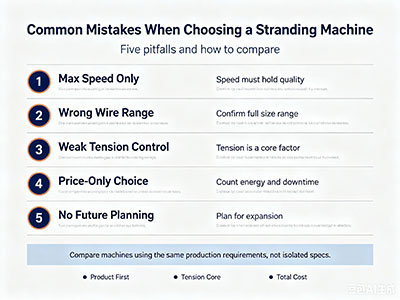
Maximum speed is attractive when comparing equipment, but it does not guarantee better production. The machine must maintain stable quality at the actual production speed required for the cable product.
A machine may perform well with one wire size but become unsuitable outside its intended operating range. The complete wire diameter range should always be confirmed before purchase.
Poor tension control can create conductor defects even when the machine has sufficient speed and capacity. Tension should be treated as a core selection parameter.
Initial equipment cost is only one part of the total operating cost. Energy use, maintenance, spare parts, downtime, production waste, and labor requirements can significantly influence long-term equipment value.
A stranding machine should ideally support the manufacturer's expected product development. If the planned product range will expand, equipment flexibility should be considered during the initial selection.
A practical comparison should use the same production requirements for every machine under consideration. Manufacturers can create a technical comparison covering conductor material, wire diameter, number of wires, conductor size, lay length, production speed, pay-off capacity, take-up capacity, tension control, automation, factory footprint, maintenance, and energy consumption.
Actual production requirements should be used rather than comparing isolated specifications. For example, a higher rated line speed is only valuable if the machine can maintain stable tension and conductor quality at that speed.
Manufacturers should also consider how the stranding machine integrates with existing production equipment. Compatibility can be more important than a single performance specification.
Define the cable product and conductor construction.
Confirm conductor material.
Determine individual wire diameter range.
Confirm the number of wires required.
Determine finished conductor diameter.
Define the required lay length range.
Calculate required production capacity.
Evaluate suitable stranding machine types.
Check wire tension control.
Check pay-off and take-up capacity.
Evaluate automation and control functions.
Confirm compatibility with downstream equipment.
Check factory space and installation conditions.
Evaluate maintenance requirements.
Consider future product expansion.
The right stranding machine can improve cable production in several ways. Stable wire tension helps maintain conductor consistency. Accurate lay control supports repeatable cable construction. Suitable production speed improves output without unnecessarily increasing production defects.
A properly matched stranding machine can also reduce material waste and production interruptions. When the machine configuration matches the conductor design, operators spend less time compensating for equipment limitations.
Better equipment selection can also simplify downstream processing. Consistent stranded conductors are easier to process during extrusion, cabling, shielding, sheathing, and final testing.
Choosing the right stranding machine for cable production requires a complete understanding of the cable product, conductor material, wire diameter, wire count, conductor size, lay length, production capacity, tension requirements, automation level, and downstream processing conditions.
The right stranding machine should not simply offer the highest production speed. It should provide stable wire feeding, accurate tension control, reliable stranding, consistent lay length, suitable take-up performance, and efficient operation within the required production range.
Manufacturers should also consider maintenance, factory layout, product changeover, energy consumption, and future production requirements. By evaluating the complete production process instead of focusing on a single specification, cable manufacturers can select a stranding machine that provides stable performance, consistent conductor quality, efficient production, and better long-term manufacturing value.
This website uses cookies to ensure you get the best experience on our website.


 Pусский
 中文
中文



 WhatsApp
 Phone
Phone
Comment
(0)