


 Pусский
 中文
中文


Modern Cable Manufacturing equipment plays an important role in improving production efficiency, product consistency, process control, and manufacturing flexibility. As wire and cable products become more diverse, manufacturers need equipment that can maintain stable production while handling different conductor sizes, insulation materials, cable structures, and output requirements. Modern cable manufacturing equipment connects individual production stages into a coordinated system that can reduce downtime, control material consumption, improve product quality, and increase practical production capacity.
Production efficiency is not simply determined by machine speed. A modern cable manufacturing process must balance line speed, extrusion output, conductor tension, cooling capacity, dimensional control, material handling, take-up performance, and quality inspection. Modern cable manufacturing equipment helps coordinate these factors so that the complete Production Line can operate more smoothly and consistently.
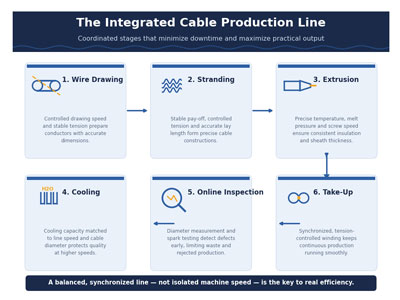
What Is Modern Cable Manufacturing Equipment?
Modern cable manufacturing equipment refers to the machinery and integrated systems used throughout wire and Cable Production. Depending on the product, the equipment may include Wire Drawing machines, annealing systems, Stranding Machines, extrusion equipment, cabling machines, shielding equipment, taping systems, armoring equipment, cooling systems, testing equipment, Take-up Machines, and Rewinding Machines.
Modern cable manufacturing equipment is designed not only to perform individual processing operations but also to support stable communication between different production stages. The objective is to create a continuous manufacturing workflow in which material movement, production speed, tension, temperature, dimensions, and finished cable handling remain under control.
Why Production Efficiency Matters in Cable Manufacturing
Production efficiency directly affects manufacturing capacity, material utilization, labor requirements, equipment availability, and delivery performance. A cable manufacturing line that frequently stops, requires excessive manual adjustment, or produces large amounts of rejected material cannot achieve its potential output even when individual machines have high rated speeds.
Modern cable manufacturing equipment helps address these problems by improving process stability. Stable equipment operation means fewer unexpected interruptions, more consistent production paraMeters, faster product changes, and better control over finished Cable Quality.
Efficiency also depends on how well the equipment works together. A fast extrusion machine cannot improve total production if the cooling system is too small or the take-up system cannot operate at the required speed. Modern cable manufacturing equipment therefore focuses on balanced line performance rather than isolated machine speed.
How Modern Cable Manufacturing Equipment Improves Production Efficiency
1. Higher Production Stability
Stable operation is one of the most important benefits of modern cable manufacturing equipment. Production equipment with reliable drive systems, controlled temperature zones, accurate feeding, and stable tension can maintain operating conditions for long periods.
Stable production reduces unnecessary stops and adjustments. When the conductor moves consistently and the processing parameters remain within the required range, manufacturers can produce longer continuous lengths of cable with fewer interruptions.
Modern cable manufacturing equipment also allows operators to monitor important parameters during production. Early identification of abnormal temperature, pressure, speed, or tension conditions can help prevent larger production problems.
2. Improved Automation
Automation is a major factor in modern cable manufacturing equipment. Automated control systems can coordinate motor speed, extrusion output, temperature, line speed, cooling, tension, and take-up operation.
Instead of relying entirely on manual adjustments, operators can establish production parameters through a centralized control system. This improves repeatability and reduces the possibility of inconsistent manual operation.
Automation also allows manufacturers to save operator time. One operator can monitor several production parameters from a control interface rather than manually checking every part of the production line.
3. Better Production Speed Control
Modern cable manufacturing equipment provides more accurate control of production speed. Speed control is important because wire and cable processes require synchronization between multiple machines.
For example, an extrusion system must coordinate screw speed with conductor speed and take-up speed. If these speeds are not properly synchronized, insulation thickness can change and cable quality may become inconsistent.
Modern cable manufacturing equipment can maintain more stable speed relationships between upstream and downstream processes. This makes it easier to increase production speed while maintaining product quality.
4. Improved Tension Control
Tension control has a significant influence on cable manufacturing efficiency. Excessive tension can stretch conductors or cable components, while insufficient tension can cause unstable material movement and poor winding.
Modern cable manufacturing equipment uses controlled pay-off, traction, Dancer systems, and take-up equipment to maintain stable tension. This is especially important during high-speed production and when manufacturing cables with multiple components.
Stable tension also improves dimensional consistency. When the conductor remains correctly positioned during extrusion, the insulation can be distributed more evenly around it.
5. More Accurate Extrusion
Extrusion is one of the most important stages in many cable manufacturing processes. Modern cable manufacturing equipment improves extrusion efficiency through controlled feeding, screw rotation, temperature management, melt pressure control, and accurate tooling.
A stable extrusion process helps maintain consistent insulation or sheath thickness. Excessive thickness can increase material consumption, while insufficient thickness may affect the required cable characteristics.
Modern extrusion equipment can also support online measurement and process monitoring. Continuous monitoring helps operators identify dimensional changes earlier and make adjustments before large quantities of material are affected.
6. Better Temperature Control
Temperature control is essential when processing insulation and sheathing materials. Different materials require different processing conditions, and unstable temperatures can cause changes in melt behavior and surface quality.
Modern cable manufacturing equipment commonly uses multiple independently controlled heating and cooling zones. This allows operators to establish suitable temperature profiles for different materials and production conditions.
Stable temperature control helps reduce material variation and supports more consistent extrusion. It can also reduce unnecessary energy consumption caused by excessive heating or unstable process conditions.
7. Reduced Material Waste
Material waste is a major factor affecting cable manufacturing efficiency. Waste can occur during startup, product changes, dimensional adjustment, process instability, equipment failure, and rejected production.
Modern cable manufacturing equipment helps reduce waste through faster parameter adjustment, stable feeding, accurate measurement, and better process control. When equipment reaches stable production conditions more quickly, less material is consumed during startup and changeover.
Accurate diameter control can also reduce over-extrusion. Maintaining the required insulation thickness instead of consistently producing excessive thickness can improve material utilization over long production runs.
8. Faster Product Changeover
Cable manufacturers often need to produce multiple cable specifications on the same production line. Frequent product changes can reduce overall production efficiency if tooling replacement, cleaning, temperature adjustment, and parameter setup take too much time.
Modern cable manufacturing equipment can improve changeover efficiency through accessible tooling, digital parameter settings, recipe management, and simplified adjustment procedures.
Once a stable production recipe has been established, operators can use recorded parameters as a starting point for future production. This can reduce setup time and improve repeatability when returning to the same cable specification.
Modern Cable Manufacturing Equipment and Wire Drawing
Wire drawing is an important upstream process for many cable products. The purpose of wire drawing is to reduce conductor diameter while achieving the required dimensional accuracy and surface condition.
Modern cable manufacturing equipment for wire drawing can provide controlled drawing speed, stable tension, lubrication management, and accurate diameter reduction. Stable drawing conditions help prepare conductors for subsequent annealing, stranding, extrusion, or other cable manufacturing processes.
When wire drawing equipment operates efficiently, the benefits extend to the rest of the production line. Consistent conductor dimensions make downstream processing easier and help improve overall cable manufacturing stability.
Modern Cable Manufacturing Equipment and Stranding
Stranding combines multiple wires or conductors into a controlled arrangement. Modern cable manufacturing equipment improves stranding efficiency through stable pay-off, controlled tension, accurate lay length, and synchronized take-up.
Stable stranding is especially important when cable construction requires precise geometric relationships between individual conductors. Variations in tension or lay length can influence finished cable dimensions and mechanical behavior.
Modern stranding equipment can also reduce manual intervention. Automated controls allow operators to monitor production speed, tension, lay parameters, and other important operating conditions.
Modern Cable Manufacturing Equipment and Extrusion
Extrusion equipment is commonly used to apply insulation or protective sheathing to conductors and cable cores. Modern cable manufacturing equipment improves extrusion efficiency by combining stable material feeding, precise temperature control, accurate screw speed, controlled melt pressure, and reliable cooling.
The extrusion process should be matched to the material being processed. Different materials can have different melting behavior, viscosity, temperature requirements, and cooling characteristics. A properly configured extrusion system helps maintain consistent production across the required product range.
Modern cable manufacturing equipment can also integrate online diameter measurement and spark testing. These systems provide additional process monitoring and help identify potential defects during continuous production.
Modern Cable Manufacturing Equipment and Cooling
Cooling is often overlooked when evaluating production efficiency. However, cooling capacity can become a major limitation when manufacturers increase cable production speed.
After extrusion, the insulation or sheath must be cooled sufficiently before the cable enters downstream equipment. If cooling is inadequate, the material may remain too soft and become difficult to handle accurately.
Modern cable manufacturing equipment can use coordinated cooling systems that match water circulation, cooling length, cable diameter, insulation thickness, and production speed. Proper cooling allows the extrusion process to operate closer to its practical production capacity.
Modern Cable Manufacturing Equipment and Online Inspection
Online inspection improves production efficiency by identifying problems during manufacturing instead of waiting until the finished cable reaches final inspection.
Diameter measurement can continuously monitor cable dimensions. Spark testing can identify certain insulation defects during production. Other inspection systems can monitor process parameters and provide information to operators.
When a problem is detected early, the affected production length can be limited. This reduces material waste and prevents long production runs from continuing under incorrect conditions.
Modern Cable Manufacturing Equipment and Take-Up Systems
The take-up system is the final stage of many continuous cable manufacturing lines. Its performance directly affects the practical output of the complete line.
A modern take-up system must maintain stable tension while winding cable neatly and consistently onto the selected reel. Poor winding can create handling problems even when the cable itself meets dimensional requirements.
Modern cable manufacturing equipment can synchronize take-up speed with upstream production speed. Automatic tension control and coordinated winding help reduce manual adjustment and improve continuous production.
How Automation Reduces Downtime
Downtime has a direct effect on production efficiency. It can result from equipment failures, material changes, product changes, tooling adjustments, process instability, or operator intervention.
Modern cable manufacturing equipment can reduce downtime through automated monitoring and preventive maintenance functions. When operating data is continuously monitored, abnormal conditions can be identified before they cause major interruptions.
Production records can also help manufacturers identify recurring problems. If a specific process repeatedly causes downtime, maintenance and process teams can investigate the root cause and improve the operating procedure.
Modern Cable Manufacturing Equipment and Energy Efficiency
Energy efficiency is increasingly important in cable manufacturing. Extruders, drawing machines, stranding equipment, cooling systems, traction systems, and take-up equipment all consume energy.
Modern cable manufacturing equipment can improve energy utilization through efficient motors, variable-speed control, improved heating systems, optimized cooling, and better synchronization between machines.
Energy efficiency should be evaluated together with production output. A machine that consumes less installed power but produces significantly less cable may not provide better overall efficiency. A more useful measurement is energy consumption relative to the amount of qualified finished cable produced.
How Modern Cable Manufacturing Equipment Improves Quality
Production efficiency and product quality are closely connected. Producing cable quickly is not useful if a high percentage of the output requires rework or rejection.
Modern cable manufacturing equipment improves quality by maintaining more stable production parameters. Consistent conductor dimensions, stable stranding, accurate extrusion, controlled cooling, reliable tension, and online inspection all contribute to finished cable consistency.
Better quality also improves production efficiency because fewer rejected products mean less material waste, less rework, fewer interruptions, and better utilization of machine capacity.
Improving Factory Layout with Modern Cable Manufacturing Equipment
Production efficiency also depends on factory layout. Modern cable manufacturing equipment should be arranged according to material flow, production sequence, operator access, maintenance requirements, and finished product handling.
A well-planned layout minimizes unnecessary material movement. Raw materials should move logically through drawing, stranding, extrusion, cabling, testing, and take-up processes without unnecessary backtracking.
Maintenance access is equally important. Equipment that is difficult to access can require longer downtime during inspection or repair. Modern cable manufacturing equipment should therefore be installed with sufficient space for operation, maintenance, tooling changes, and material handling.
Data Management and Production Monitoring
Production data provides useful information for improving manufacturing efficiency. Modern cable manufacturing equipment can record operating conditions such as speed, temperature, output, tension, production length, and equipment status.
Manufacturers can use this information to compare different production runs and identify opportunities for improvement. Data can also help determine whether efficiency losses come from machine speed, material changes, product changeover, maintenance, or other factors.
Over time, production data can support better scheduling and maintenance decisions. It can also help production teams establish more repeatable operating conditions for frequently manufactured cable specifications.
Preventive Maintenance and Equipment Efficiency
Modern cable manufacturing equipment requires regular preventive maintenance to maintain production efficiency. Even a highly automated system can lose performance when components become worn, sensors become inaccurate, or cooling systems become contaminated.
Maintenance programs should include inspection of drive systems, bearings, screws, barrels, heaters, cooling systems, sensors, tooling, tension devices, and take-up mechanisms.
Preventive maintenance can reduce unexpected downtime and extend equipment service life. It also helps maintain consistent product quality because worn components are less likely to cause uncontrolled process changes.
Choosing Modern Cable Manufacturing Equipment
When selecting modern cable manufacturing equipment, manufacturers should first define the products they intend to produce. Important information includes conductor size, cable construction, insulation material, finished diameter, required output, line speed, reel size, and production volume.
Next, evaluate the equipment according to actual production requirements. Maximum machine speed should not be the only consideration. Practical output, dimensional stability, changeover time, material utilization, maintenance requirements, energy consumption, automation level, and compatibility with existing equipment are equally important.
Manufacturers should also evaluate the complete production line. A single high-performance machine cannot improve total production efficiency if other stages cannot keep pace.
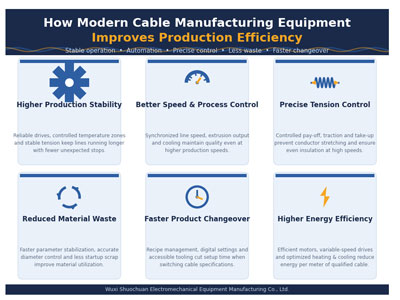
Key Factors Affecting Production Efficiency
Equipment stability
Production speed
Material feeding accuracy
Temperature control
Tension control
Extrusion stability
Cooling capacity
Online inspection
Automation level
Product changeover time
Material utilization
Energy consumption
Preventive maintenance
Factory layout
Production line synchronization
Common Mistakes That Reduce Production Efficiency
One common mistake is focusing only on rated machine speed. A production line may have a high-speed machine but still operate slowly because of cooling, tension, inspection, or take-up limitations.
Another mistake is ignoring material waste. Small increases in insulation thickness or repeated startup waste can become significant over long production runs.
Manufacturers may also underestimate changeover time. If a line produces many cable specifications, slow tooling changes and repeated manual parameter adjustments can reduce actual daily output.
Finally, insufficient preventive maintenance can create unexpected downtime. Equipment that appears operational may still lose efficiency because of worn components, inaccurate sensors, unstable temperature control, or poor cooling performance.
Practical Ways to Increase Production Efficiency
Manufacturers can improve production efficiency by establishing standard operating parameters for each cable specification. These parameters should include production speed, temperature settings, extrusion output, cooling conditions, tension, and take-up settings.
Production teams should monitor material consumption and compare actual usage with theoretical requirements. Unusual increases can indicate excessive insulation thickness, process instability, or equipment problems.
Changeover procedures should also be standardized. Preparing tooling, materials, reels, production parameters, and inspection equipment before stopping the line can significantly reduce unnecessary downtime.
Finally, maintenance should be scheduled according to actual equipment operating conditions. Regular inspection allows small problems to be corrected before they develop into production interruptions.
The Role of Integrated Production Lines
Modern cable manufacturing equipment provides the greatest benefit when individual machines are integrated into a complete production line. Wire drawing, annealing, stranding, extrusion, cooling, inspection, traction, and take-up should operate according to coordinated production parameters.
Integrated production reduces manual transfer between stages and improves production continuity. It also makes it easier to monitor the complete manufacturing process and identify the source of efficiency losses.
For high-volume cable production, synchronization becomes especially important. The production speed of each stage should match the capacity of the next stage to avoid bottlenecks and unnecessary accumulation of work in progress.
Future Development of Cable Manufacturing Equipment
The development of modern cable manufacturing equipment is increasingly focused on automation, process monitoring, energy efficiency, flexible production, and data-based optimization.
Future production systems are expected to provide more integrated control of extrusion, drawing, stranding, cooling, inspection, and take-up processes. More detailed production data can help manufacturers understand equipment performance and improve operating conditions.
Flexible equipment is also becoming increasingly valuable because cable manufacturers may need to produce many specifications in smaller batches. Faster changeover, recipe management, automatic parameter adjustment, and modular tooling can help maintain efficiency in this environment.
Conclusion
Modern cable manufacturing equipment improves production efficiency by combining stable mechanical operation, automation, precise process control, accurate measurement, reliable material handling, and coordinated downstream equipment. The greatest improvement does not necessarily come from increasing machine speed. It comes from creating a balanced production system that minimizes interruptions while maintaining consistent cable quality.
Modern cable manufacturing equipment can improve wire drawing, stranding, extrusion, cooling, inspection, take-up, and other manufacturing stages. Better tension control, temperature control, dimensional measurement, automation, and production synchronization help manufacturers reduce material waste, improve output, shorten changeover time, and maintain consistent product quality.
For manufacturers planning to upgrade their production lines, the most effective approach is to evaluate the complete manufacturing process. Product specifications, material characteristics, production volume, equipment capacity, factory layout, maintenance requirements, energy consumption, and future production needs should all be considered. Properly selected modern cable manufacturing equipment can provide a stable foundation for higher production efficiency, better resource utilization, and more reliable long-term cable manufacturing.



 WhatsApp
 Phone
Phone
Comment
(0)