

How Does a Stranding Machine Work in Cable Manufacturing?
A stranding machine is an important piece of equipment in Modern Cable Manufacturing. It combines multiple individual wires into a uniform stranded conductor by controlling wire feeding, tension, rotation, lay length, forming, traction, and take-up. Understanding how a Stranding Machine Works helps cable manufacturers improve conductor consistency, Production Efficiency, dimensional accuracy, and overall Cable Quality.
A stranding machine is industrial equipment designed to combine several individual wires into a single stranded conductor or cable element. Instead of using one solid conductor, multiple wires are arranged helically around a common axis. This structure can provide improved flexibility, bending performance, mechanical stability, and suitability for different cable constructions.
The basic principle of a stranding machine is straightforward: individual wires are supplied from pay-off units, guided toward a common stranding point, twisted according to a specified lay length, and then pulled through the Production Line before being wound onto a take-up reel. Although the basic principle is simple, accurate coordination between every component is essential for stable cable manufacturing.
A Modern Stranding Machine normally includes wire pay-off systems, tension control devices, wire guides, rotating cages or stranding mechanisms, closing dies, haul-off or capstan systems, take-up equipment, and an electrical control system. These components work together to maintain stable wire movement and consistent stranding quality.
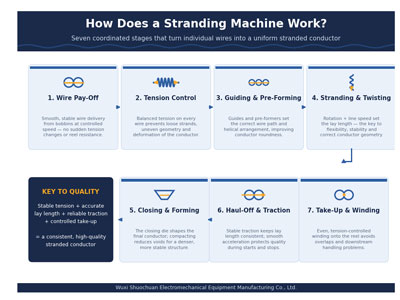
The working process of a stranding machine can be divided into several continuous stages. Each stage affects the final conductor structure, so stable operation throughout the process is important.
The first stage of a stranding machine is wire pay-off. Individual wires are loaded onto separate reels or bobbins. Depending on the machine design and cable construction, the pay-off system may contain several wire positions arranged around a central axis.
As the production line operates, each wire is released from its bobbin and guided toward the stranding section. The pay-off system must provide smooth and stable wire delivery. Sudden changes in wire tension, uncontrolled reel rotation, or excessive resistance can affect the quality of the finished conductor.
A well-designed stranding machine therefore uses appropriate pay-off mechanisms and wire guides to ensure that every wire reaches the stranding point at a controlled speed and tension.
Wire tension control is one of the most important functions of a stranding machine. Multiple wires must enter the stranding area with balanced tension. If one wire is significantly tighter or looser than the others, the finished conductor may have uneven geometry, loose strands, deformation, or inconsistent lay.
Depending on the machine configuration, tension can be controlled through mechanical brakes, tension rollers, Dancer systems, sensors, or electronically controlled pay-off units. The objective is the same: maintain stable tension while the wires move continuously toward the stranding point.
Consistent tension is particularly important when producing conductors with strict dimensional requirements. Stable tension helps keep the individual wires evenly distributed around the conductor and supports a more uniform finished surface.
After leaving the pay-off units, the wires pass through a series of guides. These guides establish the correct wire path and help prevent unnecessary contact between individual wires and machine components.
Some stranding machine configurations also include pre-forming systems. Pre-forming prepares individual wires for the required helical arrangement before they reach the closing point. Proper pre-forming can help improve conductor roundness and reduce stress during the stranding process.
The wire path should remain smooth and consistent. Excessive friction or poor alignment can increase wire tension and create surface damage. For this reason, guide design, guide material, positioning, and maintenance all influence stranding machine performance.
The central operation of a stranding machine is the twisting process. Individual wires are brought together and arranged around a common axis. The rotating part of the machine creates the required helical movement while the production line continuously pulls the forming conductor forward.
The relationship between rotational speed and line speed determines the lay length. Lay length is the axial distance required for a wire to complete one full revolution around the conductor. Different cable constructions require different lay lengths.
A shorter lay can produce a different mechanical and flexibility characteristic from a longer lay. Therefore, accurate control of rotational speed and line speed is essential when a manufacturer needs a specific conductor construction.
After the individual wires are brought together, they pass through a closing area or closing die. This stage helps establish the final shape of the stranded conductor and keeps the wires in the required position.
Depending on the cable design, the conductor may remain round or may undergo additional forming or compacting. Compacting can reduce empty spaces between wires and create a denser conductor structure.
The closing system must be matched to the wire material, conductor size, number of wires, and required finished diaMeter. Excessive pressure can damage the wire surface, while insufficient forming may result in poor conductor geometry.
Once the conductor has been formed, the haul-off or capstan system pulls it through the stranding machine. The traction system provides the continuous movement required for production and maintains the relationship between line speed and rotational speed.
Stable traction is critical because changes in line speed can directly influence lay length. If the haul-off speed fluctuates unexpectedly while the rotating section remains constant, the conductor structure may become inconsistent.
Modern stranding machine systems therefore use coordinated drive and control systems to maintain stable production speed. Smooth acceleration and deceleration are also important when starting or stopping the machine.
At the final stage, the stranded conductor is wound onto a take-up reel. The take-up system must maintain suitable winding tension and distribute the conductor evenly across the reel.
Uneven winding can create overlapping layers, excessive tension, loose sections, or difficulty during downstream processing. A suitable take-up system should therefore work in coordination with the haul-off system.
Stable winding is especially important when the stranded conductor will later enter an extrusion, cabling, shielding, or sheathing process.
A stranding machine provides the controlled process required to transform individual wires into a practical conductor structure. Stranded conductors are widely used because their construction can provide better flexibility than equivalent solid conductors.
In cable manufacturing, a stable stranding process also supports consistent conductor diameter, predictable lay length, controlled wire distribution, and reliable downstream processing. Poor stranding can create problems that continue into insulation extrusion, cabling, sheathing, testing, and final winding.
For this reason, the performance of a stranding machine should not be evaluated only by production speed. Wire tension stability, dimensional control, mechanical reliability, ease of adjustment, maintenance requirements, and compatibility with downstream equipment are equally important.
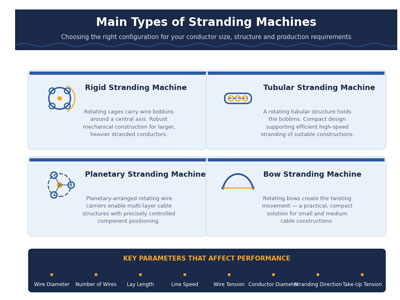
A rigid stranding machine uses rotating cages to carry wire bobbins around a central axis. It is commonly considered when producing larger or heavier stranded conductors and applications that require robust mechanical construction.
The configuration can be adapted to different conductor structures and wire counts. Rigid systems are particularly useful when manufacturers need stable handling of larger wire sizes and substantial conductor assemblies.
A tubular stranding machine uses a rotating tubular structure containing wire bobbins. Its compact rotating arrangement can support efficient high-speed stranding for suitable conductor constructions.
The machine configuration, bobbin capacity, wire size, and required production speed determine whether a tubular stranding machine is appropriate for a specific cable manufacturing application.
A planetary stranding machine uses a planetary arrangement of rotating wire carriers. It can be configured for multi-layer cable structures and applications where controlled positioning of several components is required.
Its flexible configuration makes it suitable for various complex conductor and cable manufacturing processes.
A bow stranding machine uses rotating bows to create the required twisting movement. It can provide a practical solution for certain small and medium cable constructions where production speed, flexibility, and compact equipment configuration are important.
Several parameters directly influence the performance of a stranding machine. Understanding these parameters helps manufacturers achieve stable production.
Wire diameter: The diameter of individual wires affects equipment configuration, guide selection, and production capacity.
Number of wires: Different conductor constructions require different pay-off and stranding configurations.
Lay length: Accurate lay length is essential for consistent conductor geometry.
Line speed: Production speed must remain coordinated with rotational speed.
Wire tension: Balanced tension helps prevent uneven strand formation.
Conductor diameter: Final diameter depends on wire size, wire count, lay structure, and forming conditions.
Stranding direction: The required direction must remain consistent throughout production.
Take-up tension: Stable winding prevents deformation and improves downstream handling.
Tension is one of the most important factors in a stranding machine because every individual wire contributes to the final conductor structure. If wire tension is inconsistent, some wires may become tighter than others. This can cause uneven wire distribution and affect conductor roundness.
Stable tension also helps reduce sudden wire movement during high-speed production. When tension control is properly adjusted, the stranding machine can operate more smoothly and produce a more consistent conductor.
Manufacturers should regularly inspect tension devices, guide rollers, brakes, sensors, and pay-off components. Mechanical wear or contamination can gradually change the tension characteristics of the machine.
Lay length determines how tightly individual wires are arranged around the conductor. It is closely related to conductor flexibility, dimensional characteristics, and mechanical behavior.
A stranding machine must maintain the selected lay length throughout the production run. Variations can occur when rotational speed, line speed, wire tension, or control settings are unstable.
For this reason, the machine control system should coordinate the rotating section and haul-off system accurately. Stable synchronization helps maintain consistent lay length from the beginning to the end of a production run.
Uneven tension can cause loose wires, irregular conductor shape, or inconsistent strand distribution. The first step is to inspect the pay-off system, brakes, tension devices, and wire guides.
Incorrect lay length can result from improper speed coordination or incorrect machine settings. Operators should verify the relationship between rotating speed and line speed.
Surface damage may be caused by worn guides, excessive friction, incorrect alignment, or excessive tension. Regular inspection of wire-contact components can help reduce this problem.
Uneven winding can occur when take-up tension, traversing movement, or reel alignment is incorrect. The take-up system should be synchronized with the haul-off speed.
Diameter variation may be related to wire diameter differences, unstable tension, inconsistent lay length, poor forming, or improper closing conditions. A systematic inspection of the entire stranding process is normally more effective than adjusting only one component.
Improving stranding machine efficiency starts with stable machine operation. Operators should establish suitable production parameters before running at full speed. Correct wire preparation, accurate reel loading, proper tension settings, and suitable guide positioning can reduce unnecessary interruptions.
Automation can further improve efficiency by coordinating pay-off, rotation, haul-off, tension control, and take-up functions. When production parameters are monitored continuously, operators can identify abnormal conditions earlier and reduce material waste.
Preventive maintenance is another important factor. Bearings, guide rollers, tension devices, drive components, electrical systems, and safety devices should be inspected according to an established maintenance schedule.
Selecting a stranding machine should begin with the actual cable manufacturing requirements. The manufacturer should consider conductor material, individual wire diameter, number of wires, maximum conductor diameter, required lay length, production speed, and final cable application.
The machine should also be evaluated according to factory conditions. Available floor space, reel handling methods, operator access, maintenance requirements, power supply, and integration with upstream and downstream equipment can all affect the practical value of a stranding machine.
Another important consideration is control flexibility. A suitable control system should allow operators to set and monitor key production parameters while maintaining stable synchronization between the stranding mechanism, haul-off, and take-up.
Stranding machines are used across many areas of wire and cable manufacturing. Typical applications include power cables, control cables, electronic wires, communication cables, automotive wires, industrial cables, flexible cables, and other stranded conductor products.
The required machine configuration depends on the construction and application of the finished product. Small electronic wires may require a different stranding solution from large power conductors or heavy industrial cables.
For this reason, the best stranding machine is not necessarily the machine with the highest rated speed. It is the machine that provides a suitable combination of production capacity, tension control, stranding accuracy, reliability, maintenance convenience, and compatibility with the complete manufacturing process.
A stranding machine is normally one stage of a larger wire and cable production system. Before stranding, wires may pass through Wire Drawing, annealing, cleaning, or other preparation processes. After stranding, the conductor may enter extrusion, cabling, shielding, taping, armoring, sheathing, testing, and rewinding processes.
Because every stage is connected, the stranding machine should be selected with the entire production line in mind. The conductor diameter, take-up reel, line speed, tension characteristics, and downstream processing requirements should be compatible.
Good coordination between equipment can improve production continuity and reduce unnecessary manual adjustment. It also helps maintain stable material movement throughout the manufacturing process.
Regular maintenance helps maintain stable stranding machine performance. Operators should inspect bearings, rotating components, wire guides, tension devices, drive systems, electrical connections, and safety equipment at appropriate intervals.
Wire-contact surfaces should remain clean and free from excessive wear. Worn guides can increase friction and affect wire quality. Lubrication should also follow the equipment manufacturer's recommended maintenance requirements.
Operators should pay attention to unusual vibration, noise, temperature increases, unstable tension, and changes in production quality. Early detection of these conditions can prevent larger mechanical problems and unnecessary production downtime.
Modern cable manufacturing requires more than simple mechanical twisting. A high-quality stranding machine needs coordinated control of wire feeding, tension, rotation, traction, forming, and winding.
Accurate control allows manufacturers to repeat the same production parameters across different batches. This repeatability is particularly important when cable products must maintain consistent dimensions and stable performance.
Automation also allows production data and operating parameters to be monitored more effectively. When abnormal conditions occur, operators can make adjustments before the problem affects a large quantity of material.
A stranding machine works by continuously feeding individual wires, controlling their tension, guiding them toward a common stranding point, twisting them according to a specified lay length, forming the conductor, pulling it through the production line, and winding the finished conductor onto a take-up reel.
The quality of the final stranded conductor depends on the coordination of every stage. Stable tension, accurate lay length, reliable traction, suitable forming, and controlled take-up are all essential parts of the process.
For cable manufacturers, understanding how a stranding machine works makes it easier to select suitable equipment, establish correct operating parameters, reduce production problems, and improve manufacturing efficiency. When properly configured and maintained, a stranding machine can provide stable, repeatable, and efficient performance across a wide range of wire and cable production applications.
This website uses cookies to ensure you get the best experience on our website.


 Pусский
 中文
中文



 WhatsApp
 Phone
Phone
Comment
(0)