


 Pусский
 中文
中文


Choosing between an LSZH Extruder and a Standard Cable Extruder requires a clear understanding of material behavior, extrusion conditions, output requirements, temperature control, screw design, tooling, cooling, and Cable Quality. Although both systems apply insulation or sheathing around a conductor, LSZH Extruder equipment is often configured to handle the specific processing characteristics of low-smoke zero-halogen compounds. A Standard Cable Extruder may be suitable for conventional cable materials and general extrusion applications.
The difference between an LSZH Extruder and a Standard Cable Extruder is not simply a matter of machine size. LSZH materials can contain significant quantities of mineral flame-retardant fillers, which can increase melt viscosity and impose greater demands on feeding, plasticization, screw and barrel wear, pressure control, and temperature management. Understanding these differences helps wire and cable manufacturers select equipment that matches their products and production conditions.
What Is an LSZH Extruder?
An LSZH Extruder is an extrusion machine designed to process low-smoke zero-halogen materials for wire and cable insulation or jacketing. During production, the LSZH material enters the feeding system, moves through the screw and barrel, is heated and plasticized, and then passes through an extrusion head and crosshead to form a controlled layer around the conductor or cable core.
The main purpose of an LSZH Extruder is to provide stable processing of LSZH compounds while maintaining consistent cable dimensions and surface quality. Because LSZH compounds can behave differently from conventional cable materials, the screw geometry, barrel construction, temperature profile, extrusion head, and cooling system should be matched to the material and cable specification.
What Is a Standard Cable Extruder?
A Standard Cable Extruder is a general-purpose extrusion system used to process commonly used cable insulation and jacketing materials. Depending on the configuration, a Standard Cable Extruder can be used with materials such as PVC, PE, and other thermoplastic compounds.
The exact configuration of a Standard Cable Extruder depends on the material, conductor size, finished cable diaMeter, insulation thickness, required output, and production speed. A conventional extrusion system can provide stable performance when the material characteristics and machine configuration are properly matched.
However, a Standard Cable Extruder should not automatically be assumed to provide the same performance with every LSZH material. Some LSZH compounds may require changes to screw geometry, wear-resistant components, temperature control, extrusion tooling, and operating parameters.
LSZH Extruder vs. Standard Cable Extruder
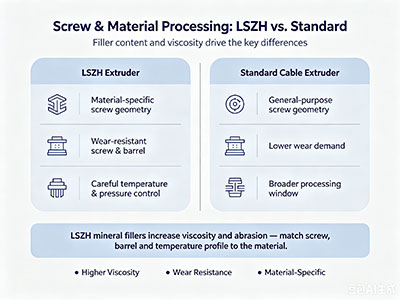
The main difference between an LSZH Extruder and a Standard Cable Extruder is the processing requirement of the material. LSZH compounds are commonly formulated with flame-retardant mineral fillers. These fillers can increase material viscosity and abrasion, which makes extrusion more demanding than some conventional thermoplastic cable materials.
A Standard Cable Extruder may prioritize flexible production, straightforward operation, and general-purpose material processing. An LSZH Extruder places greater emphasis on wear resistance, controlled plasticization, stable pressure, careful temperature management, and reliable material flow.
| Feature | LSZH Extruder | Standard Cable Extruder |
|---|---|---|
| Primary application | LSZH insulation and jacketing | Conventional cable insulation and jacketing |
| Material characteristics | Often highly filled and higher viscosity | Depends on conventional thermoplastic material |
| Screw requirements | Material-specific geometry | General or material-specific geometry |
| Wear resistance | Important because of mineral fillers | Depends on material |
| Temperature control | Highly important | Important |
| Crosshead | Matched to LSZH flow characteristics | Matched to cable material and size |
| Cooling | Must match LSZH output and line speed | Depends on material and cable size |
Difference in Material Processing
Material processing is one of the most important differences between an LSZH Extruder and a Standard Cable Extruder. LSZH compounds are designed to provide low smoke and zero halogen characteristics during fire exposure, and many formulations use mineral flame-retardant fillers. These fillers influence viscosity, density, flow, and processing behavior.
The LSZH Extruder therefore needs to generate consistent melting and material flow without creating excessive shear or uncontrolled temperature increases. The material must be distributed evenly through the extrusion system before reaching the crosshead.
A Standard Cable Extruder processing a conventional material may have a broader and more familiar processing window. However, the correct temperature, screw speed, pressure, and cooling conditions still depend on the actual compound.
Difference in Screw Design
Screw design has a direct influence on extrusion stability. An LSZH Extruder may require a screw designed specifically for the viscosity, filler content, and thermal characteristics of the LSZH compound.
The screw must provide controlled feeding, melting, mixing, and metering. Excessive shear can increase melt temperature and potentially affect material quality. Insufficient plasticization, on the other hand, can lead to unstable pressure, poor surface appearance, or incomplete material homogenization.
A Standard Cable Extruder can use a conventional screw configuration when processing materials with relatively straightforward melting and flow behavior. However, even a Standard Cable Extruder should use a suitable screw when processing a specialized compound.
For this reason, manufacturers should not compare LSZH Extruder and Standard Cable Extruder only by screw diameter. Screw geometry, compression characteristics, length-to-diameter ratio, material compatibility, and output range should all be considered.
Difference in Screw and Barrel Wear
Wear resistance is another major consideration. Mineral-filled LSZH compounds can be more abrasive than some conventional cable compounds. Long-term processing can therefore place greater demands on the screw and barrel surface.
An LSZH Extruder intended for continuous LSZH production should use components with appropriate wear resistance. This can help maintain stable extrusion performance over time and reduce the effect of dimensional changes caused by component wear.
With a Standard Cable Extruder, wear requirements depend heavily on the material being processed. Conventional materials may impose lower mechanical wear, while filled or abrasive compounds can require a more robust configuration.
When comparing an LSZH Extruder with a Standard Cable Extruder, manufacturers should ask about screw material, barrel construction, wear-resistant treatment, expected service life, inspection procedures, and replacement costs.
Difference in Temperature Control
Temperature control is important for both systems, but it becomes especially important when processing LSZH compounds. The LSZH Extruder must maintain a controlled temperature profile from feeding through plasticization and metering to the extrusion head.
If the temperature is too low, the LSZH material may not plasticize sufficiently. This can cause unstable pressure and poor surface quality. If the temperature is too high, excessive thermal stress or undesirable material behavior may occur.
A well-designed LSZH Extruder should therefore provide independently controlled heating and cooling zones. Operators should be able to monitor temperature changes and establish repeatable processing conditions.
A Standard Cable Extruder also requires accurate temperature control, but the appropriate temperature range depends on the specific conventional cable material. The key difference is that LSZH extrusion often requires closer attention to material-specific processing conditions.
Difference in Melt Pressure
Melt pressure affects the stability of the extrusion process. Changes in material viscosity, feeding rate, screw speed, and temperature can cause pressure fluctuations.
Because LSZH compounds may have higher melt viscosity, an LSZH Extruder needs to maintain stable material flow under the expected operating pressure. A suitable screw and barrel combination can help provide consistent metering and reduce unnecessary fluctuations.
A Standard Cable Extruder may operate at different pressure levels depending on the material and product specification. Therefore, the correct comparison should focus on whether each machine can maintain stable pressure at the required output rather than simply comparing maximum pressure values.
Difference in Extrusion Output
Production output should always be evaluated according to the actual material and cable specification. LSZH materials may require different processing conditions from conventional cable materials, and this can influence practical extrusion output and line speed.
An LSZH Extruder should be selected according to the required production range rather than a theoretical maximum output. The machine should provide stable output while maintaining insulation thickness, concentricity, surface quality, and temperature control.
A Standard Cable Extruder may achieve higher output with some conventional materials, but this does not mean it will automatically provide equivalent output when processing LSZH material. Actual production trials are valuable when determining practical performance.
The complete line should also be considered. Cooling length, capstan speed, diameter measurement, spark testing, and take-up capacity can limit production speed even when the LSZH Extruder itself has sufficient output capability.
Difference in Crosshead Requirements
The crosshead controls how molten material is distributed around the conductor. For an LSZH Extruder, the crosshead should be selected according to LSZH material flow behavior and the target cable dimensions.
Stable material distribution is necessary for good concentricity. If the flow is not balanced, the insulation may become thicker on one side and thinner on another. Proper tip and die selection, conductor alignment, melt pressure, and temperature control all influence the final result.
A Standard Cable Extruder also requires a properly matched crosshead, but the tooling configuration can be simpler when the processed material has more predictable flow characteristics.
Difference in Cooling Requirements
Cooling begins after the extruded material leaves the crosshead. The cooling system must remove enough heat to stabilize the insulation before the cable enters downstream equipment.
An LSZH Extruder line may require carefully matched cooling capacity because material behavior, insulation thickness, and production speed affect heat removal. If cooling is insufficient, the cable may remain too soft during traction or take-up.
A Standard Cable Extruder also requires sufficient cooling, but the cooling requirement depends on the specific conventional material. The cooling system should always be designed around the actual finished cable, line speed, and insulation thickness.
Difference in Surface Quality
Surface appearance is an important quality indicator for both LSZH Extruder and Standard Cable Extruder applications. A stable extrusion process should produce a smooth and uniform insulation or sheath.
LSZH materials can be more sensitive to processing conditions because of their formulation and filler content. Incorrect temperature, excessive shear, unstable feeding, or poor tooling can result in rough surfaces, dimensional fluctuations, or other extrusion defects.
To improve LSZH surface quality, operators should maintain stable material feeding, temperature, screw speed, melt pressure, cooling, and line tension. The extrusion head should also be kept clean and correctly aligned.
Difference in Concentricity Control
Concentricity describes how evenly the insulation surrounds the conductor. High concentricity is important for consistent electrical performance, mechanical protection, and finished cable dimensions.
Both an LSZH Extruder and a Standard Cable Extruder need stable conductor positioning and material flow to achieve good concentricity. However, the higher viscosity of some LSZH compounds makes stable processing particularly important.
Online diameter measurement can help monitor finished dimensions during production. When integrated with extrusion and line-speed control, measurement feedback can support more consistent manufacturing conditions.
Difference in Energy Consumption
Energy consumption depends on screw size, motor power, output, heating requirements, cooling systems, line speed, and operating efficiency. Therefore, it is not accurate to compare LSZH Extruder and Standard Cable Extruder only by installed motor power.
The better comparison is energy consumption per unit of finished cable. An efficient LSZH Extruder should convert energy into useful material output while maintaining stable processing conditions.
Proper screw selection, efficient temperature control, suitable motor capacity, and coordinated downstream equipment can help reduce unnecessary energy consumption.
Difference in Maintenance
Maintenance requirements depend on material characteristics and operating conditions. An LSZH Extruder processing abrasive compounds may require closer attention to screw and barrel wear than a Standard Cable Extruder processing less abrasive materials.
Operators should regularly inspect the feeding system, screw, barrel, heaters, cooling zones, extrusion head, crosshead, sensors, drive system, and downstream equipment. Material residue should also be removed according to appropriate cleaning procedures.
Preventive maintenance helps maintain stable extrusion and reduces unexpected downtime. It also allows wear-related problems to be identified before they significantly affect product quality.
Can a Standard Cable Extruder Process LSZH?
Whether a Standard Cable Extruder can process LSZH depends on its actual configuration and the specific LSZH compound. Some LSZH materials may be compatible with existing extrusion equipment when the screw, barrel, tooling, temperature control, and output requirements are suitable.
However, simply placing LSZH material into a Standard Cable Extruder does not guarantee stable production. The machine should be evaluated against the material processing requirements first.
Manufacturers considering an LSZH conversion should check screw geometry, barrel wear resistance, motor capacity, temperature control, crosshead configuration, cooling capacity, and practical output. A production trial is often the best way to confirm compatibility.
When Should You Choose an LSZH Extruder?
An LSZH Extruder is a logical choice when LSZH insulation or jacketing represents an important part of the production portfolio. It is particularly useful when manufacturers require stable processing, consistent dimensional control, continuous production, and repeatable quality across multiple LSZH cable specifications.
An LSZH Extruder can also be appropriate when production volume is high enough to justify equipment configured specifically around LSZH material behavior. In this situation, material compatibility, wear resistance, output stability, and process control become important factors in long-term Production Efficiency.
When Is a Standard Cable Extruder Suitable?
A Standard Cable Extruder may be suitable when the Production Line primarily handles conventional cable materials and does not require specialized LSZH processing. It can provide an efficient solution for general insulation and jacketing applications when the machine is properly matched to the selected material.
For manufacturers producing a broad range of materials, a flexible Standard Cable Extruder may also be useful. However, compatibility should be confirmed for every material rather than assuming that one extrusion configuration can process all compounds equally well.
How to Choose Between LSZH Extruder and Standard Cable Extruder
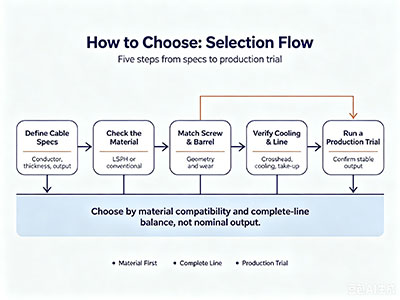
The first step is to define the cable products that the line will manufacture. Determine conductor diameter, insulation thickness, finished diameter, material type, required output, line speed, and applicable product requirements.
Next, compare the extrusion systems according to screw design, barrel construction, motor capacity, temperature control, crosshead, cooling system, measurement equipment, and take-up system.
For LSZH production, special attention should be given to material compatibility and wear resistance. For conventional Cable Production, flexibility and general-purpose processing capability may receive greater emphasis.
Finally, evaluate the complete production line instead of looking only at the main extruder. Pay-off, preheating, extrusion, cooling, diameter measurement, spark testing, haul-off, and take-up should operate as one coordinated system.
Key Questions to Ask Before Purchasing
What LSZH or conventional cable materials will be processed?
What is the required conductor diameter range?
What insulation thickness is required?
What finished cable diameter range is required?
What output is needed?
What line speed is required?
Is the screw suitable for the selected material?
Is the barrel sufficiently wear-resistant?
Can the temperature zones provide stable control?
Is the crosshead suitable for the cable dimensions?
Does the cooling system support the target speed?
Can online diameter measurement be integrated?
Is spark testing required?
Are the pay-off and take-up systems properly matched?
Can the machine be tested using the actual production material?
LSZH Extruder vs. Standard Cable Extruder: Final Comparison
The choice between an LSZH Extruder and a Standard Cable Extruder should be based on the actual cable material and production requirements. An LSZH Extruder is configured around the processing challenges associated with low-smoke zero-halogen materials, including material viscosity, filler content, wear, temperature management, pressure stability, and dimensional control.
A Standard Cable Extruder is generally intended for conventional cable extrusion applications and can be highly effective when its screw, barrel, crosshead, and downstream equipment are correctly matched to the material.
Neither machine should be selected simply because it has a higher nominal output or larger motor. The right solution is the one that maintains stable production under real operating conditions.
Conclusion
LSZH Extruder and Standard Cable Extruder systems share the same basic extrusion principle, but their practical requirements can be significantly different. The LSZH Extruder must often address higher material viscosity, mineral filler content, wear resistance, controlled plasticization, stable melt pressure, and precise temperature management. A Standard Cable Extruder can provide reliable performance for conventional materials when properly configured.
For manufacturers comparing an LSZH Extruder with a Standard Cable Extruder, the most important factors are material compatibility, screw and barrel design, output range, temperature control, crosshead configuration, cooling capacity, dimensional accuracy, maintenance, energy efficiency, and downstream synchronization.
A careful comparison should always begin with the finished cable specification and actual production material. By evaluating the entire extrusion line rather than the extruder alone, manufacturers can select equipment that supports stable output, consistent insulation quality, efficient material use, and reliable long-term wire and cable production.



 WhatsApp
 Phone
Phone
Comment
(0)