


 Pусский
 中文
中文


Choosing a high-efficiency LSZH Extruder is an important decision for manufacturers producing modern wire and cable products. LSZH materials require stable melting, controlled temperature, accurate extrusion, and reliable cooling because their processing behavior differs from many conventional insulation compounds. A properly configured high-efficiency LSZH extruder can support stable output, consistent insulation thickness, controlled cable diaMeter, efficient material use, and reliable long-term production.
When selecting a high-efficiency LSZH extruder, manufacturers should look beyond screw diameter or maximum production speed. The correct equipment must match the LSZH compound, conductor size, insulation thickness, target line speed, required output, crosshead design, cooling capacity, measurement system, and take-up equipment. A complete evaluation helps ensure that the LSZH extruder operates efficiently as part of the entire wire and Cable Production line.
What Is an LSZH Extruder?
An LSZH extruder is a specialized extrusion machine used to process Low Smoke Zero Halogen materials for wire and cable insulation or sheathing. The LSZH extruder melts and homogenizes the compound before delivering it through an extrusion head and crosshead around a moving conductor. The finished insulation must maintain stable dimensions, smooth surface quality, proper adhesion, and consistent thickness.
Compared with ordinary extrusion materials, LSZH compounds can contain a high proportion of mineral-based flame-retardant fillers. These fillers influence viscosity, melt behavior, wear characteristics, and processing stability. Therefore, an LSZH extruder needs suitable screw geometry, barrel construction, temperature control, feeding performance, and extrusion tooling.
Why Is Choosing the Right LSZH Extruder Important?
The LSZH extruder directly affects several critical production parameters. If the machine is incorrectly selected, manufacturers may experience unstable melt pressure, inconsistent insulation thickness, rough surfaces, excessive material consumption, poor concentricity, or reduced production speed.
A suitable LSZH extruder should provide stable material feeding and plasticization across the intended production range. It should also maintain reliable temperature control and consistent melt pressure during continuous operation. These characteristics are especially important when producing communication cables, electronic wires, building wires, industrial cables, control cables, and other products requiring low-smoke, halogen-free insulation or jacketing.
The right LSZH extruder also needs to work effectively with downstream equipment. Extrusion output, cooling capacity, capstan speed, diameter measurement, spark testing, and take-up speed must be coordinated. A fast LSZH extruder cannot deliver its full production potential if the cooling or take-up system becomes a bottleneck.
Start with Your Wire and Cable Specifications
The first step in choosing a high-efficiency LSZH extruder is defining the products that the line will manufacture. Start with the conductor diameter range, finished cable diameter, insulation thickness, material type, production speed, and required output.
For example, a line designed for small electronic wires has different requirements from a line designed for larger industrial cables. Smaller wires may require high line speeds and precise diameter control, while larger cables may require greater extrusion output and different tooling dimensions.
Before selecting an LSZH extruder, prepare the following information:
Conductor diameter or cross-sectional area
Finished wire or cable diameter
Required insulation or sheath thickness
LSZH material grade and formulation
Target production speed
Required material output
Single-layer or multi-layer construction
Required dimensional tolerance
Cooling requirements
Pay-off and take-up reel specifications
These specifications allow the LSZH extruder configuration to be matched with the actual production requirements instead of selecting equipment based only on nominal machine size.
Consider LSZH Material Characteristics
Material compatibility is one of the most important factors when selecting an LSZH extruder. Different LSZH formulations can have different filler contents, melt viscosities, processing temperatures, and flow characteristics. The screw and barrel should therefore be designed according to the actual material formulation rather than relying only on the general term LSZH.
A suitable LSZH extruder should provide enough plasticizing capability while avoiding excessive shear or unnecessary heat generation. Stable feeding is equally important because inconsistent material feeding can cause fluctuations in melt pressure and finished cable diameter.
Manufacturers should provide the material datasheet to the equipment supplier during the selection process. Information such as processing temperature, melt flow characteristics, filler content, density, and recommended processing conditions can help determine the appropriate LSZH extruder configuration.
Choose the Correct Screw Diameter
Screw diameter is a major specification of an LSZH extruder, but a larger screw is not automatically better. The screw diameter should be selected according to required output, product dimensions, material characteristics, and production speed.
An oversized LSZH extruder may operate inefficiently when production demand is low. An undersized LSZH extruder may struggle to provide the required output and can create unnecessary pressure on the extrusion system. The objective is to select a screw size that provides an appropriate operating range for the products being manufactured.
Manufacturers producing several wire sizes should consider the entire product range. The selected LSZH extruder should provide stable performance at both normal production output and lower-output conditions used during product changes or smaller cable production.
Understand the L/D Ratio
The L/D ratio describes the relationship between screw length and screw diameter. It influences residence time, melting, mixing, pressure development, and material homogenization. When selecting an LSZH extruder, L/D should be evaluated together with screw geometry, material formulation, output requirements, and temperature control.
A suitable LSZH extruder should provide enough processing length for stable melting and mixing without creating unnecessary residence time or excessive shear heating. The ideal screw design depends on the LSZH compound and the intended production conditions.
Rather than choosing an LSZH extruder only by a standard L/D value, manufacturers should evaluate actual extrusion tests and material-processing results. A practical test can reveal whether the machine provides stable pressure, consistent melt temperature, smooth surface quality, and sufficient output.
Evaluate Screw and Barrel Wear Resistance
LSZH compounds can place greater mechanical demands on an LSZH extruder because mineral fillers may increase abrasion during continuous processing. Screw and barrel materials should therefore be selected with service life and wear resistance in mind.
A wear-resistant LSZH extruder can maintain more stable processing performance over a longer operating period. Excessive screw or barrel wear may change material flow characteristics, reduce output stability, increase energy consumption, and make process adjustment more difficult.
When comparing equipment, manufacturers should ask about screw material, barrel construction, surface treatment, wear resistance, replacement procedures, and recommended maintenance intervals. These details can have a significant effect on the long-term operating cost of the LSZH extruder.
Check Temperature Control Accuracy
Temperature control is critical for every LSZH extruder. The material must be heated sufficiently for stable plasticization while avoiding excessive thermal stress. Temperature variation can influence melt viscosity, pressure, surface quality, and insulation dimensions.
A high-efficiency LSZH extruder should have independent temperature zones with reliable heating and cooling control. The control system should allow operators to establish stable processing conditions and monitor temperature changes during production.
Temperature control should also be considered at the extrusion head. The material must arrive at the crosshead with suitable melt temperature and pressure. Poor temperature stability can cause flow fluctuations, surface defects, and changes in insulation thickness.
Select the Right Crosshead
The crosshead is a key component of an LSZH extruder because it guides molten material around the moving conductor. Crosshead design directly affects insulation concentricity, material distribution, surface quality, and changeover efficiency.
The LSZH extruder and crosshead should be considered as one integrated system. Tooling must match the conductor size and finished cable dimensions. The die and tip combination should provide suitable material flow while maintaining stable insulation thickness.
For products with strict dimensional requirements, manufacturers should also consider centering adjustment and measurement feedback. Stable conductor positioning and controlled melt flow help the LSZH extruder produce more consistent insulation around the conductor.
Consider Production Output and Line Speed
Production output should be calculated according to actual product requirements rather than maximum machine specifications. A high-efficiency LSZH extruder needs enough capacity to achieve the target line speed while maintaining stable material processing.
Line speed depends on conductor size, insulation thickness, material output, cooling capacity, and downstream equipment. Increasing LSZH extruder speed without considering the complete line can create quality problems. If cooling is insufficient, the insulation may remain too soft when entering the capstan or take-up system.
For this reason, manufacturers should evaluate the LSZH extruder together with the entire extrusion line. Pay-off, preheating, extrusion, cooling, diameter measurement, spark testing, traction, and take-up should operate as a coordinated system.
Pay Attention to Cooling Capacity
Cooling is an essential part of LSZH extrusion. After leaving the crosshead, the hot insulation needs to be cooled sufficiently before the cable reaches subsequent equipment. Cooling performance affects dimensional stability, surface condition, and production speed.
The cooling system of an LSZH extruder line should be sized according to material characteristics, insulation thickness, line speed, and finished cable diameter. A short cooling section may restrict the usable speed of an otherwise capable LSZH extruder.
Water temperature, water circulation, cooling length, cable path, and heat removal capacity should all be evaluated during equipment selection. Proper cooling coordination allows the LSZH extruder to maintain stable production without unnecessary speed limitations.
Use Accurate Diameter and Thickness Control
Dimensional control is another important factor when selecting an LSZH extruder. Excessive insulation thickness increases material consumption, while insufficient thickness may affect product performance and compliance with applicable specifications.
An LSZH extruder can be integrated with online diameter measurement to monitor finished cable dimensions continuously. Measurement data can be used to identify diameter variation and support adjustments to extrusion output or line speed.
Accurate measurement is especially valuable during startup, product changes, and long continuous production runs. By combining stable extrusion with online monitoring, manufacturers can reduce unnecessary material usage and improve consistency from one production batch to another.
Consider Automation and Control Systems
A modern LSZH extruder should provide a practical control system that allows operators to monitor key production parameters. Important parameters include screw speed, melt pressure, temperature zones, line speed, cooling conditions, and take-up operation.
Automation can reduce manual adjustment and improve repeatability. Recipe management can also help operators reproduce established processing conditions when manufacturing the same cable specification again.
However, automation should match the actual needs of the Production Line. A highly automated LSZH extruder can be useful for high-volume manufacturing, while a flexible production environment may place greater value on quick tooling changes and simple operation.
Evaluate Energy Efficiency
Energy consumption should be considered when comparing an LSZH extruder. The screw drive, heating zones, cooling system, and Auxiliary Equipment all contribute to total energy use.
A high-efficiency LSZH extruder should convert electrical energy into useful extrusion output efficiently while maintaining stable material processing. Variable-speed drive systems can help match motor operation with actual production demand, while suitable barrel insulation can reduce unnecessary heat loss.
Energy efficiency should be evaluated together with output. A machine with slightly lower installed power may not be more efficient if it requires significantly more operating time to produce the same amount of cable. The more useful comparison is energy consumption per unit of finished product.
Think About Product Changeover
Many wire and cable manufacturers produce multiple specifications on the same LSZH extruder. In this situation, changeover time becomes an important production factor.
Tooling accessibility, crosshead cleaning, screw removal, material transition, temperature adjustment, and recipe management can all affect changeover efficiency. A practical LSZH extruder should allow operators to switch between compatible product specifications without unnecessary downtime.
Manufacturers should also consider whether separate tooling sets are required for different conductor sizes. Proper tooling organization can reduce setup time and help maintain consistent production conditions.
Check Take-Up and Pay-Off Compatibility
The LSZH extruder does not work independently. The pay-off must provide stable conductor tension, while the take-up must collect the finished cable smoothly at the required production speed.
Unstable tension can influence conductor position inside the insulation and therefore affect concentricity. Similarly, an improperly matched take-up system can create tension fluctuations, winding problems, or unnecessary line stops.
When choosing an LSZH extruder, manufacturers should confirm reel diameter, cable weight, line speed, tension control, and automatic changeover requirements for the complete line.
Common Mistakes When Choosing an LSZH Extruder
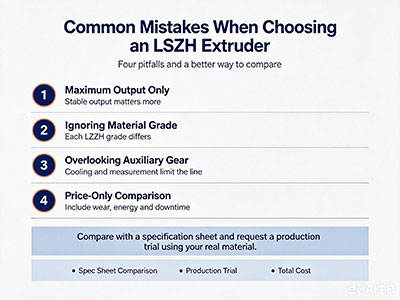
One common mistake is choosing an LSZH extruder according to maximum output alone. Maximum output does not necessarily represent stable production output for a specific cable product.
Another mistake is ignoring the actual LSZH formulation. Different material grades can require different processing conditions, screw designs, and temperature profiles.
Some buyers also focus heavily on the main machine while overlooking auxiliary equipment. Cooling, diameter measurement, spark testing, traction, pay-off, and take-up systems all influence the actual performance of the LSZH extruder line.
Finally, comparing equipment only by purchase price can lead to higher long-term costs. Maintenance requirements, screw and barrel wear, energy consumption, changeover time, material waste, and spare parts should also be included in the evaluation.
How to Compare Different LSZH Extruder Configurations
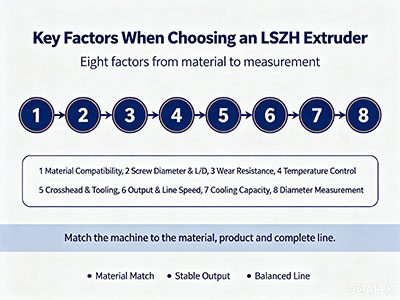
When comparing an LSZH extruder, create a technical specification sheet containing the same parameters for every proposed configuration. Compare screw diameter, L/D ratio, motor power, output range, material compatibility, temperature control, crosshead type, cooling length, measurement system, line speed, and take-up capacity.
It is also useful to request production trials using the actual LSZH material and representative cable specifications. A production test can demonstrate extrusion stability, surface quality, insulation thickness, concentricity, output, and cooling performance under realistic conditions.
This approach provides a much clearer evaluation than comparing catalog specifications alone. The best LSZH extruder is the one that consistently meets the required product specifications under practical production conditions.
Maintenance Requirements of an LSZH Extruder
Regular maintenance is necessary to keep an LSZH extruder operating efficiently. Operators should inspect the feeding system, screw, barrel, heating zones, cooling system, extrusion head, crosshead, drive system, sensors, and take-up equipment according to an established maintenance schedule.
Material residue should be managed carefully during shutdown and material changes. The extrusion head and tooling should be cleaned according to the material supplier's recommendations to avoid contamination and flow restrictions.
Wear components should also be inspected regularly. Early detection of screw, barrel, bearing, seal, or tooling problems can prevent unexpected production interruptions and protect finished Cable Quality.
Practical Selection Checklist
Before purchasing a high-efficiency LSZH extruder, manufacturers can use the following checklist:
Confirm the exact LSZH material grade.
Define the conductor diameter range.
Define finished cable diameter and insulation thickness.
Calculate the required material output.
Set the practical target line speed.
Evaluate screw diameter and L/D ratio.
Confirm screw and barrel wear resistance.
Check temperature control capability.
Select suitable crosshead and tooling.
Confirm cooling capacity and cooling length.
Evaluate online diameter measurement.
Consider spark testing requirements.
Match pay-off and take-up systems.
Review automation and control functions.
Calculate energy and maintenance costs.
Request a production test when possible.
How to Improve LSZH Extruder Efficiency After Installation
Even a well-designed LSZH extruder requires proper operating practices. Operators should establish stable processing recipes instead of making frequent unnecessary adjustments. Temperature, screw speed, line speed, cooling conditions, and tension should be recorded and reviewed regularly.
Material handling is also important. LSZH compounds should be stored and processed according to the material supplier's requirements. Contamination, moisture, inconsistent feeding, and improper storage can negatively affect extrusion stability.
Production teams should also monitor material consumption and finished cable dimensions. If the LSZH extruder consistently produces insulation above the required thickness, process optimization may reduce material waste without compromising product requirements.
Why the Complete Production Line Matters
The performance of an LSZH extruder cannot be separated from the rest of the production line. Stable extrusion requires stable conductor feeding, accurate crosshead tooling, sufficient cooling, controlled traction, reliable measurement, and smooth take-up.
A well-matched LSZH extruder line creates a balanced Production Process. The extrusion system provides consistent material flow, the cooling system stabilizes the insulation, measurement equipment monitors finished dimensions, and downstream equipment maintains controlled cable tension.
This integrated approach is especially important when manufacturers aim to increase production speed. Increasing the LSZH extruder output alone may not improve overall productivity if another part of the line becomes the limiting factor.
Conclusion
Choosing a high-efficiency LSZH extruder for wire and cable production requires more than selecting a machine with a large screw or high advertised output. The equipment should be matched carefully with LSZH material characteristics, conductor size, insulation thickness, production speed, output requirements, crosshead tooling, cooling capacity, measurement systems, and downstream equipment.
The best LSZH extruder provides stable material feeding, consistent plasticization, accurate temperature control, reliable melt pressure, controlled insulation dimensions, efficient cooling, and dependable continuous operation. Manufacturers should evaluate the complete production system and consider long-term energy consumption, maintenance, material waste, changeover time, and product flexibility.
By defining product requirements first, matching the screw and barrel to the LSZH compound, selecting suitable extrusion tooling, balancing line speed with cooling capacity, and integrating effective measurement and control systems, manufacturers can choose an LSZH extruder that supports stable production and consistent wire and cable quality. A carefully selected high-efficiency LSZH extruder can become a reliable foundation for efficient, repeatable, and flexible cable manufacturing.



 WhatsApp
 Phone
Phone
Comment
(0)