

Complete Wire and Cable Production Process: From Drawing to Rewinding
The complete wire and cable Production Process is a continuous manufacturing workflow that transforms raw conductor materials into finished wire and cable products. From Wire Drawing and conductor preparation to stranding, insulation, cabling, testing, and rewinding, every stage affects dimensional accuracy, electrical performance, surface quality, and Production Efficiency. Understanding the complete wire and cable production process helps manufacturers select suitable equipment, coordinate production stages, control material tension, and maintain consistent product quality.
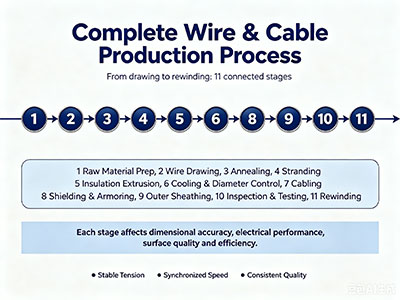
The complete wire and cable production process consists of several connected stages rather than one independent operation. Depending on the cable structure, the production process may include wire drawing, annealing, stranding, insulation extrusion, cabling, shielding, armoring, sheathing, testing, and rewinding. Different wire and cable products require different combinations of these processes.
In a typical production workflow, copper or aluminum rod is first processed through wire drawing equipment to achieve the required conductor diaMeter. The drawn wire may then undergo annealing to restore flexibility and improve conductivity-related characteristics. Multiple conductors can be stranded together before insulation is applied. After extrusion and cooling, insulated cores may be cabled, shielded, armored, or sheathed according to the final cable specification.
The final production stage commonly involves inspection and rewinding. Rewinding equipment transfers finished wire or cable onto reels with controlled tension and winding patterns. This makes the product easier to store, transport, inspect, and prepare for subsequent processing or delivery.
Raw material preparation is the starting point of the wire and cable production process. Copper and aluminum are widely used as conductor materials because of their electrical and mechanical properties. Before entering production equipment, raw materials should be checked for dimensions, surface condition, material consistency, and suitability for the intended product.
Good raw material preparation reduces problems during wire drawing and subsequent processing. Surface contamination, unsuitable rod dimensions, or inconsistent material properties can increase die wear, affect drawing stability, and create quality variations. For this reason, material inspection should be treated as an important part of the complete wire and cable production process.
Wire drawing is one of the most important stages in the complete wire and cable production process. During wire drawing, a metal rod passes through one or more dies to gradually reduce its cross-sectional area and increase its length. Multiple drawing stages can be arranged to achieve the required conductor diameter and surface condition.
A Wire Drawing Production Line must maintain stable material movement and controlled drawing conditions. Drawing speed, die selection, lubrication, cooling, reduction ratio, and tension can all affect the final wire. Excessive drawing stress may contribute to surface defects or dimensional instability, while unsuitable process parameters can increase material waste and equipment wear.
Modern wire drawing equipment focuses on stable production, accurate diameter control, efficient material handling, and reliable continuous operation. Consistent wire drawing provides a solid foundation for later stages such as stranding, extrusion, and rewinding.
Wire drawing can change the mechanical condition of a metal conductor. Depending on the material and product specification, annealing may be used to restore ductility and improve flexibility. During annealing, the conductor is heated under controlled conditions and then processed according to the required production parameters.
Stable annealing is particularly important when producing flexible wire and cable. If the conductor is too hard, later stranding and forming operations may become more difficult. If the annealing process is inconsistent, conductor performance can vary along the length of the wire.
In a complete wire and cable production process, wire drawing and annealing therefore need to work as coordinated stages. Stable conductor preparation makes downstream operations more predictable and helps maintain consistent product characteristics.
Stranding combines multiple individual wires into a larger conductor or cable element. The wires are twisted according to a specified direction and lay length. This process can improve flexibility, mechanical handling, and structural performance compared with a single solid conductor of similar overall size.
A Stranding Machine controls wire feeding, tension, twisting, lay length, and take-up. Stable tension is especially important because uneven tension can affect conductor geometry and create irregularities in the stranded structure.
Different cable designs may require different stranding equipment. Rigid frame stranders, tubular stranders, Cage Stranders, bunchers, and other configurations can be selected according to conductor diameter, strand construction, production speed, and cable requirements.
Within the complete wire and cable production process, stranding is a critical transition between individual conductor preparation and cable construction. Accurate stranding helps ensure that subsequent insulation and cabling operations can run smoothly.
After conductor preparation, many wire and cable products require an insulation layer. Insulation extrusion applies a controlled layer of polymer material around the conductor or stranded core. The extruder melts the material and pushes it through an extrusion head, where the insulation is formed around the moving conductor.
Extrusion temperature, screw speed, material flow, conductor speed, die dimensions, and cooling conditions must work together. The insulation needs to maintain a consistent thickness and concentricity while remaining free from visible defects.
The extrusion stage is an important part of the complete wire and cable production process because insulation directly affects electrical safety, mechanical protection, and product performance. Stable extrusion also helps reduce material consumption by maintaining the specified insulation thickness without unnecessary excess.
After extrusion, the insulated wire passes through a cooling section. Cooling solidifies the insulation layer and prepares the product for subsequent handling. Controlled cooling helps prevent deformation while maintaining the required external dimensions.
Online diameter measurement can be integrated into the Production Line to monitor product dimensions continuously. When production parameters change, real-time measurements can help operators identify deviations before large quantities of material are affected.
Stable cooling and diameter control are particularly important for high-speed wire and cable production. When line speed increases, the relationship between extrusion output, cooling capacity, traction speed, and take-up speed becomes increasingly important.
For multi-core cables, individual insulated cores are often assembled into a larger cable structure. Cabling equipment controls the arrangement and twisting of the cores while maintaining appropriate tension and forming conditions.
Depending on the cable design, fillers or other structural elements may be added during this stage. These components can help maintain cable geometry and provide the required roundness or structural stability.
The cabling process must be coordinated carefully with the characteristics of the insulated cores. Excessive tension can damage insulation, while insufficient control can lead to unstable cable geometry. Accurate guidance and synchronized machine operation therefore contribute directly to production consistency.
Some wire and cable products require additional functional or mechanical layers. Shielding may be used to control electromagnetic interference, while taping can provide separation, insulation, or structural support. Armoring can improve mechanical protection for cable designs intended for demanding installation environments.
These operations add complexity to the complete wire and cable production process. Each additional layer must be applied with controlled tension and stable alignment. Poor layer positioning can affect the outer diameter, flexibility, and subsequent sheathing process.
Production equipment should therefore be selected according to the complete cable structure rather than considering individual machines separately. The interaction between pay-off systems, processing units, traction equipment, and take-up systems has a direct effect on production stability.
Outer sheathing provides an additional protective layer around the cable. Depending on the application, sheath materials may include different thermoplastic or other specialized compounds. The sheathing process generally uses an extrusion system to apply the material evenly around the cable core.
The outer sheath must meet dimensional and surface requirements while providing suitable protection against mechanical handling and environmental exposure. Extrusion temperature, material flow, line speed, die configuration, and cooling conditions need to remain stable.
For manufacturers, stable sheathing is an important part of the complete wire and cable production process because defects at this stage can affect the appearance and usability of the finished cable. Consistent process control also reduces unnecessary material consumption.
Quality inspection is integrated throughout the complete wire and cable production process rather than being limited to the final stage. Operators may monitor conductor diameter, insulation thickness, cable diameter, surface condition, electrical properties, mechanical characteristics, and other product-specific parameters.
Testing equipment can identify problems such as insulation defects, dimensional deviations, conductor abnormalities, or other production issues. Online inspection is particularly useful because it allows deviations to be identified during continuous production.
Final inspection provides another opportunity to verify that finished wire and cable products meet the required specifications before rewinding, packaging, storage, or shipment. A systematic inspection process helps reduce the risk of defective products entering the next production or application stage.
Rewinding is the final handling stage in many wire and cable production processes. After manufacturing and inspection, finished wire or cable is transferred onto a designated reel or spool. A Rewinding Machine controls the winding speed, tension, traverse movement, and reel rotation to create an orderly finished package.
Stable rewinding is important because excessive tension can stretch or damage the product, while insufficient tension can create loose or uneven winding. An appropriate winding pattern also makes the finished reel easier to store, transport, inspect, and use.
For manufacturers producing different wire and cable specifications, a flexible rewinding machine can improve production adaptability. Reel dimensions, cable diameter, winding speed, and tension requirements should all be considered when selecting equipment.
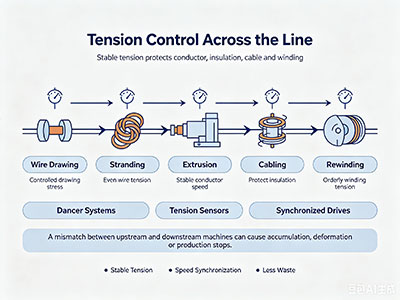
Tension control is one of the most important factors throughout the complete wire and cable production process. From wire drawing to stranding, extrusion, cabling, and rewinding, the material must move through different machines without excessive pulling force or uncontrolled slack.
Stable tension helps protect conductor geometry, insulation surfaces, cable structure, and finished winding quality. Modern production lines may use Dancer systems, tension sensors, controlled drives, and synchronized motors to maintain stable material movement.
When multiple machines operate as one production system, speed synchronization becomes equally important. A mismatch between upstream and downstream equipment can cause material accumulation, excessive tension, product deformation, or production interruptions.
Improving efficiency does not simply mean increasing line speed. A reliable complete wire and cable production process should balance production speed, product quality, material consumption, equipment stability, and maintenance requirements.
First, manufacturers should select equipment according to the actual cable specification. Wire diameter, conductor material, cable structure, production capacity, reel size, and required line speed should all be considered.
Second, production stages should be properly synchronized. Pay-off, processing, traction, testing, and rewinding equipment should work together rather than operating as isolated machines. Stable synchronization can reduce unnecessary stops and improve material utilization.
Third, preventive maintenance should be included in daily production management. Dies, bearings, rollers, guides, heating components, cooling systems, tension devices, and winding components should be inspected according to operating conditions.
Fourth, production data can be used to identify recurring problems. Monitoring line speed, tension, temperature, diameter, output, and material consumption can help manufacturers locate process deviations and improve operating parameters.
Common production problems include unstable wire diameter, uneven stranding, insulation defects, inconsistent cable diameter, excessive tension, poor winding, and frequent equipment downtime. These issues can originate from individual machines or from poor coordination between production stages.
For example, inconsistent wire drawing can influence subsequent stranding. Unstable extrusion conditions can affect insulation thickness. Incorrect tension during rewinding can produce uneven reels even when the cable itself meets its dimensional requirements.
For this reason, troubleshooting should consider the complete wire and cable production process rather than focusing only on the location where a defect becomes visible.
When planning a wire and Cable Production Line, manufacturers should begin with the finished product requirements and then work backward through each production stage. The conductor material, conductor diameter, number of cores, insulation material, cable structure, finished diameter, reel specification, and production capacity all influence equipment selection.
The compatibility of individual machines is also important. A high-speed machine cannot deliver its full production potential if another stage of the line cannot maintain the required speed or tension. Equipment layout, material transfer distance, operator access, maintenance space, and automation level should also be considered during production line planning.
A well-designed complete wire and cable production process connects each stage into one coordinated workflow. This approach can improve production stability while making quality control and maintenance easier to manage.
The complete wire and cable production process begins with raw material preparation and wire drawing and continues through annealing, stranding, insulation extrusion, cooling, cabling, shielding, armoring, sheathing, testing, and rewinding according to the product structure. Every stage contributes to the final performance and manufacturing efficiency of the wire or cable.
Wire drawing establishes conductor dimensions, stranding builds the required conductor structure, extrusion provides insulation and protection, and rewinding prepares the finished product for handling and delivery. When these stages are properly coordinated, manufacturers can achieve stable production, consistent dimensions, controlled material consumption, and reliable finished Cable Quality.
Understanding the complete wire and cable production process is therefore essential when selecting production equipment or improving an existing manufacturing line. A coordinated system that combines accurate processing, stable tension control, effective inspection, synchronized operation, and reliable rewinding can provide a strong foundation for efficient wire and cable manufacturing.
This website uses cookies to ensure you get the best experience on our website.


 Pусский
 中文
中文



 WhatsApp
 Phone
Phone
Comment
(0)