


 Pусский
 中文
中文


A vertical Cage Strander is an important type of cable manufacturing equipment designed to combine multiple wires or cable elements into a controlled stranded structure. Its Vertical Cage configuration can provide practical advantages in production organization, material handling, tension control, space utilization, and continuous cable manufacturing. For manufacturers working with large conductors, heavy cable components, or demanding production requirements, understanding how a vertical cage strander improves cable Production Efficiency is important when selecting production equipment.
The efficiency of a vertical cage strander does not depend on one feature alone. Production efficiency comes from the coordinated operation of the cage, pay-off system, wire guides, tension control, haul-off, forming equipment, and take-up system. When these systems are correctly matched, the vertical cage strander can maintain stable wire movement, consistent stranding, controlled production speed, and reliable finished Cable Quality.
Modern stranding equipment is available in different configurations for different cable manufacturing requirements. Rigid cage systems, for example, are commonly used for conductor manufacturing and can support applications involving copper, aluminum, overhead conductors, power cables, screening, and armoring. :contentReference[oaicite:0]{index=0} A vertical cage strander takes the cage concept further by arranging the main stranding structure vertically, creating a production configuration suitable for specific large-scale cable applications.
What Is a Vertical Cage Strander?
A vertical cage strander is a cable production machine in which the main stranding cage is positioned vertically. Individual wires, steel wires, or other cable elements are supplied through dedicated pay-off positions and guided into the stranding area. Controlled cage rotation and synchronized linear movement then create the required stranded or laid-up structure.
The vertical cage strander can include several major systems, such as a central pay-off, vertical stranding cage, wire pay-off units, tension devices, guiding components, closing or forming equipment, haul-off, take-up equipment, drive systems, and electrical control systems. The exact configuration depends on the cable construction and production requirements.
Vertical stranding equipment is particularly relevant to large cable manufacturing. Large vertical stranding and laying-up systems can be designed with substantial cage and turn-plate dimensions, large pay-off capacity, and powerful haul-off systems for demanding cable applications. :contentReference[oaicite:1]{index=1}
How Does a Vertical Cage Strander Work?
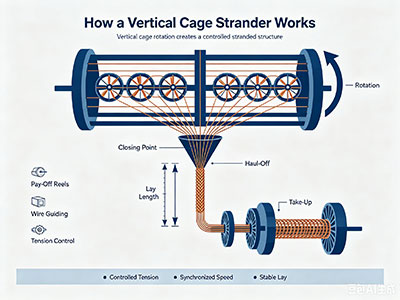
The working principle of a vertical cage strander is based on controlled rotation, wire feeding, tension management, and synchronized take-up. Individual wires are loaded onto pay-off reels. As the cage rotates, each wire follows a controlled path around the central production axis.
At the same time, the haul-off system pulls the newly formed cable forward. The relationship between cage rotation and linear movement determines the lay characteristics of the finished product. If the production speed and rotational speed remain properly synchronized, the machine can maintain a consistent stranded structure throughout a long production run.
The process normally includes wire pay-off, tension control, wire guiding, stranding or laying-up, closing, haul-off, measurement, and take-up. Each stage affects the final production result, so the vertical cage strander must operate as an integrated production system rather than as an isolated rotating cage.
How Does a Vertical Cage Strander Improve Production Efficiency?
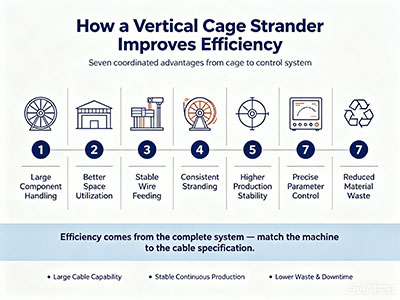
A vertical cage strander can improve cable production efficiency in several ways. Its main advantages are related to equipment organization, material handling, production stability, large-cable capability, process synchronization, and effective use of factory space.
1. Efficient Handling of Large Cable Components
Large cable products require equipment capable of handling substantial wire quantities and heavy production components. A vertical cage strander can be configured around large pay-off positions and a strong vertical cage structure, making it suitable for demanding cable production applications.
Large conductor manufacturing may involve numerous individual wires that must be supplied simultaneously and maintained under controlled tension. Rigid cage stranding systems commonly use multiple cage sections with independent drives and controlled pay-off tension for this type of production. :contentReference[oaicite:2]{index=2}
By providing an organized structure for these wire positions, a vertical cage strander can support continuous material feeding and reduce unnecessary interruptions during production.
2. Better Use of Production Space
Factory layout has a direct influence on cable production efficiency. A conventional Production Line may require substantial horizontal floor space because the equipment extends along a long production axis. A vertical cage strander uses a vertical cage arrangement, which can change how the main rotating structure occupies the production area.
This can be useful in facilities where floor space is limited but sufficient building height is available. Instead of considering only the floor footprint, manufacturers can use the vertical dimension of the factory when planning the production line.
However, vertical equipment requires appropriate building clearance. Installation planning should consider machine height, lifting access, maintenance space, cable routing, safety zones, and the movement of reels and other materials.
3. Stable Wire Feeding
Stable wire feeding is essential to efficient cable manufacturing. A vertical cage strander uses multiple pay-off positions to supply individual wires continuously. Each wire needs to reach the forming area at a controlled speed and tension.
If wire feeding is unstable, the production line may experience loose strands, wire vibration, uneven conductor formation, or wire breakage. Stable pay-off systems help reduce these problems and allow the machine to maintain continuous operation.
Tension control systems can also help compensate for changes in reel diaMeter as material is consumed. Controlled bobbin tension is an important feature in many modern stranding systems because stable tension supports consistent wire positioning and product quality. :contentReference[oaicite:3]{index=3}
4. Improved Stranding Consistency
A major benefit of a vertical cage strander is its ability to maintain a controlled relationship between cage rotation and linear cable movement. This relationship determines the lay length and overall geometry of the stranded product.
When the rotational speed and haul-off speed are accurately synchronized, the individual wires can follow consistent paths around the central axis. Stable lay characteristics reduce variations in the finished conductor and support more predictable downstream cable processing.
For manufacturers, consistent stranding is not only a quality issue. It also contributes to production efficiency because fewer irregular products need to be adjusted, reworked, or discarded.
5. Higher Production Stability
Production efficiency is closely connected to production stability. A machine that runs quickly but frequently stops may produce less usable output than a machine that operates at a stable speed for long periods.
A vertical cage strander can be configured with coordinated drive systems, tension controls, monitoring functions, and safety systems to support stable continuous operation. Some rigid cage systems use independent motors for individual cage sections and synchronized control to maintain accurate production parameters. :contentReference[oaicite:4]{index=4}
Stable operation reduces unnecessary stops and starts. It also makes production planning easier because operators can maintain a more predictable manufacturing cycle.
6. Better Control of Production Parameters
Modern Cable Manufacturing requires accurate control of several parameters. A vertical cage strander may incorporate a centralized control system that allows operators to manage cage speed, line speed, lay length, tension, and take-up operation.
Digital controls can make production setup more repeatable. Instead of manually adjusting multiple mechanical components for every production change, operators can use defined process parameters to establish the required production conditions.
Some stranding systems use programmable controls to synchronize cage and capstan speeds and manage pay-off tension. :contentReference[oaicite:5]{index=5} This type of coordinated control can reduce setup variation and support consistent production between different batches.
7. Reduced Material Waste
Material waste can have a significant impact on cable manufacturing costs. Copper, aluminum, steel wire, and other cable materials represent valuable production inputs. Poor tension control, incorrect lay settings, wire breakage, and unstable take-up can increase material waste.
A properly configured vertical cage strander helps reduce these risks by maintaining controlled wire feeding and stable production parameters. When the production line reaches the required operating condition quickly and maintains it consistently, fewer meters of cable may be lost during adjustment and correction.
Waste reduction also improves overall production efficiency because operators spend less time handling defective material and more time producing finished cable.
Vertical Cage Strander and Tension Control
Tension control is one of the most important factors affecting vertical cage strander performance. Every individual wire should be fed at an appropriate tension. If one wire has significantly different tension from another, the final stranded structure can become uneven.
As a pay-off reel changes from full to empty, the material winding diameter changes. Without suitable tension compensation, the wire feeding condition can also change. Modern stranding systems can use mechanical or electronic tension control to maintain more stable wire movement throughout the reel cycle. :contentReference[oaicite:6]{index=6}
Stable tension can improve conductor consistency, reduce wire breakage, and make the overall Production Process more predictable. For high-volume cable manufacturing, these improvements can have a direct effect on usable output.
Vertical Cage Strander and Production Speed
Production speed is another important factor in cable manufacturing efficiency. However, simply increasing the speed of a vertical cage strander does not automatically increase useful production output.
Speed must be balanced with wire diameter, strand count, cable diameter, material characteristics, tension stability, cage dynamics, and take-up capacity. If the machine runs faster than the material handling and control systems can support, wire vibration and tension variation may increase.
A better approach is to identify the stable operating range for each cable specification. Within this range, the vertical cage strander can maintain consistent production without creating unnecessary quality problems or machine stress.
Vertical Cage Strander for Large Cable Production
The vertical cage strander is especially useful when cable production involves large and heavy components. Large conductors can require numerous wires, large reels, high mechanical strength, and powerful haul-off systems.
Rigid cage stranding technology is widely used for conductor manufacturing, including copper and aluminum conductors, overhead conductors, screening, and armoring applications. :contentReference[oaicite:7]{index=7}
For large cable production, the machine must be designed around the complete process. The cage, pay-off, forming equipment, capstan, take-up, and control system all need sufficient capacity. Selecting only a large cage without matching the rest of the production line can create a bottleneck.
How Vertical Configuration Supports Factory Efficiency
Factory efficiency is not limited to machine output. It also includes how efficiently operators use production space, move materials, perform maintenance, and organize cable production processes.
A vertical cage strander can provide an alternative equipment layout for facilities that need to manage large cable components while controlling horizontal floor usage. The vertical configuration can make the main stranding area more compact in one dimension, although the required building height must be carefully evaluated.
Efficient factory planning should include the movement path of raw wire reels, finished cable, lifting equipment, maintenance personnel, and replacement components. A well-planned installation can reduce unnecessary handling time and improve the overall workflow.
Reducing Downtime with Better Equipment Control
Downtime directly reduces cable production efficiency. Common causes include wire breakage, incorrect setup, equipment adjustment, reel replacement, mechanical faults, and maintenance requirements.
A vertical cage strander equipped with appropriate monitoring and control functions can help operators identify abnormal conditions earlier. Wire break detection, tension monitoring, speed monitoring, and controlled stopping functions can reduce the impact of production problems.
Maintenance planning is equally important. Bearings, wire guides, drive components, brakes, electrical systems, and safety devices should be inspected regularly. Preventive maintenance can help identify wear before it becomes a major production interruption.
Vertical Cage Strander and Automation
Automation can further improve the efficiency of a vertical cage strander. Automated parameter management allows operators to establish repeatable production conditions, while synchronized drives can coordinate cage rotation, haul-off, and take-up.
Automation can also reduce manual intervention during normal production. When the machine automatically maintains defined operating parameters, operators can focus more on production monitoring, material preparation, quality inspection, and maintenance.
For manufacturers producing several cable specifications, recipe-based control can also make product changeovers more consistent. Each cable specification can have defined parameters for speed, lay, tension, and take-up operation.
Applications of Vertical Cage Strander Equipment
A vertical cage strander can be considered for various cable manufacturing applications depending on its configuration. These may include large conductors, power cable components, armored cable structures, screening processes, and other heavy-duty cable production requirements.
The specific application depends on the wire material, conductor diameter, cable construction, production speed, and required machine capacity. Equipment used for Copper Wire may require different settings from equipment processing aluminum or steel wire.
Manufacturers should therefore evaluate the complete technical requirements before selecting a vertical cage strander. The machine should be matched to the actual production specification rather than selected only according to nominal machine size.
How to Choose a Vertical Cage Strander
Choosing the right vertical cage strander begins with identifying the products that the machine must manufacture. The following factors should be reviewed before equipment selection.
Wire Diameter
Determine the minimum and maximum individual wire diameter. The pay-off system, guides, tension system, and cage configuration should all be suitable for the required wire range.
Number of Wires
The required number of individual wires determines the number and arrangement of pay-off positions. Complex conductor structures may require multiple cage sections or additional forming equipment.
Finished Cable Diameter
The maximum stranded or laid-up diameter should be considered when selecting the cage, forming equipment, haul-off, and take-up system.
Production Speed
Define the target production speed according to actual cable specifications. The highest possible machine speed is not always the most efficient operating speed.
Reel Dimensions
Pay-off and take-up reel sizes directly affect production capacity and material handling. Large reels can reduce the frequency of material changes but also require suitable lifting and loading equipment.
Factory Conditions
Check available floor space, building height, lifting capacity, maintenance access, cable routing, and safety clearance before installing a vertical cage strander.
Operational Practices That Improve Efficiency
Even a well-designed vertical cage strander requires proper operation to achieve its expected efficiency. Operators should verify wire quality and reel installation before starting production.
All pay-off reels should be properly positioned and secured. Wire guides should be clean and correctly aligned. Tension settings should be checked before the machine reaches production speed.
During operation, operators should monitor wire tension, cage movement, cable appearance, take-up winding, machine vibration, and abnormal sounds. Early identification of problems can prevent extended production losses.
Production parameters should also be documented for different cable specifications. Recording successful settings can make future production runs faster and more consistent.
Why Production Efficiency Depends on the Complete System
A vertical cage strander is only one part of a complete cable manufacturing process. Its efficiency depends on how well it works together with pay-off equipment, wire guides, forming systems, haul-off, take-up, control systems, and downstream cable equipment.
If the cage can operate at a high speed but the take-up system cannot handle the output, the entire production line becomes limited by the slower component. Similarly, if wire tension is unstable, increasing the cage speed may reduce product quality rather than increase usable output.
For this reason, manufacturers should evaluate the entire production line when calculating efficiency. Output, product quality, material utilization, changeover time, downtime, maintenance requirements, and operator workload should all be considered.
Conclusion
A vertical cage strander can improve cable production efficiency through controlled wire feeding, stable tension, synchronized stranding, organized material handling, effective use of production space, and continuous production capability. Its vertical cage structure can be particularly useful for applications involving large cable components and demanding manufacturing conditions.
The greatest efficiency gains come when the vertical cage strander is correctly matched to the cable specification. Wire diameter, strand count, finished cable diameter, production speed, reel dimensions, tension requirements, haul-off capacity, and factory conditions should all be considered before equipment selection.
With appropriate machine configuration, automation, preventive maintenance, and operating practices, a vertical cage strander can support stable cable production while helping manufacturers reduce material waste, minimize downtime, improve process consistency, and make better use of available production resources.



 WhatsApp
 Phone
Phone
Comment
(0)