

How to Build an Efficient Wire and Cable Production Line?
Building an efficient wire and Cable Production Line requires more than selecting individual machines. A complete Production Line must connect Wire Drawing, annealing, stranding, extrusion, cabling, testing, and rewinding into a stable manufacturing workflow. Proper equipment matching, accurate process control, reliable material handling, and effective automation can help improve Production Efficiency while maintaining consistent wire and Cable Quality.
An efficient wire and cable production line is an integrated manufacturing system designed to move conductor materials through multiple processing stages with minimal interruption. Depending on the product structure, a wire and cable production line may include wire drawing equipment, annealing equipment, Stranding Machines, extruders, cooling systems, take-up systems, testing equipment, and Rewinding Machines.
The main purpose of an efficient wire and cable production line is to coordinate these machines so that each stage operates at an appropriate speed and tension. When equipment is properly matched, production can become more stable, material waste can be reduced, and operators can manage the process more effectively.
Different wire and cable products require different production configurations. A line designed for fine electronic wire may differ significantly from a line used for large power cables or specialized industrial cables. Therefore, production planning should begin with the finished cable specification rather than simply choosing equipment based on rated speed.
The first step in building an efficient wire and cable production line is defining the final product. Important paraMeters include conductor material, conductor diameter, number of conductors, insulation material, cable structure, finished diameter, required production capacity, reel size, and quality requirements.
Copper and aluminum conductors may require different processing conditions. Fine wires may require precise drawing and tension control, while larger conductors can require different stranding and take-up configurations. Multi-core cables may require additional cabling, shielding, taping, or sheathing equipment.
Understanding these requirements helps determine the complete equipment configuration. It also prevents manufacturers from purchasing machines that cannot operate efficiently together. An efficient wire and cable production line should be designed around the actual manufacturing process and expected production conditions.
Wire drawing is often one of the first major processing stages in a wire and cable production line. The purpose of wire drawing is to reduce the diameter of copper or aluminum rod gradually until the required conductor size is achieved.
A stable drawing process requires suitable dies, lubrication, cooling, speed control, and tension management. Drawing reductions should be selected according to the material and final conductor dimensions. Excessive reduction in one stage can increase stress and affect surface quality, while unsuitable process conditions can increase die wear.
When building an efficient wire and cable production line, manufacturers should consider how the drawing equipment connects with downstream processes. Consistent conductor dimensions make later stranding and extrusion operations easier to control. Stable drawing also helps reduce material losses caused by dimensional deviations.
Depending on the conductor material and final product requirements, annealing may be integrated into the Wire Drawing Production Line. Wire drawing can increase the hardness of a conductor, while controlled annealing can restore suitable flexibility and improve the conductor's processing characteristics.
Annealing conditions should remain stable along the production length. Inconsistent heating or cooling can create variations that may become noticeable during subsequent stranding or forming operations.
For an efficient wire and cable production line, annealing should not be treated as an isolated operation. Its speed and material handling should be coordinated with wire drawing so that the conductor moves continuously and reliably through the production system.
Stranding is a major stage in many wire and cable production lines. During stranding, multiple individual wires are combined and twisted into a conductor or cable component. The machine must control wire feeding, tension, twisting direction, lay length, and take-up.
The correct stranding machine depends on conductor construction, wire diameter, required production speed, and cable application. Different configurations may be suitable for different products. A Vertical Cage Strander, for example, can be considered when production requires a configuration suitable for handling multiple wires or larger cable components.
Stable tension is particularly important during stranding. If individual wires are fed with inconsistent tension, the finished conductor may have uneven geometry or irregular lay. Therefore, an efficient wire and cable production line should provide coordinated pay-off and tension control throughout the stranding stage.
Extrusion applies insulation or an outer sheath around the conductor or cable core. The extrusion system normally includes an extruder, extrusion head, heating system, cooling section, traction equipment, and take-up system.
Extrusion performance depends on material characteristics, temperature settings, screw speed, line speed, die configuration, and cooling conditions. These parameters must be coordinated to maintain consistent insulation thickness and cable diameter.
For high-speed production, the relationship between extrusion output and line speed becomes particularly important. If extrusion output is too high or too low compared with the actual line speed, insulation thickness can change. An efficient wire and cable production line therefore requires accurate synchronization between the extruder, traction system, and take-up system.
After extrusion, the insulated wire or cable enters a cooling section. Cooling solidifies the insulation or sheath and helps stabilize the external dimensions. The cooling process should provide consistent conditions along the production path.
Traction equipment controls the movement of the wire or cable through the extrusion line. If traction speed fluctuates, product diameter and insulation thickness may also change. Stable traction is therefore essential for maintaining dimensional consistency.
An efficient wire and cable production line combines extrusion, cooling, traction, and take-up into one coordinated system. Speed synchronization reduces sudden tension changes and allows the product to move continuously through the line.
Tension control is one of the most important considerations when building an efficient wire and cable production line. Wire and cable materials pass through numerous machines, rollers, guides, processing units, and take-up devices. Each component can influence material tension.
Excessive tension may stretch the conductor or affect insulation and cable structure. Insufficient tension can cause loops, unstable feeding, uneven winding, or poor product formation. A suitable tension control system maintains stable material movement without placing unnecessary mechanical stress on the product.
Dancer systems, tension sensors, controlled motors, and synchronized drives can be used according to the production line design. The appropriate solution depends on product size, line speed, material characteristics, and machine configuration.
Multi-core wire and cable products require additional assembly after individual insulated cores are produced. Cabling equipment brings several cores together and forms them into the required cable structure.
During cabling, the production line needs to maintain appropriate core tension and alignment. Excessive tension can affect the insulation, while poor alignment can produce an irregular cable shape. Fillers or other structural components may also be introduced depending on the cable design.
When designing an efficient wire and cable production line, the cabling stage should be matched with upstream extrusion equipment and downstream sheathing equipment. The production speeds, cable accumulation capacity, and take-up arrangements should be considered as one system.
Some cable products require additional layers between the insulated cores and outer sheath. Shielding, taping, and armoring equipment can be incorporated according to the final cable structure.
Shielding can provide electrical or electromagnetic protection, while tapes can provide separation or structural support. Armoring can add mechanical protection to cables designed for demanding installation conditions.
Each additional production stage introduces another point where tension, alignment, and material handling must be controlled. For this reason, an efficient wire and cable production line should allow different processing units to operate in a synchronized manner.
Outer sheathing is the final extrusion stage for many finished cables. The sheath provides a protective layer around the cable structure and must meet the specified thickness, diameter, surface, and material requirements.
The sheathing extruder should be selected according to cable diameter, sheath material, required production speed, and output capacity. The extrusion head must provide stable material distribution around the cable.
Cooling and traction must also be coordinated with extrusion output. A well-designed sheathing stage helps maintain stable cable dimensions and reduces defects caused by inconsistent processing conditions.
Quality control should be integrated into an efficient wire and cable production line rather than being performed only after production is complete. Online monitoring can help identify dimensional or process deviations while the product is still running through the line.
Depending on the product, manufacturers may monitor conductor diameter, insulation thickness, cable diameter, surface condition, temperature, tension, and electrical characteristics. Online inspection can reduce the amount of material produced before a problem is detected.
Final testing remains important because finished wire and cable products need to meet defined technical requirements before packaging or delivery. Combining online monitoring with final inspection provides a more complete approach to production quality management.
Take-up and rewinding are essential parts of a wire and cable production line. After processing, the finished wire or cable must be wound onto reels in an orderly and controlled manner.
A suitable rewinding machine should provide stable winding tension, accurate traverse movement, and appropriate reel handling. The winding system must match the cable diameter, reel dimensions, line speed, and finished product characteristics.
Poor rewinding can create loose layers, uneven edges, excessive tension, or damaged surfaces. Even if the cable has been manufactured correctly, improper winding can reduce handling quality. Therefore, an efficient wire and cable production line should give take-up and rewinding the same attention as upstream processing equipment.
Automation can significantly improve the coordination of a wire and cable production line. Automated control systems can synchronize line speed, extrusion output, traction, tension, and take-up operation.
When production parameters are linked, operators can manage the complete line more efficiently. Automated monitoring can also help identify abnormal conditions and provide useful production data.
However, automation should be matched with actual production needs. A highly automated system is not automatically efficient if its configuration is unsuitable for the product. The goal should be stable operation, easy parameter adjustment, reliable monitoring, and efficient maintenance.
Factory layout directly influences the efficiency of a wire and cable production line. Machines should be positioned according to the production sequence, material movement direction, maintenance requirements, and operator access.
Unnecessary material movement can increase handling time and create additional opportunities for product damage. Adequate space should also be provided around major machines for inspection, maintenance, tooling changes, and troubleshooting.
A logical layout allows raw materials to enter the production area efficiently and finished wire and cable to move toward inspection, packaging, or storage without unnecessary backtracking.
Material efficiency is an important part of building an efficient wire and cable production line. Copper, aluminum, insulation materials, and sheath compounds can represent a significant portion of manufacturing costs.
Stable drawing, accurate extrusion, controlled tension, and reliable rewinding can all help reduce unnecessary material loss. Online monitoring can identify dimensional deviations early, reducing the amount of defective material generated during production.
Manufacturers should also evaluate setup waste, startup material, transition losses, and scrap generated during tooling changes. Improving these areas can increase overall production efficiency without simply increasing machine speed.
Equipment maintenance is essential for maintaining an efficient wire and cable production line. Production interruptions caused by worn components, damaged guides, unstable heating systems, or mechanical failures can reduce output and increase operating costs.
Regular inspection should cover dies, bearings, rollers, guides, motors, transmission components, heating elements, cooling systems, sensors, tension devices, and winding components. Maintenance intervals should reflect actual operating conditions and production intensity.
Preventive maintenance also helps identify small problems before they become major failures. A stable production line is easier to schedule, easier to operate, and more capable of maintaining consistent product quality.
Improving an existing wire and cable production line usually requires attention to several connected factors. Increasing speed alone may increase defects or mechanical stress if downstream equipment cannot keep up.
A better approach is to evaluate the complete production workflow. Manufacturers can analyze production speed, downtime, material consumption, tension stability, changeover time, product quality, and equipment utilization.
Production bottlenecks should be identified first. If one machine consistently operates below the capacity of the rest of the line, improving that stage may provide a larger efficiency gain than increasing the speed of other equipment.
Process parameters should also be standardized for different product specifications. Clear operating procedures make production more repeatable and reduce dependence on individual operator experience.
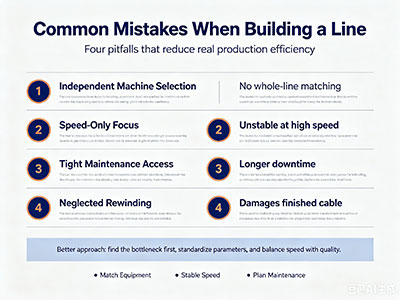
One common mistake is selecting machines independently without considering the complete wire and cable production line. Individual machines may have excellent performance but still fail to work efficiently together if their speed, tension, reel capacity, or material handling requirements do not match.
Another mistake is focusing only on maximum production speed. Actual production efficiency depends on stable operating speed, product quality, downtime, material consumption, and changeover efficiency.
Insufficient maintenance space is another problem. Equipment that is difficult to access can require longer maintenance periods, increasing downtime.
Finally, manufacturers may underestimate the importance of rewinding and material handling. Finished wire and cable must be packaged correctly to protect product quality and support efficient storage and transportation.
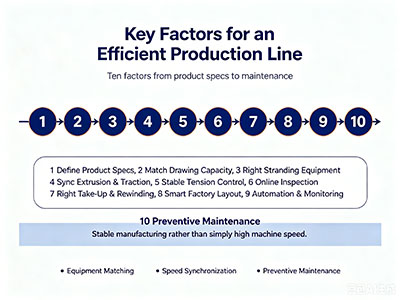
Define the final wire and cable specifications before selecting equipment.
Match wire drawing capacity with downstream conductor processing.
Use appropriate stranding equipment for the required cable structure.
Coordinate extrusion output with traction and line speed.
Maintain stable tension throughout material movement.
Integrate online inspection where appropriate.
Select take-up and rewinding equipment according to reel and cable requirements.
Design the factory layout around material flow and maintenance access.
Use automation to improve synchronization and process monitoring.
Establish preventive maintenance and standardized operating procedures.
Building an efficient wire and cable production line requires a complete understanding of the manufacturing process. Wire drawing, annealing, stranding, extrusion, cooling, cabling, shielding, sheathing, testing, and rewinding must be considered as connected stages rather than independent operations.
The most effective production line balances equipment capacity, production speed, material tension, product quality, automation, maintenance, and factory layout. Proper equipment matching helps each stage operate reliably, while synchronized control reduces production interruptions and unnecessary material waste.
An efficient wire and cable production line should ultimately provide stable manufacturing rather than simply high machine speed. By starting with finished product requirements, selecting compatible equipment, controlling critical parameters, monitoring quality, and maintaining the complete system, manufacturers can create a production line capable of consistent and efficient wire and cable manufacturing.
This website uses cookies to ensure you get the best experience on our website.


 Pусский
 中文
中文



 WhatsApp
 Phone
Phone
Comment
(0)