

High-Efficiency LSZH Extruder: Features, Applications and Benefits
A high-efficiency LSZH Extruder is an important piece of equipment in modern wire and cable manufacturing. Designed to process low-smoke zero-halogen materials, an LSZH extruder applies insulation or protective layers around conductors with controlled extrusion conditions. Stable output, accurate temperature control, consistent material flow, and reliable production speed make the high-efficiency LSZH extruder suitable for demanding Cable Production applications.
A high-efficiency LSZH extruder is an extrusion machine designed to process low-smoke zero-halogen compounds used in wire and cable production. LSZH materials are commonly selected when reduced smoke generation and the absence of halogens are important considerations for a cable application.
The LSZH extruder melts and conveys the insulation material through a controlled extrusion system before forming it around a conductor or cable core. The complete extrusion process normally involves material feeding, plasticizing, conveying, extrusion, sizing, cooling, traction, and take-up.
The high-efficiency LSZH extruder focuses on stable material processing while maintaining suitable production speed and product consistency. Its performance depends on screw design, barrel configuration, heating and cooling control, extrusion head design, material feeding, line synchronization, and cooling capacity.
Wire and cable products are used in buildings, transportation systems, communication networks, industrial facilities, electrical installations, and other environments where fire-related performance can be an important consideration. LSZH materials are used in cable designs where low smoke and low halogen characteristics are required by the product specification or application.
Processing LSZH compounds requires appropriate extrusion conditions because these materials can behave differently from conventional insulation materials. Temperature, residence time, material flow, screw configuration, and cooling conditions need to be controlled carefully.
A suitable high-efficiency LSZH extruder provides the process stability needed to produce consistent insulation or sheathing. This can help manufacturers maintain dimensional accuracy, surface quality, production continuity, and efficient material utilization.
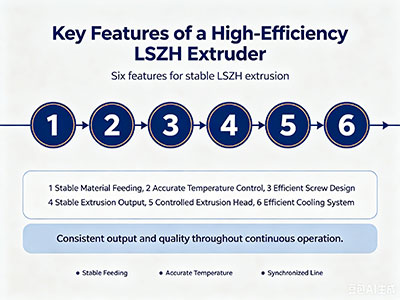
The main features of a high-efficiency LSZH extruder are related to material processing stability, temperature management, output consistency, and production control. Although equipment configurations vary according to application, several features are especially important for LSZH extrusion.
Consistent material feeding is essential for stable extrusion. An LSZH extruder should provide controlled material supply to the screw so that extrusion output remains relatively stable during continuous production.
Feeding instability can result in fluctuations in insulation thickness, surface appearance, or cable diaMeter. A properly designed feeding system helps maintain continuous material flow and supports more predictable extrusion conditions.
Temperature control is one of the most important features of a high-efficiency LSZH extruder. LSZH compounds need to be processed within an appropriate temperature range. Excessive heat may affect the material, while insufficient heat can lead to incomplete plasticization and unstable extrusion.
Independent temperature zones allow operators to control different sections of the barrel according to the material and production requirements. Heating and cooling systems work together to maintain stable processing conditions.
The screw is responsible for conveying, melting, mixing, and pressurizing the LSZH material. Screw geometry has a direct influence on extrusion output and material processing behavior.
A suitable screw design can provide stable conveying and plasticization while maintaining consistent pressure. The correct screw configuration should be selected according to LSZH compound characteristics, conductor size, production speed, and required output.
Output stability is essential when producing insulated wire and cable at continuous production speeds. An LSZH extruder should maintain consistent material flow so that the insulation layer remains uniform along the length of the cable.
Stable output also makes downstream processes easier to control. When extrusion output and line speed remain synchronized, manufacturers can reduce dimensional fluctuations and improve overall production consistency.
The extrusion head determines how the molten LSZH material is distributed around the conductor or cable core. Head design, die selection, centering, and adjustment influence insulation thickness and concentricity.
Accurate head adjustment is particularly important for fine wire and cable applications. Uneven material distribution can create variations in insulation thickness and may affect finished cable dimensions.
After extrusion, the insulated conductor enters a cooling section. Proper cooling solidifies the LSZH layer and helps maintain the required cable dimensions.
Cooling conditions should match extrusion speed and material characteristics. At higher production speeds, insufficient cooling capacity can affect dimensional stability. An efficient LSZH extruder system therefore needs coordinated extrusion, cooling, traction, and take-up operation.
The operating principle of a high-efficiency LSZH extruder is based on controlled feeding, plasticization, conveying, extrusion, sizing, cooling, and winding. LSZH material enters the feeding system and moves toward the heated barrel.
Inside the barrel, the screw conveys and plasticizes the material. Controlled heat and mechanical shear transform the material into a suitable molten state. The screw then pushes the material toward the extrusion head.
At the extrusion head, the LSZH material is formed around the moving conductor or cable core. The coated product then passes through a cooling system, where the insulation or sheath solidifies.
Traction equipment maintains stable product movement, while the take-up system winds the finished wire or cable onto a reel. Throughout the process, line speed, temperature, pressure, tension, and winding conditions need to remain coordinated.
Production speed is an important factor when evaluating an LSZH extruder. Higher speed can increase output, but only when the extrusion system, cooling system, traction unit, and take-up equipment can maintain stable operation.
Simply increasing extruder speed does not automatically create a more efficient Production Line. If the material is not completely plasticized, if cooling is insufficient, or if take-up tension becomes unstable, product quality can deteriorate.
A high-efficiency LSZH extruder should therefore be evaluated according to stable production speed rather than maximum speed alone. The practical goal is to maintain consistent output and product quality throughout continuous operation.
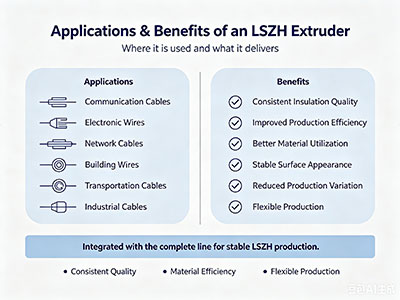
The applications of an LSZH extruder are mainly associated with wire and cable products that use low-smoke zero-halogen insulation or sheath materials. These products can be found in various electrical, communication, industrial, transportation, and building-related applications.
LSZH extrusion can be used for communication cable products where cable construction requires suitable insulation and protective layers. Stable extrusion helps maintain consistent dimensions and supports downstream cable assembly.
Electronic wire manufacturing can require accurate insulation dimensions and stable surface quality. A high-efficiency LSZH extruder can provide controlled material application for suitable LSZH electronic wire products.
Network cable production requires consistent conductor and insulation geometry. LSZH materials may be selected according to cable specifications and installation requirements. An LSZH extruder helps form a stable insulation or protective layer around the cable structure.
Building wire and cable applications can require specific fire-related material characteristics. Where LSZH materials are specified, an appropriate LSZH extruder can be used to process the insulation or sheath continuously.
Transportation-related cable systems can have demanding requirements for smoke, material characteristics, flexibility, and dimensional consistency. LSZH extrusion equipment can support the production of suitable cable constructions when the required material is used.
Industrial cable applications often require reliable insulation, consistent dimensions, and stable manufacturing. Depending on the application and cable specification, LSZH extrusion can be integrated into the Production Process.
The benefits of a high-efficiency LSZH extruder extend beyond extrusion speed. A well-designed system can support stable product quality, efficient material processing, easier production management, and reliable continuous operation.
Stable temperature, material flow, pressure, and extrusion speed help maintain consistent insulation thickness. Consistency is important because variations can affect cable dimensions, flexibility, and downstream processing.
A high-efficiency LSZH extruder can support continuous operation with stable material output. When extrusion equipment is properly synchronized with traction and take-up systems, manufacturers can achieve smoother production and reduce unnecessary interruptions.
Accurate extrusion control can reduce excessive insulation or sheath material consumption. Maintaining the specified layer thickness helps manufacturers use LSZH compounds more efficiently while reducing waste caused by dimensional deviations.
Consistent material plasticization and extrusion conditions contribute to a smoother finished surface. Stable extrusion can reduce visible irregularities and support a more consistent appearance along the finished wire or cable.
When temperature, extrusion output, traction speed, and tension remain stable, production variation can be reduced. This creates more predictable manufacturing conditions and simplifies quality control.
A properly configured LSZH extruder can be adapted to different conductor sizes, LSZH compounds, insulation thicknesses, and cable specifications. Production flexibility is useful for manufacturers handling multiple wire and cable products.
Temperature management is critical to LSZH extruder performance. The material must be heated sufficiently for proper plasticization while avoiding unnecessary thermal stress.
Each barrel zone may require an appropriate temperature setting. The feed zone, compression area, metering section, and extrusion head can have different thermal requirements. Operators should establish parameters according to the specific LSZH material and actual production conditions.
Cooling is equally important. Once the material leaves the extrusion head, it needs to solidify without excessive deformation. The relationship between extrusion temperature, line speed, cooling capacity, and cable diameter should be considered as part of the complete extrusion process.
Concentricity refers to how evenly the insulation layer is distributed around the conductor. Good concentricity helps maintain consistent insulation thickness and finished cable dimensions.
Extrusion head alignment, die selection, conductor centering, material flow, and line tension can all affect concentricity. If the conductor moves away from the center of the die, one side of the insulation may become thinner than the other.
A high-efficiency LSZH extruder should therefore work with stable conductor guidance and controlled tension. Online measurement systems can also be used where production requirements call for continuous dimensional monitoring.
Tension control is closely connected with extrusion quality. The conductor must enter the extrusion head smoothly without excessive pulling force or uncontrolled slack.
Unstable tension can influence the position of the conductor inside the extrusion head. This can affect insulation thickness and concentricity. After extrusion, traction and take-up tension must also remain synchronized.
For this reason, the LSZH extruder should be considered as part of a complete wire and Cable Production Line. The extruder, pay-off, traction, cooling, measurement, and take-up systems need to work together.
Choosing the correct high-efficiency LSZH extruder begins with the production requirements. Manufacturers should identify the conductor diameter range, LSZH material type, insulation or sheath thickness, required production speed, output capacity, and finished cable dimensions.
Screw diameter and screw configuration should match the required output. The heating system should provide sufficient temperature control, while the extrusion head should support accurate material distribution.
Cooling capacity is another important consideration. If the production line is designed for high-speed operation, the cooling system must be able to stabilize the extruded layer at the required speed.
Manufacturers should also consider automation, control interface, maintenance accessibility, spare components, and compatibility with existing production equipment. A high-efficiency LSZH extruder should fit the entire manufacturing workflow rather than being evaluated as an isolated machine.
Regular maintenance helps maintain stable LSZH extruder performance. Important components include the screw, barrel, extrusion head, heating elements, cooling systems, feeding components, sensors, motors, transmission parts, and control systems.
Material residue should be managed appropriately to reduce contamination and processing problems. Temperature sensors should be checked regularly to ensure accurate readings. Mechanical components should also be inspected for abnormal wear.
Preventive maintenance can reduce unexpected downtime and help maintain stable extrusion conditions. Maintenance schedules should be adjusted according to production hours, material characteristics, operating temperature, and machine usage.
Common LSZH extrusion problems can include unstable output, uneven insulation thickness, poor surface appearance, inconsistent diameter, insufficient plasticization, and excessive material waste.
Unstable output may be related to feeding conditions, screw operation, material temperature, or pressure fluctuations. Uneven insulation can be caused by die alignment, conductor position, tension variation, or inconsistent material flow.
Surface problems may result from unsuitable processing temperatures, contamination, material degradation, or extrusion conditions that do not match the LSZH compound.
Troubleshooting should begin by checking the complete extrusion system. Temperature, material feeding, screw speed, extrusion pressure, line speed, cooling, tension, and take-up conditions should be evaluated together.
Manufacturers can improve LSZH extruder performance by establishing standardized processing parameters for different materials and cable specifications. Stable temperature settings, appropriate screw speed, controlled line speed, and consistent tension provide a reliable starting point.
Production data can also help identify recurring problems. Monitoring output, temperature, pressure, diameter, line speed, and material consumption allows operators to compare production conditions and identify deviations.
Tooling condition should also be monitored. Worn or unsuitable dies can affect insulation geometry and surface quality. Regular inspection and timely replacement can help maintain extrusion accuracy.
Finally, the LSZH extruder should be integrated with the complete production line. Coordinated pay-off, extrusion, cooling, traction, measurement, and take-up operation can improve overall manufacturing efficiency.
LSZH extrusion technology continues to develop alongside the broader wire and cable manufacturing industry. Production systems increasingly focus on higher process stability, improved automation, precise temperature control, lower material waste, and easier production monitoring.
Digital monitoring can provide manufacturers with more production information, while automated control can help maintain stable operating parameters. Improved extrusion head and screw technologies can also support more consistent material processing.
The future of the high-efficiency LSZH extruder is therefore closely connected with complete production line integration. Rather than focusing only on extrusion output, manufacturers are increasingly concerned with total production efficiency, product consistency, energy use, maintenance, and process control.
A high-efficiency LSZH extruder is an important solution for wire and cable manufacturers processing low-smoke zero-halogen materials. Stable feeding, accurate temperature control, suitable screw design, consistent extrusion output, reliable extrusion heads, effective cooling, and synchronized take-up operation all contribute to dependable LSZH extrusion.
The applications of an LSZH extruder cover various wire and cable products, including communication cables, electronic wires, network cables, building cables, transportation cables, and industrial cables, depending on the required material and product specification.
The main benefits of a high-efficiency LSZH extruder include consistent insulation quality, improved production efficiency, better material utilization, stable surface appearance, reduced production variation, and flexible manufacturing capability. By selecting equipment according to actual cable requirements and integrating extrusion with the complete production line, manufacturers can achieve more stable and efficient LSZH Cable Production.
This website uses cookies to ensure you get the best experience on our website.


 Pусский
 中文
中文



 WhatsApp
 Phone
Phone
Comment
(0)